|
|
March 16, 2020 Washington, DC
March 16-17, 2020 Washington, DC
March 19, 2020Washington, DC
April 29-May 1, 2020 |
|
|
|
|
|
BUILDING CAPACITY ABROAD FOR RESEARCH AND POLICY MAKING
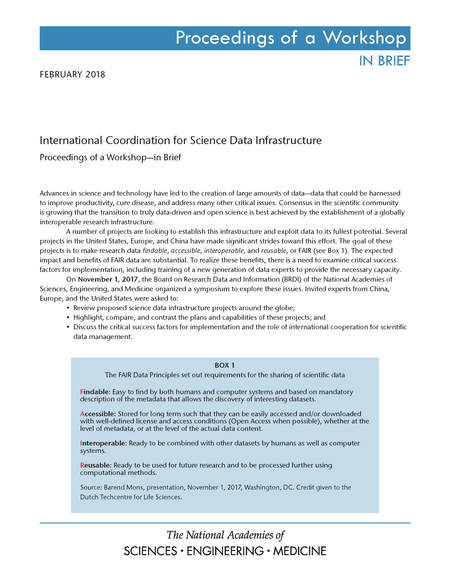 International Coordination for Science Data Infrastructure: Proceedings of a Workshop - in Brief (2018) International Coordination for Science Data Infrastructure: Proceedings of a Workshop - in Brief (2018)
 Read online free Read online free  Buy the book or Download the Free PDF Buy the book or Download the Free PDF
A number of projects are looking to establish this infrastructure and exploit data to its fullest potential. Several projects in the United States, Europe, and China have made significant strides toward this effort. The goal of these projects is to make research data findable, accessible, interoperable, and reusable, or FAIR. The expected impact and benefits of FAIR data are substantial. To realize these benefits, there is a need to examine critical success factors for implementation, including training of a new generation of data experts to provide the necessary capacity. On November 1, 2017, the National Academies of Sciences, Engineering, and Medicine organized a symposium to explore these issues. This publication briefly summarizes the presentations and discussions from the symposium.(Board on Research Data and Information)
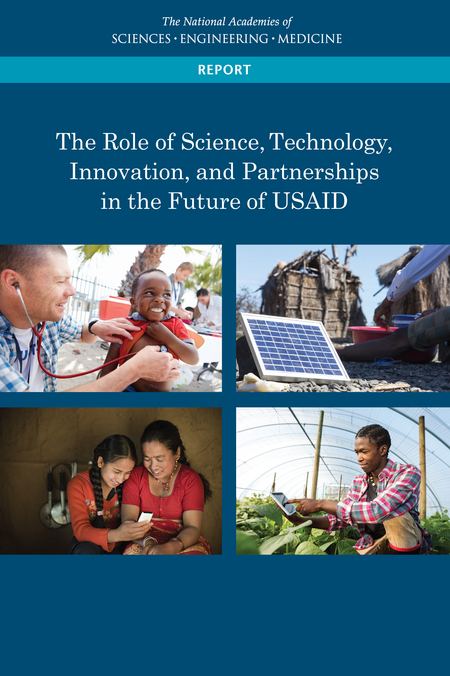 The Role of Science, Technology, Innovation, and Partnerships in the Future of USAID (2017) The Role of Science, Technology, Innovation, and Partnerships in the Future of USAID (2017)
Read online free Buy the book or Download the Free PDF  View report highlights (PDF) View report highlights (PDF)  View media coverage View media coverage
The United States has long recognized that the nation’s prosperity and security depend on how we address challenges of disasters, poverty, famine, and disease around the world. The U.S. Agency for International Development (USAID) has played a vital role in promoting U.S. national and international interests by advancing strategies for employing science, technology, and innovation to respond to global challenges. The focus by USAID on science, technology, and innovation is critical to improve development outcomes. At the core of this progress is the engagement of science institutions and other innovative enterprises and their commitment to work in partnership with USAID to research, test, and scale solutions.Development, Security, and Cooperation (DSC)
 Science and Technology Capabilities of the Department of State: Letter Report (April 2014) Science and Technology Capabilities of the Department of State: Letter Report (April 2014)
Read online free Buy the book or Download the Free PDF
This interim report of the National Research Council was written in response to a request from former Under Secretary Robert Hormats, to undertake an assessment of the capabilities of the Department of State that are particularly important as science and technology become integral aspects of diplomacy. Development, Security, and Cooperation (DSC)
 Reducing Maternal and Neonatal Mortality in Indonesia: Saving Lives, Saving the Future (December 2013) Reducing Maternal and Neonatal Mortality in Indonesia: Saving Lives, Saving the Future (December 2013)
Read online free Buy the book or Download the Free PDF
View report highlights (PDF)
The Republic of Indonesia, home to over 240 million people, is the world's fourth most populous nation. Ethnically, culturally, and economically diverse, the Indonesian people are broadly dispersed across an archipelago of more than 13,000 islands. Rapid urbanization has given rise to one megacity (Jakarta) and to 10 other major metropolitan areas. And yet about half of Indonesians make their homes in rural areas of the country. Indonesia, a signatory to the United Nations Millennium Declaration, has committed to achieving the Millennium Development Goals (MDGs). However, recent estimates suggest that Indonesia will not achieve by the target date of 2015 MDG 4 - reduction by two-thirds of the 1990 under - 5 infant mortality rate (number of children under age 5 who die per 1,000 live births) - and MDG 5 - reduction by three-quarters of the 1990 maternal mortality ratio (number of maternal deaths within 28 days of childbirth in a given year per 100,000 live births). Although much has been achieved, complex and indeed difficult challenges will have to be overcome before maternal and infant mortality are brought into the MDG-prescribed range.
Reducing Maternal and Neonatal Mortality in Indonesia is a joint study by the U.S. National Academy of Sciences and the Indonesian Academy of Sciences that evaluates the quality and consistency of the existing data on maternal and neonatal mortality; devises a strategy to achieve the Millennium Development Goals related to maternal mortality, fetal mortality (stillbirths), and neonatal mortality; and identifies the highest priority interventions and proposes steps toward development of an effective implementation plan. According to the UN Human Development Index (HDI), in 2012 Indonesia ranked 121st out of 185 countries in human development. However, over the last 20 years the rate of improvement in Indonesia\'s HDI ranking has exceeded the world average. This progress may be attributable in part to the fact that Indonesia has put considerable effort into meeting the MDGs. This report is intended to be a contribution toward achieving the Millennium Development Goals. Development, Security, and Cooperation (DSC)
 Improving Democracy Assistance: Building Knowledge Through Evaluations and Research (2008) Improving Democracy Assistance: Building Knowledge Through Evaluations and Research (2008)
Read online free Buy the book or Download the Free PDF Download the report brief (PDF)
Over the last 25 years, the United States has made support for the spread of democracy to other nations an increasingly important element of its national security policy. Despite substantial expenditures, knowledge about the actual impacts of the U.S. Agency for International Development’s (USAID) democracy and governance assistance remains limited–-and the subject of current debate in the policy and scholarly communities. This report provides a roadmap to enable USAID and its partners to assess what works and what does not, both retrospectively and in the future, through improved monitoring and evaluation methods and rebuilding USAID’s internal capacity to develop, absorb, and act on improved knowledge. Development, Security, and Cooperation (DSC)
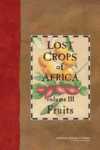 Lost Crops of Africa: Volume III: Fruits (2008) Lost Crops of Africa: Volume III: Fruits (2008)
Read online free Buy the book or Download the Free PDF Download the report brief(154KB)  Listen to the Podcast (Fri, 6 Jun 2008 11:18:58 -0400) Listen to the Podcast (Fri, 6 Jun 2008 11:18:58 -0400)
Related:
Lost Crops of Africa: Volume II: Vegetables (2006)
Lost Crops of Africa: Volume 1 - Grains, (1996)
This report is the third in a series evaluating underexploited African plant resources that could help broaden and secure Africa's food supply. The volume describes 24 little-known indigenous African cultivated and wild fruits that have potential as food- and cash-crops but are typically overlooked by scientists, policymakers, and the world at large. The book assesses the potential of each fruit to help overcome malnutrition, boost food security, foster rural development, and create sustainable landcare in Africa. Each fruit is also described in a separate chapter, based on information provided and assessed by experts throughout the world. Volume I describes African grains and Volume II African vegetables. Development, Security, and Cooperation (DSC)
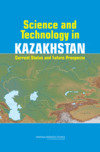 Science and Technology in Kazakhstan: Current Status and Future Projects (2007) Science and Technology in Kazakhstan: Current Status and Future Projects (2007)
Read online free Download the report brief (PDF) Buy the book or Download the Free PDF
Kazakhstan has an ambitious program to increase its technological competitiveness in the global market place during the next few years, but achieving success will depend in large measure on the effectiveness of upgraded science and technology (S&T) capabilities. This report identifies important opportunities and limitations in the education system, research and development (R&D) institutions, production companies, and service organizations to help governmental organizations in Kazakhstan with strong interests in S&T chart the future course of the country. Development, Security, and Cooperation (DSC)
 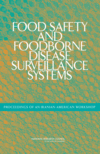 Food Safety and Foodborne Disease Surveillance Systems: Proceedings of an Iranian-American Workshop (2006) Read online free Buy the book or Download the Free PDF Download the report brief (PDF)In October 2004 the Research Center for Gastroenterology and Liver Diseases of Shaheed Beheshti University hosted in Tehran an Iranian-American workshop on Food Safety and Surveillance Systems for Foodborne Diseases. The purposes of the workshop were to initiate contacts between Iranian and American specialists, exchange information about relevant activities in the two countries, and set the stage for future cooperation in the field. The participants also identified important aspects of food safety that should be addressed more intensively by both countries, including surveillance, research, international trade, and risk assessment. The framework for the workshop had been developed during a meeting of Iranian and American specialists in June 2003 in Les Treilles, France. More that 100 specialists participated in the workshop in their personal capacities, along with representatives of the World Health Organization and the Food and Agriculture Organization. These proceedings include a number of papers that were presented at the workshop together with summaries of discussions following presentation of the papers. Development, Security, and Cooperation (DSC)
 Lost Crops of Africa: Volume II: Vegetables (2006) Read online free Download the report brief (163KB) View the summary, (48.09MB) Buy the book or Download the Free PDF Listen to the Podcast (Fri, 1 Jun 2007 13:54:57 -0400) Lost Crops of Africa: Volume II: Vegetables (2006) Read online free Download the report brief (163KB) View the summary, (48.09MB) Buy the book or Download the Free PDF Listen to the Podcast (Fri, 1 Jun 2007 13:54:57 -0400)
View media coverage
Related:
Lost Crops of Africa: Volume III: Fruits (2008)
Lost Crops of Africa: Volume 1 - Grains, (1996)
This report is the second in a series of three evaluating underexploited African plant resources that could help broaden and secure Africa's food supply. The volume describes 18 little-known indigenous African vegetables (including tubers and legumes) that have potential as food- and cash-crops but are typically overlooked by scientists, policymakers, and the world at large. The book assesses the potential of each vegetable to help overcome malnutrition, boost food security, foster rural development, and create sustainable landcare in Africa. Each vegetable is also described in a separate chapter, based on information provided and assessed by experts throughout the world. Volume I describes African grains and Volume III African fruits. Development, Security, and Cooperation (DSC)
 The Fundamental Role of Science and Technology in International Development: An Imperative for the U.S. Agency for International Development (2006) Read online free Download the report brief (PDF) Buy the book or Download the Free PDFAn NRC committee assessed the capabilities of AID to draw on the science and technology resources of the nation in designing and carrying out development assistance programs. It recommends steps that AID should consider in enhancing these capabilities. Special attention is devoted to partnerships that involve AID together with international, regional, U.S. governmental, and private sector organizations in fields such as heath care, agriculture and nutrition, education and job creation, and energy and environment. Development, Security, and Cooperation (DSC) The Fundamental Role of Science and Technology in International Development: An Imperative for the U.S. Agency for International Development (2006) Read online free Download the report brief (PDF) Buy the book or Download the Free PDFAn NRC committee assessed the capabilities of AID to draw on the science and technology resources of the nation in designing and carrying out development assistance programs. It recommends steps that AID should consider in enhancing these capabilities. Special attention is devoted to partnerships that involve AID together with international, regional, U.S. governmental, and private sector organizations in fields such as heath care, agriculture and nutrition, education and job creation, and energy and environment. Development, Security, and Cooperation (DSC)  Innovating for Profit in Russia: Developments in the Urals Region - Summary of a Workshop (2005) Innovating for Profit in Russia: Developments in the Urals Region - Summary of a Workshop (2005)
Read online free Buy the book or Download the Free PDF
The National Research Council hosted an interacademy workshop in Yekaterinburg, Russia together with the Russian Academy of Sciences in October 2004 as a means of exploring various aspects of industrial innovation in the Urals region of Russia. Workshop presenters focused on the establishment of cooperative business partnerships between Russian industrial companies and Russian research organizations, particularly those in the closed nuclear cities of Russia. The concept of “market pull” was therefore an important aspect of the workshop, including partnerships between Russian researchers and international companies, as well as those with international research centers. However, given the complex economic and research climates in Russia, which are intensified in the nuclear cities, cooperation between Russian industry and Russian researchers were of primary during the workshop presentations and subsequent discussions as captured in this workshop summary. Development, Security, and Cooperation (DSC)
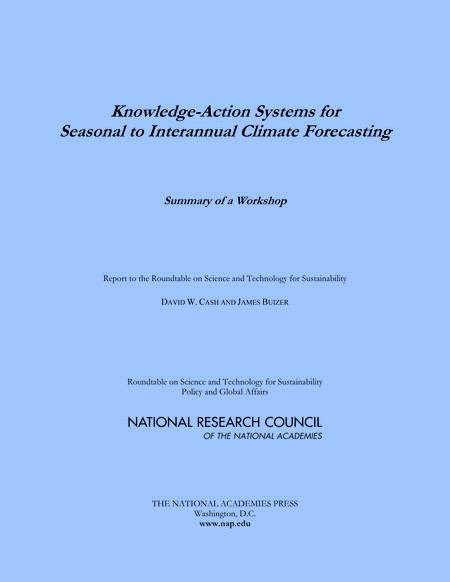 Knowledge-Action Systems for Seasonal to Interannual Climate Forecasting: Summary of a Workshop (2005) Knowledge-Action Systems for Seasonal to Interannual Climate Forecasting: Summary of a Workshop (2005)
Read online free Buy the book or Download the Free PDF
The National Academies' Roundtable on Science and Technology for Sustainability hosted a workshop "Knowledge-Action Systems for Seasonal to Interannual Climate Forecasting" in 2004 to discover and distill general lessons about the design of effective systems for linking knowledge with action from the last decade's experience with the production and application of seasonal to interannual climate forecasts. Workshop participants described lessons they had learned based on their experiences developing, applying, and using decision support systems in the United States, Columbia, Brazil, and Australia. Some of the key lessons discussed, as characterized by David Cash and James Buizer, were that effective knowledge-action systems: define and frame the problem to be addressed via collaboration between knowledge users and knowledge producers; tend to be end-to-end systems that link user needs to basic scientific findings and observations; are often anchored in "boundary organizations" that act as intermediaries between nodes in the system - most notably between scientists and decision makers; feature flexible processes and institutions to be responsive to what is learned; use funding strategies tailored to the dual public/private character of such systems; and require people who can work across disciplines, issue areas, and the knowledge–action interface. Science and Technology for Sustainability Program (STS)
 Water Conservation, Reuse, and Recycling: Proceedings of an Iranian-American Workshop (2005) Water Conservation, Reuse, and Recycling: Proceedings of an Iranian-American Workshop (2005)
Read online free Download the report brief (PDF) Buy the book or Download the Free PDF
In December 2002, a group of specialists on water resources from the United States and Iran met in Tunis, Tunisia, for an interacademy workshop on water resources management, conservation, and recycling. This was the fourth interacademy workshop on a variety of topics held in 2002, the first year of such workshops. Tunis was selected as the location for the workshop because the Tunisian experience in addressing water conservation issues was of interest to the participants from both the United States and Iran. This report includes the agenda for the workshop, all of the papers that were presented, and the list of site visits. Development, Security, and Cooperation (DSC)
Science and Technology in Armenia: Toward a Knowledge-Based Economy (2004)
Read online free Download the report brief (PDF) Buy the book or Download the Free PDF
An NRC ad hoc committee analyzed the current status and future development potential of Armenia’s science and technology base, including human and infrastructural resources and research and educational capabilities. The committee identified those fields and institutions offering promising opportunities for contributing to economic and social development, and particularly institutions having unique and important capabilities, worthy of support from international financial institutions, private investment sources, and the Armenian and U.S. governments. The scope of the study included both pure and applied research as well as education in science-related fields. The committee’s report addresses the existing capacity of state and private research institutions, higher education capabilities and trends, scientific funding sources, innovative investment models, relevant success stories, factors hindering development of the science sector, potential domestic Armenian customers for scientific results and products, and opportunities for regional scientific collaboration. An Armenian language version of the report is also available. Development, Security, and Cooperation (DSC)
Science and Technology in U.S. Foreign Assistance: Interim Report to the Administrator, U.S. Agency for International Development (2004)
Read online free Buy the book or Download the Free PDF
This report provides the preliminary views on the critical role of science and technology (S&T) in development assistance by a committee that was established in accordance with a cooperative agreement between the U.S. Agency for International Development (USAID) and the NRC. The initial views of the committee were made available to the administrator or USAID to aid the administrator in making decisions concerning near-term steps that can be taken to strengthen the S&T capabilities of USAID and to integrate S&T more effectively into programs that are supported by USAID. Development, Security, and Cooperation (DSC)
Urbanization, Energy, and Air Pollution in China: The Challenges Ahead -- Proceedings of a Symposium (2004)
Read online free Download the report brief (PDF) Buy the book or Download the Free PDF
In October 2003, a group of experts met in Beijing under the auspices of the Chinese Academy of Sciences, Chinese Academy of Engineering, and National Academy of Engineering (NAE)/National Research Council (NRC) of the National Academies to continue a dialogue and eventually chart a rational course of energy use in China. This collection of papers is intended to introduce the reader to the complicated problems of urban air pollution and energy choices in China. Development, Security, and Cooperation (DSC)
Science for the Sustainability Transition CD-ROM (2002)
Email Sustainability@nas.edu for a copy of this CD
Sustainability is one of today’s many pressing issues that the National Academies addresses via studies and other mechanisms. National Academies studies relevant to sustainability are numerous and range from analyses of the state of science on specific topics to broad trans-disciplinary examinations of the state of the planet, including potential paths to a sustainability transition.
This CD-ROM features select reports about or pertaining to sustainability, including:
Our Common Journey: A Transition Toward Sustainability; The Drama of the Commons; Climate Change Science: An Analysis of Some Key Questions; Human Dimensions of Global Environmental Change: Research Pathways for the Next Decade; Nature and Human Society: The Quest for a Sustainable World; Nature’s Numbers: Expanding the National Economic Accounts to Include the Environment; Environmentally Significant Consumption: Research Directions; Grand Challenges in the Environmental Sciences; Plants and Population: Is There Time?; Sustainable Agriculture and the Environment in the Humid Tropics; Under the Weather: Climate, Ecosystems, and Infectious Disease; Information Systems and the Environment; and Rebuilding the Unity of Health and the Environment: A New Vision of Environmental Health for the 21st Century. Science and Technology for Sustainability Program (STS)
Successes and Difficulties of Small Innovative Firms in Russian Nuclear Cities:Proceedings of a Russian-American Workshop (2002) Read online free Buy the book or Download the Free PDFThis workshop report focuses on successes and failures of small innovative firms in five science cities in Russia. The workshop was organized by the NRC with the cooperation of Minatom. Development, Security, and Cooperation (DSC) An NRC committee was established to work with a Russian counterpart group in conducting a workshop in Moscow on the effectiveness of Russian environmental NGOs in environmental decision-making and prepared proceedings of this workshop, highlighting the successes and difficulties faced by NGOs in Russia and the United States. Development, Security, and Cooperation (DSC) 
Lost Crops of Africa: Volume I: Grains (1996)
Read online free View the report brief (214KB) Buy the book or Download the Free PDF
Related:
Lost Crops of Africa: Volume III: Fruits (2008)
Lost Crops of Africa: Volume II: Vegetables (2006)
There is an overlooked food resource in sub-Saharan Africa that has vast potential: native food plants. All in all, Africa has more than 2,000 native grains and fruits--"lost" species due for rediscovery and exploitation. This volume focuses on native cereals, dispelling myths about the nutritional value, flavor, and yield of African grains. The authors present information on where and how each grain is grown, harvested, and processed and list its benefits and limitations as a food source.
|
|