Bolstering Research and Education In Science and Engineering
 Minority Serving Institutions: America's Underutilized Resource for Strengthening the STEM Workforce (2018)
 Read online free
  Download the Free PDF
  View project website View report highlights (PDF)
There are nearly 700 minority-serving institutions (MSIs) that provide pathways to STEM educations success and workforce readiness for millions of students of color. This report identifies promising program and effective strategies that have the highest potential return on investment for the nation by increasing the quantity and quality MSI STEM graduates. This report also provides critical information and perspective about the importance of MSIs to other stakeholders in the nation's system of higher education and the organizations that support them. (Board on Higher Education and Workforce)
 Sexual Harassment of Women: Climate, Culture, and Consequences in Academic Sciences, Engineering (2018)
Read online free Download the Free PDF View project website View report highlights (PDF)
This report explores the influence of sexual harassment in academia on their career advancement of women in the scientific, technical, and medical workforce. This report reviews the research on the extent to which women in the fields of science, engineering, ad medicine are victimized by sexual harassment and examines information on the extent to which sexual harassment in academia negatively impacts the recruitment, retention, and advancement of women pursuing scientific, engineering, technical, and medical careers. It also identifies an analyzes the policies, strategies and practices that have been the most successful in preventing and addressing sexual harassment in these settings. (Committee on Women in Science, Engineering, and Medicine)
 Graduate STEM Education for the 21st Century (2018)
Read online free Download the Free PDF
This report examines the current state of U.S. graduate STEM education. This report explores how the system might best respond to ongoing developments in the conduct of research on evidence-based teaching practices and in the needs and interested of its students and the broader society it seeks to serve. This will be an essential resource for the primary stakeholders in the U.S. STEM enterprise, including federal and state policymakers, public and private funders, institutions of higher education, their administrators and faculty, leaders in business and industry, and the students the system is intended to educate. (Board on Higher Education and Workforce)
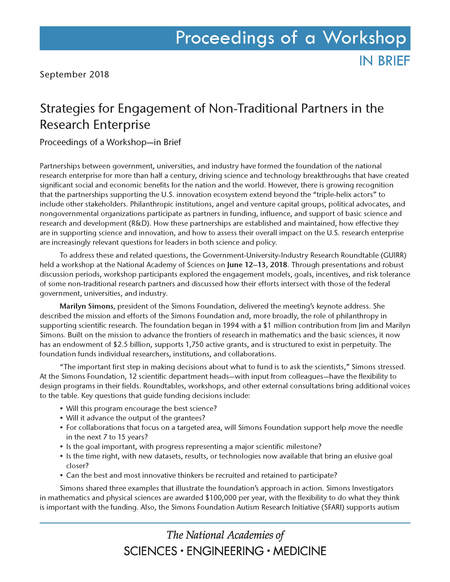 Strategies for Engagement of Non-Traditional Partners in the Research Enterprise (2018)
Read online free Download the Free PDF
Partnerships between government, universities, and industry have formed the foundation of the national research enterprise for more than half a century, driving science and technology breakthroughs that have created significant social and economic benefits for the nation and the world. However, there is growing recognition that the partnerships supporting the U.S. innovation ecosystem extend beyond the “triple-helix actors” to include other stakeholders. Philanthropic institutions, angel and venture capital groups, political advocates, and nongovernmental organizations participate as partners in funding, influence, and support of basic science and research and development. How these partnerships are established and maintained, how effective they are in supporting science and innovation, and how to assess their overall impact on the U.S. research enterprise are increasingly relevant questions for leaders in both science and policy.
To address these and related questions, the National Academies of Sciences, Engineering, and Medicine held a workshop on June 12–13, 2018. Through presentations and robust discussion periods, workshop participants explored the engagement models, goals, incentives, and risk tolerance of some non-traditional research partners and discussed how their efforts intersect with those of the federal government, universities, and industry. This publication summarizes the presentations and discussions from the workshop.(Government-University-Industry Research Roundtable)
 Supporting Mathematics Teachers in the United States and Finland (2018)
Read online free Download the Free PDF
For the past 17 years, the U.S. National Commission on Mathematics Instruction (USNC/MI) has held workshops with mathematics educators from countries that typically perform well on international assessments and have a history of strong mathematics education programs, such as Japan, China, and South Korea. Finland is among this group. Even though its mathematics education system has some common characteristics with other top-performing nations, such as a great social respect for the teaching profession, it also has unique characteristics.
The USNC/MI, a standing committee of the National Academies of Sciences, Engineering, and Medicine, planned a workshop at which U.S. and Finnish mathematics educators could exchange information and ideas about the preparation of new mathematics teachers and the means of providing them with support and professional development throughout their careers. While this is not the first time U.S. and Finnish mathematics educators have discussed educational practices, this workshop focused primarily on teacher development in both nations in the context of mathematics education. This publication summarizes the presentations and discussions from the workshop. (Board on International Scientific Organizations)
 The Integration of the Humanities and Arts with Sciences, Engineering, and Medicine in Higher Education (2018)
Read online free Download the Free PDF
This report examines the evidence behind the assertion that educational programs that mutually integrate learning experiences in the humanities and arts with sciences, technology, engineering, math, and medicine (STEMM) lead to improved educational and career outcomes for undergraduate and graduate students. It also summarizes the results of this examination and provides recommendations for all stakeholders to support appropriate endeavors to strengthen higher education initiatives in this area. (Board on Higher Education and Workforce)
 The Next Generation of Biomedical and Behavioral Sciences Researchers: Breaking Through (2018)
Read online free Download the Free PDF
Since the end of WWII, the United States has developed the world's preeminent system for biomedical research, one that has given rise to revolutionary medical advances as well as a dynamic and innovative business sector generating high-quality jobs and powering economic output and exports for the U.S. economy. However, there is a growing concern that the biomedical research enterprise is beset by several core challenges that undercut its vitality, promise, and productivity and that could diminish its critical role in the nation's health and innovation in the biomedical industry.
This report evaluates the factors that influence transitions into independent research careers in the biomedical and behavioral sciences and offers recommendations to improve those transitions. These recommendations chart a path to a biomedical research enterprise that is competitive, rigorous, fair, dynamic, and can attract the best minds from across the country. (Board on Higher Education and Workforce)
 Assessing and Responding to the Growth of Computer Science Undergraduate Enrollments (2017)
Read online free Download the Free PDF
The field of computer science (CS) is currently experiencing a surge in undergraduate degree production and course enrollments, which is straining program resources at many institutions. What does this growth mean for the future of CS programs, the role of computer science in academic instiuttions, the field as a whole, and U.S. society more broadly? This report describes current trends in computing enrollments, drivers of the enrollment surge, and the likely effects on students, faculty, and institutions. It provides recommendations for what institutions of higher education, government agencies, and the private sector can do to respond to the surge and plan for a strong and sustainable future. (Board on Higher Education and Workforce / Computer Science and Telecommunications Board).
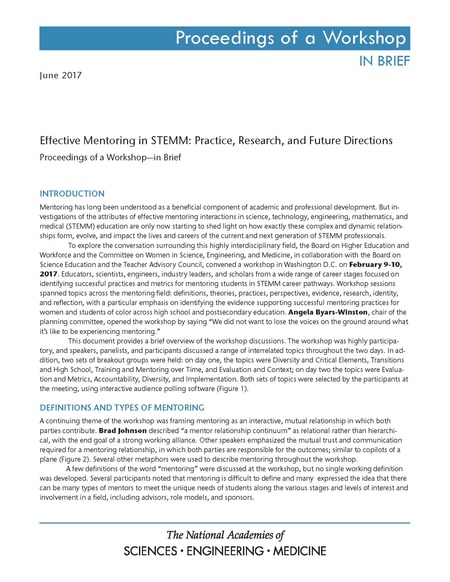 Effective Mentoring in STEMM: Practice, Research, and Future Directions: Proceedings of a Workshop–in Brief (2017)
Read online free Download the Free PDF
Mentoring has long been understood as a beneficial component of academic and professional development. But investigations of the attributes of effective mentoring interactions in science, technology, engineering, mathematics, and medical (STEMM) education are only now starting to shed light on how exactly these complex and dynamic relationships form, evolve, and impact the lives and careers of the current and next generation of STEMM professionals.(Board on Higher Education and Workforce).
 Fostering Integrity in Research (2017)
Read online free Buy the book or Download the Free PDF View report highlights (PDF)  View media coverage
The report examines challenges to scientific integrity facing the research enterprise and recommends steps that individual scientists, research sponsors, research institutions, journal publishers, and professional societies should take to meet these challenges and better protect integrity in research. Committee on Science, Engineering, Medicine, and Public Policy (COSEMPUP)
 Optimizing the Nation's Investment in Academic Research: A New Regulatory Framework for the 21st Century (2016)
Read online free Buy the book or Download the Free PDF View report highlights (PDF) View media coverage  View the video
Research universities are critical contributors to our national research enterprise. They are the principal source of a world-class labor force and fundamental discoveries that enhance our lives and the lives of others around the world. These institutions help to create an educated citizenry capable of making informed and crucial choices as participants in a democratic society. However many are concerned that the unintended cumulative effect of federal regulations undercuts the productivity of the research enterprise and diminishes the return on the federal investment in research. (Committee on Science, Technology, and Law (CSTL)/Board on Higher Education and Workforce (BHEW)).
 Quality in the Undergraduate Experience: What Is It? How Is It Measured? Who Decides? Summary of a Workshop (2016)
Read online free Buy the book or Download the Free PDF
Students, parents, and government agencies need as much information as possible about the outcomes of the higher education experience and the extent to which they can expect a fair return on their investment in higher education.In order to better understand the concept of quality - enabling students to acquire knowledge in a variety of disciplines and deep knowledge in at least one discipline, as well as to develop a range of skills and habits of mind that prepare them for career success, engaged citizenship, intercultural competence, social responsibility, and continued intellectual growth - an ad hoc planning committee of the National Academies of Sciences, Engineering, and Medicine Board on Higher Education and Workforce, with funding from the Lumina Foundation, organized a workshop in Washington, D.C., on December 14-15, 2015.This report summarizes the presentations and discussion of that event. (Board on Higher Education and Workforce).
 Mathematics Curriculum, Teacher Professionalism, and Supporting Policies in Korea and the United States: Summary of a Workshop (2015)
Read online free Buy the book or Download the Free PDF View report highlights (PDF)
On July 15-17, 2012 the United States National Commission on Mathematics Instruction and Seoul National University held a joint Korea-U.S. workshop on Mathematics Teaching and Curriculum. The workshop was organized to address questions and issues related to math teaching and curriculum that were generated by each country, including the following: What are the main concerns in the development of the curriculum? What issues have been discussed or debated among curriculum developers, teachers, teacher educators, and scholars regarding the curriculum? How have textbooks been developed for the curriculum? How are curricular tasks designed and what criteria are used? What is the role of learning trajectories in the development of curriculum? This report summarizes the presentations and discussions at the workshop. (Board on International Scientific Organizations (BISO))
 The Arc of the Academic Research Career: Issues and Implications for U.S. Science and Engineering Leadership: Summary of a Workshop (March 2014)
Read online free Buy the book or Download the Free PDF Watch related video
America's research universities have undergone striking changes in recent decades, and the traditional career path for faculty --developed in the mid-nineteenth and early twentieth centuries -- is now a source of strain for both the individuals pursuing it and the institutions in which they work. This report summarizes a workshop held in September 2013 to examine major points of tension in academic research careers from the viewpoints of both faculty members and institutions. Workshop presentations explored the challenges universities face, such as nurturing the talent of future faculty members and managing their progress through all the stages of their careers, as well as challenges faced by faculty, such as navigating early-career bottlenecks and balancing work and family. National experts from a variety of disciplines and institutions discussed successful strategies in use on campuses and identified issues not yet effectively addressed. (Committee on Science, Engineering, Medicine, and Public Policy (COSEMPUP))
 The Experimental Program to Stimulate Competitive Research (November 2013)
Read online free Buy the book or Download the Free PDF View media coverage View report highlights (PDF)
The primary federal program designed to ensure that all states are capable of participating the nation's research enterprise fall under the general rubric of the Experimental Program to Stimulate Competitive Research (EPSCOR). The National Science Foundation (NSF), Department of Energy, Department of Agriculture, and National Aeronautics and Space Administration have active EPSCOR programs. Since its inaugural year in 1979, the EPSCOR program has grown from funding programs in five states to awarding funding to 31 states in 2012. The Experimental Program to Stimulate Competitive Research assesses the effectiveness of EPSCOR and similar federal agency programs in improving national research capabilities, promoting an equitable distribution of research funding, and integrating their efforts with other initiatives designed to strengthen the nation's research capacity. This report also looks at the effectiveness of EPSCOR states in using awards to develop science engineering research and education, as well a science and engineering infrastructure within their state. The Experimental Program to Stimulate Competitive Research makes recommendations for improvement for each agency to create a more focused program with greater impact. (Committee on Science, Engineering, Medicine, and Public Policy (COSEMPUP))
 Improving Measurement of Productivity in Higher Education (November 2012)
Read online free Buy the book or Download the Free PDF
Higher education is a linchpin of the American economy and society: Teaching and research at colleges and universities contribute significantly to the nation's economic activity, both directly and through their impact on future growth; federal and state governments support teaching and research with billions of taxpayers' dollars; and individuals, communities, and the nation gain from the learning and innovation that occurs in higher education.
In the current environment of increasing tuition and shrinking public funds, a sense of urgency has emerged to better track the performance of colleges and universities in the hope that their costs can be contained while not compromising quality or accessibility. Improving Measurement of Productivity in Higher Education presents an analytically well-defined concept of productivity in higher education and recommends empirically valid and operationally practical guidelines for measuring it. In addition to its obvious policy and research value, improved measures of productivity may generate insights that potentially lead to enhanced departmental, institutional, or system educational processes.
Improving Measurement of Productivity in Higher Education constructs valid productivity measures to supplement the body of information used to guide resource allocation decisions at the system, state, and national levels and to assist policymakers who must assess investments in higher education against other compelling demands on scarce resources. This report provides administrators with better tools for improving their institutions' performance; and informs individual consumers and communities to whom colleges and universities are ultimately accountable for private and public investments in higher education. (Board on Higher Education and Workforce (BHEW)/ Committee on National Statistics)
 Research Universities and the Future of America: Ten Breakthrough Actions Vital to Our Nation's Prosperity and Security (June 2012)
Read online free Buy the book or Download the Free PDF Watch related video View media coverage
View the Infographic (PDF; .4MB) View the Summary (PDF; 1.3MB) View report highlights (PDF)
Research Universities and the Future of America presents critically important strategies for ensuring that our nation's research universities contribute strongly to America's prosperity, security, and national goals. Widely considered the best in the world, our nation's research universities today confront significant financial pressures, important advances in technology, a changing demographic landscape, and increased international competition. This report provides a course of action for ensuring our universities continue to produce the knowledge, ideas, and talent the United States needs to be a global leader in the 21st century.
Research Universities and the Future of America focuses on strengthening and expanding the partnership among universities and government, business, and philanthropy that has been central to American prosperity and security. The report focuses on the top 10 actions that Congress, the federal government, state governments, research universities, and others could take to strengthen the research and education missions of our research universities, their relationships with other parts of the national research enterprise, and their ability to transfer new knowledge and ideas to those who productively use them in our society and economy.
This report examines trends in university finance, prospects for improving university operations, opportunities for deploying technology, and improvement in the regulation of higher education institutions. It also explores ways to improve pathways to graduate education, take advantage of opportunities to increase student diversity, and realign doctoral education for the careers new doctorates will follow. Research Universities and the Future of America is an important resource for policy makers on the federal and state levels, university administrators, philanthropic organizations, faculty, technology transfer specialists, libraries, and researchers. (Board on Higher Education and Workforce (BHEW))
 Research Doctorate Programs in the Biomedical Sciences: Selected Findings from the NRC Assessment (July 2011)
Read online free Buy the book or Download the Free PDF
Research Doctorate Programs in the Biomedical Sciences: Selected Findings from the NRC Assessment examines data on the biomedical sciences programs to gather additional insight about the talent, training environment, outcomes, diversity, and international participation in the biomedical sciences workforce. This report supports an earlier publication, A Data-Based Assessment of Research-Doctorate Programs in the United States, which analyzes data and rankings from more than 5,000 doctoral programs, 982 of which were in the biomedical sciences. Research Doctorate Programs in the Biomedical Sciences explores questions about degrees and completion rates as they relate to GRE scores, student funding, program facilities, diversity among faculty members, and other variables. The report examines 11 biomedical science fields including cell and developmental biology, genetics and genomics, microbiology, nutrition, and physiology, among others. (Board on Higher Education and Workforce (BHEW))
 A Data-Based Assessment of Research-Doctorate Programs in the United States (July 2011)
Download a free copy Buy the Book Download the report brief (PDF) View media coverage
The culmination of a six-year effort, this assessment offers an unprecedented collection of data on over 5,000 doctoral programs in 62 fields at 212 universities in the United States—including information and illustrative rankings on faculty research productivity, institutional support for students, and the diversity of faculty and students, among many other characteristics. Universities are busily evaluating the data on their programs—as well as comparable programs at other institutions--and determining what changes they might want to make as a result. The assessment will serve as an essential reference guide for years to come for anyone seeking information on doctoral education in the U.S. The data from the assessment, along with data from other sources, are available free-of-charge on www.phds.org, a public website where students and others can obtain rankings of programs based on their own choice of characteristics and relative weights for those characteristics. A complete public use database for researchers will also be available at the National Academies in the near future.. (Board on Higher Education and Workforce (BHEW))
 Research Training in the Biomedical, Behavioral, and Clinical Research Sciences (2011)
Read online free Buy the book or Download the Free PDF
Comprehensive research and a highly trained workforce are essential for the improvement of health and health care both nationally and internationally. Over the past 40 years the National Research Services Award (NRSA) Program has played a large role in training the workforce responsible for dramatic advances in the understanding of various diseases and new insights that have led to more effective and targeted therapies. In spite of this program, the difficulty obtaining jobs after the postdoc period has discouraged many domestic students from pursuing graduate postdoc training. In the United States, more than 50 percent of the postdoc workforce is made up of individuals who obtained their Ph.D.s from other countries. Indeed, one can make a strong argument that the influx of highly trained and creative foreigners has contributed greatly to U.S. science over the past 70 years.
Research Training in the Biomedical, Behavioral, and Clinical Research Sciences discusses a number of important issues, including: the job prospects for postdocs completing their training; questions about the continued supply of international postdocs in an increasingly competitive world; the need for equal, excellent training for all graduate students who receive NIH funding; and the need to increase the diversity of trainees. The book recommends improvements in minority recruiting, more rigorous and extensive training in the responsible conduct of research and ethics, increased emphasis on career development, more attention to outcomes, and the requirement for incorporating more quantitative thinking in the biomedical curriculum. (Board on Higher Education and Workforce (BHEW))
 A Revised Guide to the Methodology of the Data-Based Assessment of Research-Doctorate Programs in the United States (2010)
Download online free Buy the book or Download the Free PDF
A Revised Guide to the Methodology of the Data-Based Assessment of Research-Doctorate Programs in the United States (2010) is a detailed explanation of the methodology used to collect data and calculate ranges of rankings. This version of the methodology guide replaces A Guide to the Methodology of the National Research Council Assessment of Doctorate Programs (2009).
 Gender Differences at Critical Transitions in the Careers of Science, Engineering and Mathematics Faculty (June 2010)
Read online free Download the report brief (PDF) Buy the book or Download the Free PDF
View media coverage View the Summary (PDF; 6.51MB)
Gender Differences at Critical Transitions in the Careers of Science, Engineering, and Mathematics Faculty presents new and surprising findings about career differences between female and male full-time, tenure-track, and tenured faculty in science, engineering, and mathematics at the nation's top research universities. Much of this congressionally mandated book is based on two unique surveys of faculty and departments at major U.S. research universities in six fields: biology, chemistry, civil engineering, electrical engineering, mathematics, and physics. A departmental survey collected information on departmental policies, recent tenure and promotion cases, and recent hires in almost 500 departments. A faculty survey gathered information from a stratified, random sample of about 1,800 faculty on demographic characteristics, employment experiences, the allocation of institutional resources such as laboratory space, professional activities, and scholarly productivity. This book paints a timely picture of the status of female faculty at top universities, clarifies whether male and female faculty have similar opportunities to advance and succeed in academia, challenges some commonly held views, and poses several questions still in need of answers. This book will be of special interest to university administrators and faculty, graduate students, policy makers, professional and academic societies, federal funding agencies, and others concerned with the vitality of the U.S. research base and economy. (Committee on Women in Science, Engineering, and Medicine (CWSEM))
 A Guide to the Methodology of the National Research Council Assessment of Doctorate Programs (2009)
Read online free Buy the book or Download the Free PDF
This report describes the purpose, data and methods used to calculate ranges or rankings for research-doctorate programs that participated in the NRC Assessment of Research-Doctorate programs. It is intended for those at universities who will have to explain the NRC Assessment to others at their university, to potential students, and to the press. Although the main text is fairly non-technical, it includes a technical description of the statistical methods used to derive rankings of over 5000 doctoral programs in 61 fields. (Board on Higher Education and Workforce (BHEW)
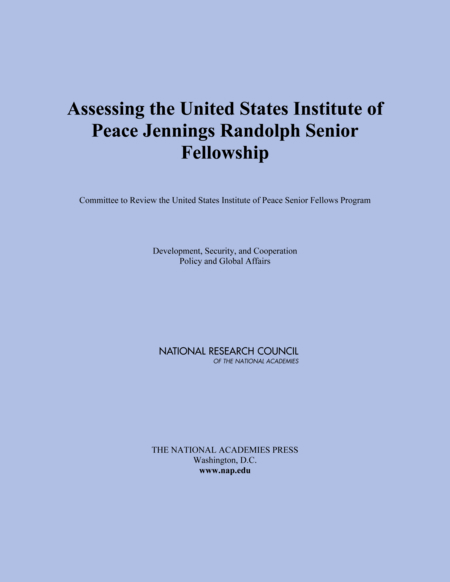 Assessing the United States Institute of Peace Jennings Randolph Senior Fellowship (2008)
Read online free Buy the book or Download the Free PDF
The United States Institute of Peace (USIP) is an independent, nonpartisan, national institution established and funded by the U.S. Congress. The goals of the USIP are to help prevent and resolve violent international conflicts; promote post-conflict stability and development; and to increase conflict management capacity, tools, and intellectual capital worldwide. One way the USIP meets those goals is through the Jennings Randolph Program for International Peace, which awards Senior Fellowships to outstanding scholars, policymakers, journalists, and other professionals from around the world to conduct research at the USIP. The Fellowship Program began in 1987, and 253 Fellowships have been awarded through 2007. This book presents a preliminary assessment of the Fellowship Program, and recommends certain steps to improve it, including more rigorous and systematic monitoring and evaluation of the Fellowship in the future. The committee also makes several recommendations intended to help USIP gain further knowledge about the perceptions of the Fellowships in the wider expert community.. (Board on Higher Education and Workforce (BHEW))
 Science Professionals: Master's Education for a Competitive World (2008)
Read online free Download the report brief (PDF) Download the PowerPoint  Listen to a Public Briefing Buy the book or Download the Free PDF
What are employer needs for staff trained in the natural sciences at the master’s degree level, and how do these professionals contribute in the workplace? A reinvigorated master's degree in the natural sciences can indeed answer the demand for science professionals in many fields and help ensure that the U.S. has the workforce it needs to stay competitive. Substantial efforts are already underway to enhance the master's in the natural sciences as a professional degree, but significant expansion is warranted. The report received significant coverage in the media, including the Chronicle of Higher Education, Inside Higher Ed, Science Daily, Chemical and Engineering News, Federal Radio News, Kiplinger, the Associated Press, and others. Also, staff are working with the Council of Graduate Schools, the National Association of System Heads, the National Professional Science Masters Association, the Council on Competitiveness, and the National Governors Association to disseminate the report. (Board on Higher Education and Workforce (BHEW))
 Evaluation of the Markey Scholars Program (2006)
Read online free Buy the book or Download the Free PDF Download the report brief (PDF)
Beginning in 1983, the Lucille P. Markey Charitable Trust spent more than $500 million over 15 years in support of students and researchers in the biomedical sciences through several programs. The Trust's Scholar Awards in Biomedical Science focused specifically on providing innovative funding and support to young biomedical researchers spanning the critical transition from postdoctoral training to the first years of a faculty appointment. The Evaluation of the Markey Scholars Program examines the research and career outcomes of the individuals funded as Markey Scholars by comparing indicators of achievement for the Scholars with those for individuals who were unsuccessful applicants for the Scholars award. The study found that the Scholars had a higher level of citations per individual and article, received more R01 grants, achieved higher rank, had a shorter time to tenure, and were located in higher ranked institutions than the biomedical scientists in the comparison groups. The report provides a series of recommendations for structuring future programs that support biomedical scientists who are navigating this critical career transition point. (Board on Higher Education and Workforce (BHEW))
Funding Biomedical Research Programs: Contributions of the Markey Trust (2006)
Read online free Buy the book or Download the Free PDF
During an interval of 15 years, the Lucille P. Markey Charitable Trust spent over $500 million on four programs in the basic biomedical sciences that support the education and research of graduate students, postdoctoral fellows, junior faculty, and senior researchers. The Markey Trust asked the NRC to evaluate these programs with two questions in mind: “Were these funds well spent?” and “What can others in the biomedical and philanthropic communities learn from the programs of the Markey Trust, both as an approach to funding biomedical research and as a model of philanthropy?” One of five resulting reports, this volume examines the Research Program Grants, which awarded $323 million to support investigators with a major commitment to the life sciences and to assist in the establishment, reorganization, or expansion of significant biomedical research centers or programs. Using information from Markey archives, materials from grant recipients, and site visits to a sample of institutional grant recipients, the authoring committee describes the impact that Markey grants made on the centers and programs funded by these grants, along with the unique aspects of the Markey approach to funding that may be applicable to other funders of biomedical research programs. (Board on Higher Education and Workforce (BHEW))
Enhancing the Community College Pathway to Engineering Careers (2005)
Read online free Download the report brief (PDF) Buy the book or Download the Free PDF
Community colleges play an important role in starting students on the road to engineering careers, but students often face obstacles in transferring to four-year educational institutions to continue their education. Enhancing the Community College Pathway to Engineering Careers, a new book from the National Academy of Engineering and the National Research Council, discusses ways to improve the transfer experience for students at community colleges and offers strategies to enhance partnerships between those colleges and four-year engineering schools to help students transfer more smoothly. In particular, the book focuses on challenges and opportunities for improving transfer between community colleges and four-year educational institutions, recruitment and retention of students interested in engineering, the curricular content and quality of engineering programs, opportunities for community colleges to increase diversity in the engineering workforce, and a review of sources of information on community college and transfer students. It includes a number of current policies, practices, and programs involving community college four-year institution partnerships. (Board on Higher Education and Workforce (BHEW))
Frameworks for Higher Education in Homeland Security (2005)
Read online free Buy the book or Download the Free PDF Download the report brief (PDF)
This report explores whether there are core pedagogical and skill-based homeland security program needs; examines current and proposed education programs focusing on various aspects of homeland security; comments on the possible parallels between homeland security, area studies, international relations, and science policy, as developed or emerging academic thrusts; and suggests potential curricula needs, particularly those that involve interdisciplinary aspects. The report concentrates almost exclusively on coursework-related offerings, primarily at the undergraduate and graduate levels. (Government-University-Industry Research Roundtable (GUIRR))
 Policy Implications of International Graduate Students and Postdoctoral Scholars in the United States (2005)
Read online free Download the report brief (PDF) Buy the book or Download the Free PDF
Policy Implications of International Graduate Students and Postdoctoral Scholars in the United States explores the role and impact of students and scholars on US educational institutions and the US economy. The nation has drawn increasingly on human resources abroad for its science and engineering workforce. However, competition for talent has grown as other countries have expanded their research infrastructure and created more opportunities for international students. The report discusses trends in international student enrollments, stay rates, and examines the impact of visa policies on international mobility of the highly skilled. (Committee on Science, Engineering, Medicine, and Public Policy (COSEMPUP))
National Laboratories and Universities: Building New Ways to Work Together -- Report of a Workshop (2005)
Read online free Buy the book or Download the Free PDF
This volume is a report of a workshop held in 2003 to address best practices and remaining challenges with respect to national laboratory-university collaborations. (Government-University-Industry Research Roundtable (GUIRR))
 Facilitating Interdisciplinary Research (2004)
Read online free Buy the book or Download the Free PDF View media coverage
Facilitating Interdisciplinary Research examines current interdisciplinary research efforts and recommends ways to stimulate and support such research.
Advances in science and engineering increasingly require the collaboration of scholars from various fields. This shift is driven by the need to address complex problems that cut across traditional disciplines, and the capacity of new technologies to both transform existing disciplines and generate new ones. At the same time, however, interdisciplinary research can be impeded by policies on hiring, promotion, tenure, proposal review, and resource allocation that favor traditional disciplines.
This report identifies steps that researchers, teachers, students, institutions, funding organizations, and disciplinary societies can take to more effectively conduct, facilitate, and evaluate interdisciplinary research programs and projects. Throughout the report key concepts are illustrated with case studies and results of the committee’s surveys of individual researchers and university provosts. (Committee on Science, Engineering, Medicine, and Public Policy (COSEMPUP))
Assessing Research-Doctorate Programs: A Methodology Study (2003)
Read online free Buy the book or Download the Free PDF
How should we assess and present information about the quality of research-doctorate programs? In recommending that the 1995 NRC rankings in Assessing the Quality of Research-Doctorate Programs: Continuity and Change be updated as soon as possible, this study presents an improved approach to doctoral program assessment which will be useful to administrators, faculty, and others with an interest in improving the education of Ph.D.s in the United States. It reviews the methodology of the 1995 NRC rankings and recommends changes, including the collection of new data about Ph.D. students, additional data about faculty, and new techniques to present data on the qualitative assessment of doctoral program reputation. It also recommends revision of the taxonomy of fields from that used in the 1995 rankings. (Board on Higher Education and Workforce (BHEW))
Attracting PhDs to K-12 Education: A Demonstration Program for Science, Mathematics, and Technology (2002)
Read online free Buy the book or Download the Free PDF
The National Research Council (NRC) has undertaken a three-phase project to explore the possibility of a program to attract science, mathematics and engineering PhDs to careers in K-12 education. The first phase of the project surveyed the interests of recent PhDs in science and mathematics in pursuing careers in secondary education. Analysis of the Phase I data suggests that a significant percentage of PhDs might be interested in pursuing careers in secondary education under some circumstances. This report from the second phase of the project presents a proposal for a national demonstration program to determine how one might prepare PhDs to be productive members of the K-12 education community. The proposed program is designed to help meet the needs of the nation's schools, while providing further career opportunities for recent PhDs in science, mathematics and engineering. (Board on Higher Education and Workforce (BHEW))
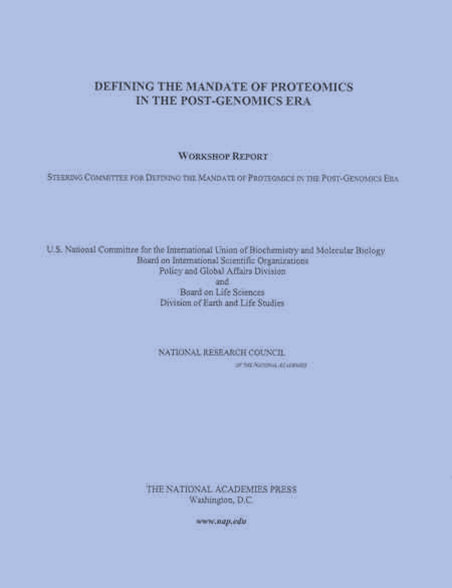 Defining the Mandate of Proteomics in the Post-Genomics Era: Workshop Report (2002)
Read online free Buy the book or Download the Free PDF
Research in proteomics is the next logical step after genomics in understanding life processes at the molecular level. In the largest sense proteomics encompasses knowledge of the structure, function and expression of all proteins in the biochemical or biological contexts of all organisms. Since that is an impossible goal to achieve, at least in our lifetimes, it is appropriate to set more realistic, achievable goals for the field. Up to now, primarily for reasons of feasibility, scientists have tended to concentrate on accumulating information about the nature of proteins and their absolute and relative levels of expression in cells (the primary tools for this have been 2D gel electrophoresis and mass spectrometry). Although these data have been useful and will continue to be so, the information inherent in the broader definition of proteomics must also be obtained if the true promise of the growing field is to be realized. Acquiring this knowledge is the challenge for researchers in proteomics and the means to support these endeavors need to be provided. An attempt has been made to present the major issues confronting the field of proteomics and two clear messages come through in this report. The first is that the mandate of proteomics is and should be much broader than is frequently recognized. The second is that proteomics is much more complicated than sequencing genomes. This will require new technologies but it is highly likely that many of these will be developed. Looking back 10 to 20 years from now, the question is: Will we have done the job wisely or wastefully? (Board on International Scientific Organizations (BISO))
Preparing for the Revolution: Information Technology and the Future of the Research University (2002)
Read online free Download the report brief (PDF) Buy the book or Download the Free PDF
The rapid evolution of information technology (IT) is transforming our society and its institutions. For the most knowledge-intensive entities of all, research universities, profound IT-related challenges and opportunities will emerge in the next decade or so. Yet, there is a sense that some of the most significant issues are not well understood by academic administrators, faculty, and those who support or depend on the institution’s activities. This study identifies those information technologies likely to evolve in the near term (a decade or less) that could ultimately have a major impact on the research university. It also examines the possible implications of these technologies for the research university—its activities (learning, research, outreach) and its organization, management, and financing—and for the broader higher education enterprise. The authoring committee urges research universities and their constituents to develop new strategies to ensure that they survive and thrive in the digital age. (Government-University-Industry Research Roundtable (GUIRR))
Issues for Science and Engineering Researchers in the Digital Age (2001)
Read online free Buy the book or Download the Free PDF
This guide for students and faculty discusses opportunities and implications of conducting research in a digital environment. (Committee on Science, Technology, and Law (CSTL))
Trends in Federal Support of Research and Graduate Education (2001)
Read online free Buy the book or Download the Free PDF
The Board on Science, Technology and Economic Policy updated its 1999 analysis (Appendix A, Securing America's Industrial Strength, 1999) of changes since 1990 in the distribution of federal research funding by field of science and engineering) by incorporating FY 1998 and FY 1999 obligations from the NSF Federal Funds survey, with particular attention to the trends in basic research support, changes in research fields' relative dependence on research-sponsoring agencies, and the relationship between changes in research support and changes in enrollment in graduate training in selected fields of research. The Board did not recommend funding levels for any discipline but addressed procedural aspects of R&D budgeting. (Board on Science, Technology and Economic Policy (STEP))