|
|
March 16, 2020 Washington, DC
March 16-17, 2020 Washington, DC
March 19, 2020Washington, DC
April 29-May 1, 2020 |
|
|
|
|
Making Sound policy for Science & Technology
 Authenticity, Integrity, and Security in a Digital World: Authenticity, Integrity, and Security in a Digital World:
Proceedings of a Workshop–in Brief (2019)
 Read online free Read online free  Buy the book or download the free PDF Buy the book or download the free PDF
Digital technology is incorporated into nearly every facet of American life, from commerce, community, healthcare, food systems, transportation, education, media, entertainment, and employment. Its increasingly integral nature raises critical questions moving forward, such as what emerging technologies are complicating the ability to verify authenticity and integrity in a digital world? Also, what emerging technologies enable the creation of systems of trust that enforce standards of authenticity, integrity, and security? How can partnerships between government, universities, and companies shape public policy to prioritize authenticity and integrity within systems—and who will be the stewards and custodians of such systems? To address these and related questions, the National Academies of Sciences, Engineering, and Medicine held a workshop on February 19-20, 2019. Through presentations from experts and robust discussions, the workshop focused on technologies, processes, and governance that affect digital privacy and security now and into the coming decades. This publication summarizes the presentations and discussions from the workshop.
 Data Matters: Ethics, Data, and International Research Collaboration in a Changing World (2019) Data Matters: Ethics, Data, and International Research Collaboration in a Changing World (2019)
Read online free Buy the book or download the free PDF
A workshop held on March 14-16, 2018, in Washington, DC explored the changing opportunities and risks of data management and use across disciplinary domains. The third workshop in a series, participants gathered to examine advisory principles for consideration when developing international research agreements, in the pursuit of highlighting promising practices for sustaining and enabling international research collaborations at the highest ethical level possible. The intent of the workshop was to explore, through an ethical lens, the changing opportunities and risks associated with data management and use across disciplinary domains—all within the context of international research agreements. This publication summarizes the presentations and discussions from the workshop. Government-University-Industry-Research Roundtable (GUIRR)
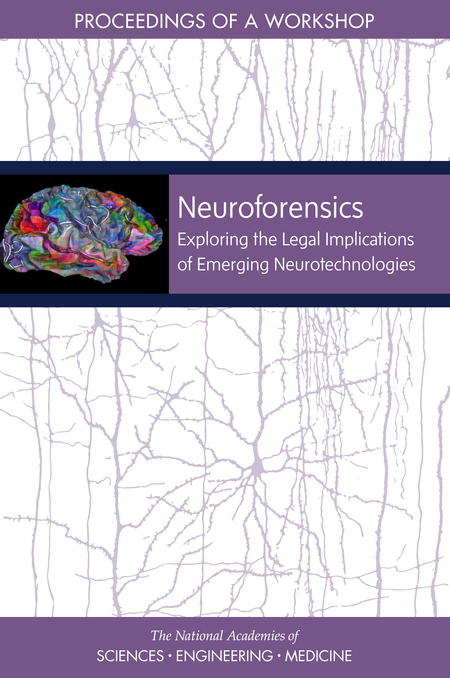 Neuroforensics: Exploring the Legal Implications of Emerging Neurotechnologies: Proceedings of a Workshop (2018) Neuroforensics: Exploring the Legal Implications of Emerging Neurotechnologies: Proceedings of a Workshop (2018)
Read online free Buy the book or download the free PDF
Discussions around the intersection between neuroscience and the law began decades ago. Originally used mostly in death penalty cases, the role of neuroscience has extended to cases involving drugs, assault, burglary, child abuse, rape, fraud, theft, and kidnapping. Neuroscience has also begun to play an increasingly important role in making policy, particularly where the law is unclear and ambiguous.
In March 2018, the National Academies of Science, Engineering and Medicine organized a workshop in order to explore the current uses of neuroscience and bring stakeholders from neuroscience and legal societies together in both the United Kingdom and the United States. Participants worked together to advance an understanding of neurotechnologies that could impact the legal system and the state of readiness to consider these technologies and where appropriate, to integrate them into the legal system. This publication summarizes the presentations and discussions from the workshop.
(Committee on Science, Technology and Law)
 Dual Use Research of Concern in the Life Sciences: Current Issues and Controversies (2017) Dual Use Research of Concern in the Life Sciences: Current Issues and Controversies (2017)
Read online free Buy the book or download the free PDF
While the U.S. has a solid record in conducting biological research safely, the policies and regulations governing the dissemination of dual-use research in the life sciences – research that could potentially be misused to cause harm – are fragmented. In addition, most life scientists have little awareness of biosecurity issues. This report offers options for dissemination of information from dual-use research, based on a review of existing mechanisms such as retraction, FOIA, classification, and export controls, and considering the applicability of free speech to a scientist's right to publish research results. Committee on Science, Technology and Law (CSTL)
 Diplomacy for the 21st Century (2015) Read online free Buy the book or Download the Free PDF Diplomacy for the 21st Century (2015) Read online free Buy the book or Download the Free PDF
 View Media CoverageDiplomacy for the 21st Century recommends steps that the Department of State should embrace to take full advantage of the leading science and technology (S&T) capabilities of the United States. These capabilities provide the department with many opportunities to promote a variety of the interests of the United States and its allies in a rapidly changing world wherein S&T are important drivers of economic development at home and abroad and help ensure international security. This report assesses and makes recommendations concerning the changing environment for the conduct of diplomacy in the years ahead, with a focus on the role of S&T in the development and implementation of U.S. policies and programs. According to this report, prompt steps by the department s leadership are essential to ensure adequate comprehension of the importance of S&T-related developments throughout the world and to incorporate this understanding within the nation's foreign policy for the 21st century. This report also urges the adoption by the department of a broader whole-of-society approach in carrying out its responsibilities at home and abroad - extending beyond traditional interagency coordination and the narrow band of current external partners to include foundations, universities, research centers, and other groups who are extending their international reach. Development, Security, and Cooperation (DSC) View Media CoverageDiplomacy for the 21st Century recommends steps that the Department of State should embrace to take full advantage of the leading science and technology (S&T) capabilities of the United States. These capabilities provide the department with many opportunities to promote a variety of the interests of the United States and its allies in a rapidly changing world wherein S&T are important drivers of economic development at home and abroad and help ensure international security. This report assesses and makes recommendations concerning the changing environment for the conduct of diplomacy in the years ahead, with a focus on the role of S&T in the development and implementation of U.S. policies and programs. According to this report, prompt steps by the department s leadership are essential to ensure adequate comprehension of the importance of S&T-related developments throughout the world and to incorporate this understanding within the nation's foreign policy for the 21st century. This report also urges the adoption by the department of a broader whole-of-society approach in carrying out its responsibilities at home and abroad - extending beyond traditional interagency coordination and the narrow band of current external partners to include foundations, universities, research centers, and other groups who are extending their international reach. Development, Security, and Cooperation (DSC)
 Potential Risks and Benefits of Gain-of-Function Research: Summary of a Workshop (February 2015) Read online free Buy the book or Download the Free PDF View Media Coverage Potential Risks and Benefits of Gain-of-Function Research: Summary of a Workshop (February 2015) Read online free Buy the book or Download the Free PDF View Media Coverage On October 17, 2014, spurred by incidents at U.S. government laboratories that raised serious biosafety concerns, the United States government launched a one-year deliberative process to address the continuing controversy surrounding so-called "gain-of-function" (GOF) research on respiratory pathogens with pandemic potential. The gain of function controversy began in late 2011 with the question of whether to publish the results of two experiments involving H5N1 avian influenza and continued to focus on certain research with highly pathogenic avian influenza over the next three years. The heart of the U.S. process is an evaluation of the potential risks and benefits of certain types of GOF experiments with influenza, SARS, and MERS viruses that would inform the development and adoption of a new U.S. Government policy governing the funding and conduct of GOF research.
Potential Risks and Benefits of Gain-of-Function Research is the summary of a two-day public symposia on GOF research. Convened in December 2014 by the Institute of Medicine and the National Research Council, the main focus of this event was to discuss principles important for, and key considerations in, the design of risk and benefit assessments of GOF research. Participants examined the underlying scientific and technical questions that are the source of current discussion and debate over GOF research involving pathogens with pandemic potential. This report is a record of the presentations and discussion of the meeting. Committee on Science, Technology and Law (CSTL)
The theme of this international symposium is the promotion of greater sharing of scientific data for the benefit of research and broader development, particularly in the developing world. This is an extraordinarily important topic. Indeed, I have devoted much of my own career to matters related to the concept of openness. I had the opportunity to promote and help build the open courseware program at the Massachusetts Institute of Technology (MIT). This program has made the teaching materials for all 2,000 subjects taught at MIT available on the Web for anyone, anywhere, to use anytime at no cost. In countries where basic broadband was not available, we shipped it in on hard drives and compact disks. Its impact has been worldwide, but it has surely had the greatest impact on the developing world. I am also a trustee of a nonprofit organization named Ithaca that operates Journal Storage (JSTOR) and other entities that make scholarly information available at very low cost. The culture of science has been international and open for centuries. Indeed, the scientific enterprise can only work when all information is open and accessible, because science works through critical analysis and replication of results. In recent years, as some scientific data, and especially technological data, have increased in economic value frequently has caused us to be far less open with information than business and free enterprise require us to be. Indeed, the worldwide shift to what is known as open innovation is strengthening every day. Finally, since the end of World War II, the realities of modern military conflict and now terrorism have led governments to restrict information through classification. This is important, but I believe that we classify far too much information. The last thing we need today, at the beginning of the twenty-first century, is further arbitrary limitations on the free flow of scientific information, whether by policies established by governments and businesses, or by lack of information infrastructure. For all these reasons, the international sharing of scientific data is one of the topics of great interest here at the National Academies and has been the subject of many of our past reports. This is the primary reason why this symposium has been co-organized by the NRC's Policy and Global Affairs Division—the Board on International Scientific Organizations (BISO) and the Board on Research Data and Information (BRDI). The Case for International Sharing of Scientific Data: A Focus on Developing Countries: Proceedings of a Symposium summarizes the symposium. Board on International Scientific Organizations (BISO)/Board on Research Data and Information (BRDI) Digital technologies and networks are now part of everyday work in the sciences, and have enhanced access to and use of scientific data, information, and literature significantly. They offer the promise of accelerating the discovery and communication of knowledge, both within the scientific community and in the broader society, as scientific data and information are made openly available online. The focus of this project was on computer-mediated or computational scientific knowledge discovery, taken broadly as any research processes enabled by digital computing technologies. Such technologies may include data mining, information retrieval and extraction, artificial intelligence, distributed grid computing, and others. These technological capabilities support computer-mediated knowledge discovery, which some believe is a new paradigm in the conduct of research. The emphasis was primarily on digitally networked data, rather than on the scientific, technical, and medical literature. The meeting also focused mostly on the advantages of knowledge discovery in open networked environments, although some of the disadvantages were raised as well. The workshop brought together a set of stakeholders in this area for intensive and structured discussions. The purpose was not to make a final declaration about the directions that should be taken, but to further the examination of trends in computational knowledge discovery in the open networked environments, based on the following questions and tasks: 1. Opportunities and Benefits: What are the opportunities over the next 5 to 10 years associated with the use of computer-mediated scientific knowledge discovery across disciplines in the open online environment? What are the potential benefits to science and society of such techniques?
2. Techniques and Methods for Development and Study of Computer-mediated Scientific Knowledge Discovery: What are the techniques and methods used in government, academia, and industry to study and understand these processes, the validity and reliability of their results, and their impact inside and outside science?
3. Barriers: What are the major scientific, technological, institutional, sociological, and policy barriers to computer-mediated scientific knowledge discovery in the open online environment within the scientific community? What needs to be known and studied about each of these barriers to help achieve the opportunities for interdisciplinary science and complex problem solving?
4. Range of Options: Based on the results obtained in response to items 1-3, define a range of options that can be used by the sponsors of the project, as well as other similar organizations, to obtain and promote a better understanding of the computer-mediated scientific knowledge discovery processes and mechanisms for openly available data and information online across the scientific domains. The objective of defining these options is to improve the activities of the sponsors (and other similar organizations) and the activities of researchers that they fund externally in this emerging research area. Board on Research Data and Information (BRDI) The growth of electronic publishing of literature has created new challenges, such as the need for mechanisms for citing online references in ways that can assure discoverability and retrieval for many years into the future. The growth in online datasets presents related, yet more complex challenges. It depends upon the ability to reliably identify, locate, access, interpret, and verify the version, integrity, and provenance of digital datasets. Data citation standards and good practices can form the basis for increased incentives, recognition, and rewards for scientific data activities that in many cases are currently lacking in many fields of research. The rapidly-expanding universe of online digital data holds the promise of allowing peer-examination and review of conclusions or analysis based on experimental or observational data, the integration of data into new forms of scholarly publishing, and the ability for subsequent users to make new and unforeseen uses and analyses of the same data-either in isolation, or in combination with, other datasets. The problem of citing online data is complicated by the lack of established practices for referring to portions or subsets of data. There are a number of initiatives in different organizations, countries, and disciplines already underway. An important set of technical and policy approaches have already been launched by the U.S. National Information Standards Organization (NISO) and other standards bodies regarding persistent identifiers and online linking.
The workshop summarized in For Attribution -- Developing Data Attribution and Citation Practices and Standards: Summary of an International Workshop was organized by a steering committee under the National Research Council's (NRC's) Board on Research Data and Information, in collaboration with an international CODATA-ICSTI Task Group on Data Citation Standards and Practices. The purpose of the symposium was to examine a number of key issues related to data identification, attribution, citation, and linking to help coordinate activities in this area internationally, and to promote common practices and standards in the scientific community. Board on Research Data and Information (BRDI) In August 2009 the National Research Council held a workshop to identify some of the major challenges that hinder large-scale data integration in the sciences and some of the technologies that could lead to solutions. The workshop examined a collection of scientific research domains, with application experts explaining the issues in their disciplines and current best practices. This approach allowed the participants to gain insights about both commonalities and differences in the data integration challenges facing the various communities. The workshop also featured experts working on the cutting edge of techniques for handling data integration problems. Workshop participants identified areas in which the emerging needs of research communities are not being addressed and opportunities for addressing these needs through closer engagement between the affected communities and cutting-edge computer science. ( Policy and Global Affairs/ Board on Mathematical Sciences and their Applications)  Ensuring the Integrity, Accessibility, and Stewardship of Research Data in the Digital Age (November 2009) Ensuring the Integrity, Accessibility, and Stewardship of Research Data in the Digital Age (November 2009)
Read online free  Download the report brief (PDF) Buy the book or Download the Free PDF View media coverage Download the report brief (PDF) Buy the book or Download the Free PDF View media coverage
As digital technologies are expanding the power and reach of research, they also create complex issues: complications in ensuring the validity of research data; standards that do not keep pace with the high rate of innovation; restrictions on data sharing that reduce the ability of researchers to verify results and build on previous research; and huge increases in the amount of data being generated, creating severe challenges in preserving that data for long-term use. This report recommends that all researchers receive appropriate training in the management of research data and calls on them to make all research data, methods, and other information underlying results publicly accessible in a timely manner. The stewardship of research data is also a critical long-term task for the research enterprise and its stakeholders. In 2010, committee co-chairs and staff engaged scientists and information professionals on these issues at the annual meetings of the AAAS and the Coalition on Networked Information, as well as the NAS E-Journal Summit and the International Association of Scientific and Technological Libraries. (Committee on Science, Engineering, Medicine, and Public Policy (COSEMPUP))
On Being a Scientist: A Guide to Responsible Conduct in Research, Third Edition (March 2009)
Read online free Download the report brief (PDF) Buy the book or download the free PDF  View the video View the video
On Being a Scientist was designed to supplement the informal lessons in ethics provided by research supervisors and mentors. The book describes the ethical foundations of scientific practices and some of the personal and professional issues that researchers encounter in their work. It applies to all forms of research--whether in academic, industrial, or governmental settings-and to all scientific disciplines.
This third edition of On Being a Scientist reflects developments since the publication of the original edition in 1989 and a second edition in 1995. A continuing feature of this edition is the inclusion of a number of hypothetical scenarios offering guidance in thinking about and discussing these scenarios. (Committee on Science, Engineering, Medicine, and Public Policy (COSEMPUP)) 
Evaluation of the Reference Manual on Scientific Evidence: Letter Report (January 2009)
Read online free Buy the book or Download the Free PDF
At the request of the Federal Judicial Center, the Committee on Science, Technology, and Law is developing the third edition of the federal judges' Reference Manual on Scientific Evidence. This brief report describes the results of an assessment done to collect user comments on the first and second editions of the Reference manual, as well as suggestions for the third edition. These comments and suggestions on format, audience, and content will be used to guide the development of the third edition. (Committee on Science, Technology, and Law (CSTL))
 Science and Technology for America's Progress: Ensuring the Best Presidential Appointments in the New Administration (2008) Science and Technology for America's Progress: Ensuring the Best Presidential Appointments in the New Administration (2008)
Read online free Buy the book or Download the Free PDF View media coverage View report highlights (PDF)
The new administration and the nation need exceptionally able scientists, engineers, and health professionals to serve in the federal government. This report lists 80 high-level science and technology appointees who are crucial to advise the new President on issues ranging from energy to health care to economic growth. Congress and the new President should reduce the obstacles to attracting the most qualified people to these jobs, and members of the scientific community should consider serving in them. Immediately after the election the President-elect should select a confidential adviser on science and technology to help identify and recruit the best candidates for key S&T appointments, to participate in budget decisions for fiscal years 2009 and 2010, and to provide guidance in the event of a crisis. The Academies presidents sent the report to the two Presidential candidates in September 2008, echoing the recommendations of other prominent groups such as the Woodrow Wilson Center and the Center for the Study of the Presidency. (Committee on Science, Engineering, Medicine, and Public Policy (COSEMPUP))
Evaluating Research Efficiency in the U.S. Environmental Protection Agency (2008)
Read online free Download the report brief (PDF) Buy the book or Download the Free PDF
The EPA announced in September 2010 that it will use new metrics for assessing the effectiveness of its air, waste, water, climate and other programs, based on a decision by OMB to discontinue the Program Assessment Rating Tool (PART). Instead, OMB will conduct "constructive performance reviews focused on high-priority performance goals agency leaders have identified.” This shift was influenced by a May 2010 GAO report on ways to measure federal program efficiency that “excluded research and development programs from our sample of selected programs based on the findings of [Evaluating Research Efficiency], which raised questions about the feasibility of developing valid outcome-based efficiency measures for federal research programs.” (Committee on Science, Engineering, Medicine, and Public Policy (COSEMPUP))
India's Changing Innovation System: Achievements, Challenges, and Opportunities for Cooperation: Report of a Symposium (2007) Read online free Buy the book or Download the Free PDF
As part of its review of Comparative Innovation Policy: Best Practice for the 21st Century, the Board on Science, Technology, and Economic Policy (STEP) convened a symposium in 2006 to examine the policy changes that have contributed to India's enhanced innovative capacity. Convening leaders from the public and private sectors in India and the U.S., the symposium identified accomplishments and existing challenges in the Indian innovation system and reviewed opportunities for enhanced cooperation between the two countries. This report summarizes the symposium presentations, along with an introductory analysis of policy issues raised at the symposium and a research paper examining India’s knowledge economy. ( Board on Science, Technology and Economic Policy (STEP))  Innovation Policies for the 21st Century: Report of a Symposium Innovation Policies for the 21st Century: Report of a Symposium (2007) Read online free Buy the book or Download the Free PDF
To mark the opening of a study of Comparative Innovation Policy: Best Practice for the 21st Century the Board on Science, Technology, and Economic Policy (STEP) convened a symposium providing an overview of areas to be examined in the study and topics requiring further policy attention. The event highlighted the policies and programs of leading nations and provided valuable insights into some of the common challenges of growing and supporting high-technology industry and the commercialization of public investments in R&D. This report contains a summary of the symposium proceedings and an introduction analyzing the issues and placing them in a broader policy context. ( Board on Science, Technology and Economic Policy (STEP)) 
Advanced Research Instrumentation and Facilities (2006)
Read online free Buy the book or Download the Free PDF
In recent years, the instrumentation needs of the nation’s research communities have changed and expanded. The need for particular instruments has become broader, crossing scientific and engineering disciplines. The growth of interdisciplinary research that focuses on problems defined outside the boundaries of individual disciplines demands more instrumentation. Instruments that were once of interest only to specialists are now required by a wide array of scientists to solve critical research problems. The need for entirely new types of instruments—such as distributed networks, cybertools, and sensor arrays—is increasing. Researchers are increasingly dependent on advanced instruments that require highly specialized knowledge and training for their proper operation and use. The National Academies Committee on Science, Engineering, and Public Policy Committee on Advanced Research Instrumentation was asked to describe the current programs and policies of the major federal research agencies for advanced research instrumentation, the current status of advanced mid-sized research instrumentation on university campuses, and the challenges faced by each. The committee was then asked to evaluate the utility of existing federal programs and to determine the need for and, if applicable, the potential components of an interagency program for advanced research instrumentation. (Committee on Science, Engineering, Medicine, and Public Policy (COSEMPUP))
 Strategies for Preservation of and Open Access to Scientific Data in China: Summary of a Workshop (2006) Strategies for Preservation of and Open Access to Scientific Data in China: Summary of a Workshop (2006)
Read online free Buy the book or Download the Free PDF
Preservation of and open access to digital scientific resources are essential to global research, yet the challenges in storing and maintaining access to these collections are substantial. China faces major hurdles in this regard. A workshop held in June 2004 in Beijing convened scientific information managers, digital archiving experts, national science policy and funding officials, and representatives of development organizations to explore the scientific and technical, legal and policy, institutional and economic, and management aspects of creating sustainable and accessible archives of digital health and environmental data in China. (Board on International Scientific Organizations (BISO))
 Reaping the Benefits of Genomic and Proteomic Research: Intellectual Property Rights, Innovation, and Public Health (2006) Reaping the Benefits of Genomic and Proteomic Research: Intellectual Property Rights, Innovation, and Public Health (2006)
Read online free Download the report brief (PDF) Buy the book or download the Free PDF
The patenting and licensing of human genetic material and proteins represents an extension of intellectual property (IP) rights to naturally occurring biological material and scientific information, much of it well upstream of drugs and other disease therapies. This report concludes that IP restrictions rarely impose significant burdens on biomedical research, but there are reasons to be apprehensive about their future impact on scientific advances in this area. The report recommends 13 actions that policy-makers, courts, universities, and health and patent officials should take to prevent the increasingly complex web of IP protections from getting in the way of potential breakthroughs in genomic and proteomic research. It endorses the National Institutes of Health guidelines for technology licensing, data sharing, and research material exchanges and says that oversight of compliance should be strengthened. It recommends enactment of a statutory exception from infringement liability for research on a patented invention and raising the bar somewhat to qualify for a patent on upstream research discoveries in biotechnology. With respect to genetic diagnostic tests to detect patient mutations associated with certain diseases, the report urges patent holders to allow others to perform the tests for purposes of verifying the results. (Board on Science, Technology and Economic Policy (STEP) and (Committee on Science, Technology, and Law (CSTL))
 Science and Technology in the National Interest: Ensuring the Best Presidential and Federal Advisory Committee Science and Technology Appointments (2005) Science and Technology in the National Interest: Ensuring the Best Presidential and Federal Advisory Committee Science and Technology Appointments (2005)
Read online free Download the report brief (PDF) Buy the book or Download the Free PDF
Download the summary (PDF; .11mb)
In 2004, an ad hoc committee was charged with preparing this third report examining the most senior S&T appointments to federal government positions and updating the accompanying list of the most urgent S&T presidential appointments. Sufficient changes have occurred since the National Academies 2000 report on presidential appointments—including the 2001 terrorist attacks, the anthrax deaths, the reorganization of homeland-security activities in the federal government, new developments in S&T, and concerns about the politicization of S&T decision making and advice—to warrant this new edition. In contrast with previous reports on the subject, this one covers not only presidential appointments to top S&T leadership positions but also the appointment of scientists, engineers, and health professionals to serve on federal advisory committees that focus on science-based policy or on the review of research proposals. The committee recognizes that other areas of federal responsibility are as important as S&T, but S&T appointments are the only ones within its purview. (Committee on Science, Engineering, Medicine, and Public Policy (COSEMPUP))
 Electronic Scientific, Technical, and Medical Journal Publishing and Its Implications: Proceedings of a Symposium (2004) Electronic Scientific, Technical, and Medical Journal Publishing and Its Implications: Proceedings of a Symposium (2004)
Read online free Buy the book or Download the Free PDF
This report is the proceedings of a 2003 symposium on "Electronic Scientific, Technical, and Medical Journal Publishing and Its Implications," which brought together experts in STM publishing, both producers and users of these publications, to: (1) identify the recent technical changes in publishing, and other factors, that influence the decisions of journal publishers to produce journals electronically; (2) identify the needs of the scientific, engineering, and medical community as users of journals, whether electronic or printed; (3) discuss the responses of not-for-profit and commercial STM publishers and of other stakeholders in the STM community to the opportunities and challenges posed by the shift to electronic publishing; and (4) examine the spectrum of proposals that has been put forth to respond to the needs of users as the publishing industry shifts to electronic information production and dissemination. (Board on International Scientific Organizations (BISO))
 Electronic Scientific, Technical, and Medical Journal Publishing and Its Implications: Report of a Symposium (2004) Electronic Scientific, Technical, and Medical Journal Publishing and Its Implications: Report of a Symposium (2004)
Read online free Buy the book or Download the Free PDF
The Symposium on Electronic Scientific, Technical, and Medical (STM) Journals and Its Implications addressed five key areas. The first two—costs of publication and publication business models and revenue—focused on the STM publishing enterprise as it exists today and, in particular, how it has evolved since the advent of electronic publishing. This was followed by a review of copyright and licensing issues of concern to the authors and to universities. The final two sessions looked toward the future, specifically, at what publishing may be in the future and what constitutes a publication in the digital environment. (Board on International Scientific Organizations (BISO))
Science and Technology in U.S. Foreign Assistance: Interim Report to the Administrator, U.S. Agency for International Development (2004)
Read online free Buy the book or Download the Free PDF
This report provides the preliminary views on the critical role of science and technology (S&T) in development assistance by a committee that was established in accordance with a cooperative agreement between the U.S. Agency for International Development (USAID) and the NRC. The initial views of the committee were made available to the administrator or USAID to aid the administrator in making decisions concerning near-term steps that can be taken to strengthen the S&T capabilities of USAID and to integrate S&T more effectively into programs that are supported by USAID. (Development, Security, and Cooperation (DSC))
Setting Priorities for Large Research Facility Projects Supported by the National Science Foundation (2004)
Read online free Download the report brief (PDF) Buy the book or Download the Free PDF
Download the summary (PDF; .11mb)
In 1995, the National Science Foundation (NSF) created a special account to fund large (several tens of millions of dollars) research facilities. Over the years, these facilities have come to represent an increasingly prominent part of the nation’s R&D portfolio. Recently concern has intensified about the way NSF is selecting projects for this account. In 2003, six U.S. Senators including the chair and ranking member of the Senate Subcommittee on VA, HUD, and Independent Agencies Appropriations expressed these concerns in a letter to the NRC asking it to “review the current prioritization process and report to us on how it can be improved.” This report presents a series of recommendations on how NSF can improve its priority setting process for large research facilities. While noting that NSF has improved this process, the report states that further strengthening is needed if NSF is to meet future demands for such projects. (Committee on Science, Engineering, Medicine, and Public Policy (COSEMPUP)) 
Ensuring the Quality of Data Disseminated by the Federal Government: Workshop Report (2003)
Read online free Buy the book or Download the Free PDF
The National Academies Science, Technology, and Law Program convened three workshops focusing on specific aspects of OMB's "Guidelines for Ensuring and Maximizing the Quality, Objectivity, Utility, and Integrity of Information Disseminated by Federal Agencies." The workshops were intended to assist the agencies in developing their agency-specific implementation guidelines. This workshop report details the approaches agencies are considering using to implement the guidelines. (Committee on Science, Technology, and Law (CSTL))
 Access to Research Data in the 21st Century: An Ongoing Dialogue Among Interested Parties, Report of a Workshop (2002) Access to Research Data in the 21st Century: An Ongoing Dialogue Among Interested Parties, Report of a Workshop (2002)
Read online free Buy the book or Download the Free PDF
In the years since the Shelby Amendment, scientists, industry, and policy makers have struggled over how the public’s new right of access should be applied to scientific data. There is loose agreement that research data should be accessible, but wide disagreement over the “depth” to which the public has such a right. The National Academies’ Science, Technology, and Law Program held a workshop to explore the mounting tensions in the federal regulatory process between the need to provide access to research data and the need to protect the integrity of the research process. The workshop provided a picture of the debate arising from passage of the Shelby Amendment and the resulting OMB revisions of Circular A-110. This report is a summary of the workshop. (Committee on Science, Technology, and Law (CSTL))
 Defining the Mandate of Proteomics in the Post-Genomics Era: Workshop Report (2002) Defining the Mandate of Proteomics in the Post-Genomics Era: Workshop Report (2002)
Read online free Buy the book or Dowload the Free PDF
Research in proteomics is the next logical step after genomics in understanding life processes at the molecular level. In the largest sense proteomics encompasses knowledge of the structure, function and expression of all proteins in the biochemical or biological contexts of all organisms. Since that is an impossible goal to achieve, at least in our lifetimes, it is appropriate to set more realistic, achievable goals for the field. Up to now, primarily for reasons of feasibility, scientists have tended to concentrate on accumulating information about the nature of proteins and their absolute and relative levels of expression in cells (the primary tools for this have been 2D gel electrophoresis and mass spectrometry). Although these data have been useful and will continue to be so, the information inherent in the broader definition of proteomics must also be obtained if the true promise of the growing field is to be realized. Acquiring this knowledge is the challenge for researchers in proteomics and the means to support these endeavors need to be provided. An attempt has been made to present the major issues confronting the field of proteomics and two clear messages come through in this report. The first is that the mandate of proteomics is and should be much broader than is frequently recognized. The second is that proteomics is much more complicated than sequencing genomes. This will require new technologies but it is highly likely that many of these will be developed. Looking back 10 to 20 years from now, the question is: Will we have done the job wisely or wastefully? (Board on International Scientific Organizations (BISO))
Observations on the President's Fiscal Year 2003 Federal Science and Technology Budget (2002)
Read online free Buy the book or Download the Free PDF
Fifth in a series of annual reports, this study provides observations on the Administration’s FY 2003 budget proposal for federal science and technology (FS&T) programs. The first section of the report outlines the development during the 1990s of national goals for science and technology (S&T), re-iterating the importance of U.S. leadership in these fields. It also comments on development of approach to tabulating and analyzing the federal S&T investment. The second section of the report summarizes the President’s FY 2003 budget proposal, including proposals for spending on research for countering terrorism. The third section provides observations on the President’s proposal, noting differences in funding trends by agency and outlining an approach to FS&T budgeting that focuses on both priority-driven and discovery-oriented research. The final section provides recommendations for ensuring that federally-funded S&T programs provide high-quality research outcomes that are relevant to agency missions and provide the U.S. with global leadership in S&T. (Committee on Science, Engineering, Medicine, and Public Policy (COSEMPUP))
 Making the Living World Engineerable: Science, Practice, and Policy: Proceedings of a Workshop—in Brief (2016) Making the Living World Engineerable: Science, Practice, and Policy: Proceedings of a Workshop—in Brief (2016)
Read online free Buy the book or download the free PDF
On November 16, 2016, the Forum on Synthetic Biology of the National Academies of Sciences, Engineering, and Medicine's Committee on Science, Technology, and Law hosted a workshop titled Making the Living World Engineerable: Science, Practice, and Policy. The workshop was organized by an ad hoc planning committee to discuss current trends in synthetic biology, including international scientific and technical developments in synthetic biology; possible risks and benefits related to these developments; and legal, regulatory, and policy concerns. This Proceedings of a Workshop-in Brief highlights the presentation of the event. Committee on Science, Technology and Law (CSTL)
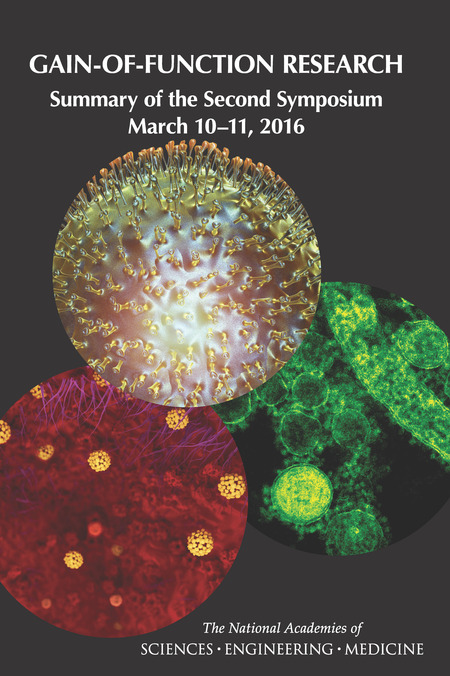 Gain-of-Function Research: Summary of the Second Symposium, March 10-11, 2016 (March 2016) Gain-of-Function Research: Summary of the Second Symposium, March 10-11, 2016 (March 2016)
Read online free Buy the book or download the free PDF View Media Coverage
On March 10-11, 2016, the National Academies of Sciences, Engineering, and Medicine held a public symposium on potential U.S. government policies for the oversight of gain-of- function (GOF) research. This was the Academies’ second meeting held at the request of the U.S. government to provide a mechanism to engage the life sciences community and the broader public and solicit feedback on optimal approaches to ensure effective federal oversight of GOF research as part of a broader U.S. government deliberative process. Committee on Science, Technology and Law (CSTL)
|
|