|
|
March 16, 2020 Washington, DC
March 16-17, 2020 Washington, DC
March 19, 2020Washington, DC
April 29-May 1, 2020 |
|
|
|
|
AIDING GLOBAL SECURITY THROUGH RESEARCH
 Improving International Resilience and Response to Chemical, Biological, Radiological, and Nuclear Events (2019) Improving International Resilience and Response to Chemical, Biological, Radiological, and Nuclear Events (2019)
 Read online free Read online free  Buy the book or Download the Free PDF Buy the book or Download the Free PDF
Chemical, biological, radiological, and nuclear (CBRN) events are rare, but can be highly destructive. In addition to potentially causing large numbers of fatalities and injuries, these events may also destabilize governments, create conditions that exacerbate violence, or promote terrorism. They may overwhelm the infrastructure and response capacity of the nations where they occur, especially those lacking specialized resources. They can also trigger global economic effects: a single CBRN event that damages facilities in one place can affect supply chains and operations worldwide. Strengthening national and international resilience and capacity to respond to CBRN events is seen as a global security priority.
 Developments in Violent Extremism in the Middle East and Beyond: Proceedings of a Workshop-in Brief (2019) Developments in Violent Extremism in the Middle East and Beyond: Proceedings of a Workshop-in Brief (2019)
Read online free Buy the book or Download the Free PDF Twenty-five scientists and analysts from the United States, Russia, France, and the United Arab Emirates (UAE) convened at a workshop at New York University Abu Dhabi (NYUAD) on April 1-3, 2019 to discuss recent developments and trends in violent extremism in a number of hot spots of the world. The U.S. National Academies of Sciences, Engineering, and Medicine (the National Academies), in collaboration with the Russian Academy of Sciences (RAS), the French National Council for Scientific Research (CNRS), and NYUAD organized the workshop. This gathering was the fourth workshop jointly sponsored by the National Academies and RAS since 2015 that has addressed the challenge of coping with violent extremism. Held in the immediate aftermath of the terrorist attack at the Al Noor Mosque in Christchurch, New Zealand, the workshop sent a strong message to the international community that individuals and groups with extremist views and access to weapons continue to be both an immediate and a long-term threat in many countries, even as ISIS and al-Qaeda are losing control over large areas of land in the Middle East. This publication summarizes the presentations and discussions from the workshop.
 The Convergence of Violent Extremism and Radiological Security The Convergence of Violent Extremism and Radiological Security
Proceedings of a Workshop–in Brief (2019)
Read online free Buy the book or Download the Free PDF Thirty scientists, engineers, analysts, and other security-oriented specialists from six countries gathered December 10-12, 2018, in Helsinki, Finland, for a workshop on the convergence of violent extremism and radiological security. Discussions focused on regional and national trends, particularly in politically unstable areas where extremists and disenfranchised groups could access radiological sources and use these sources as weapons of terrorism. This was the third workshop sponsored by the National Academies of Sciences, Engineering, and Medicine and the Russian Academy of Sciences concerning global concerns about the activities and intentions of individuals or dissident organizations that threaten security in a number of countries. The primary goal of the workshop was to contribute to U.S., Russian, and European appreciation of how, why, when, and where radiological terrorism could be a near-term outcome of the spread of violent extremism and highlight opportunities for international collaboration to prevent such terrorism. This publication summarizes the presentations and discussions from the workshop. Development, Security, and Cooperation (DSC).
 Cooperative Threat Reduction Programs for the Next Ten Years and Beyond: Proceedings of a Symposium - in Brief (2018) Cooperative Threat Reduction Programs for the Next Ten Years and Beyond: Proceedings of a Symposium - in Brief (2018)
Read online free Buy the book or Download the Free PDF
The Cooperative Threat Reduction (CTR) Program was created by the United States after the dissolution of the Soviet Union to provide financial assistance and technical expertise to secure or eliminate nuclear weapons delivery systems; warheads, chemical weapons materials, biological weapons facilities, and nuclear, biological, and chemical weapons technology and expertise from the vast Soviet military complex. On September 18-19, 2017, the NAS held a symposium to discuss the state of CTR and the future of CTR programs over the next 10 years and beyond. More than 120 participants and speakers met to share experience gained implementing CTR and to explore CTR in light of new developments in science and technology, such as the convergence of chemistry and biology, the life-sciences revolution, and the needs and interests of the scientific communities in different countries. Participants also considered how government CTR programs should change and/or be reframed for the current and evolving global security and international political environment, as well as domestic requirements for impact and accountability. This publication summarizes the presentations and discussions from the workshop. Committee on International Security and Arms Control (CISAC)
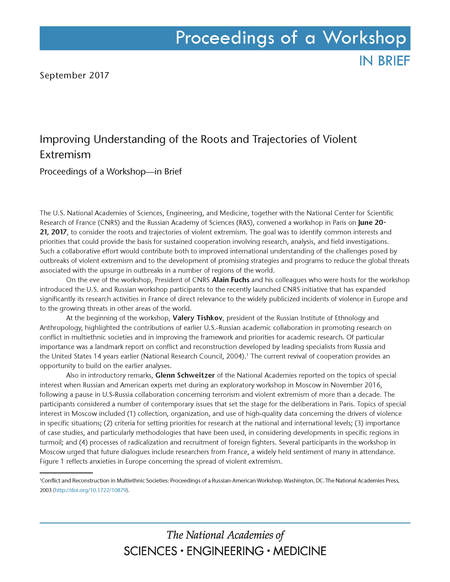 Improving Understanding of the Roots and Trajectories of Violent Extremism: Proceedings of a Workshop (2016) Improving Understanding of the Roots and Trajectories of Violent Extremism: Proceedings of a Workshop (2016)
Read online free Buy the book or Download the Free PDF The U.S. National Academies of Sciences, Engineering, and Medicine, together with the National Center for Scientific Research of France and the Russian Academy of Sciences, convened a workshop in Paris on June 20-21, 2017, to consider the roots and trajectories of violent extremism. The goal was to identify common interests and priorities that could provide the basis for sustained cooperation involving research, analysis, and field investigations. This collaborative effort contributed both to improved international understanding of the challenges posed by outbreaks of violent extremism and to the development of promising strategies and programs to reduce the global threats associated with the upsurge in outbreaks in a number of regions of the world. This publication briefly summarizes the presentations and discussions from the workshop. Development, Security, and Cooperation (DSC)
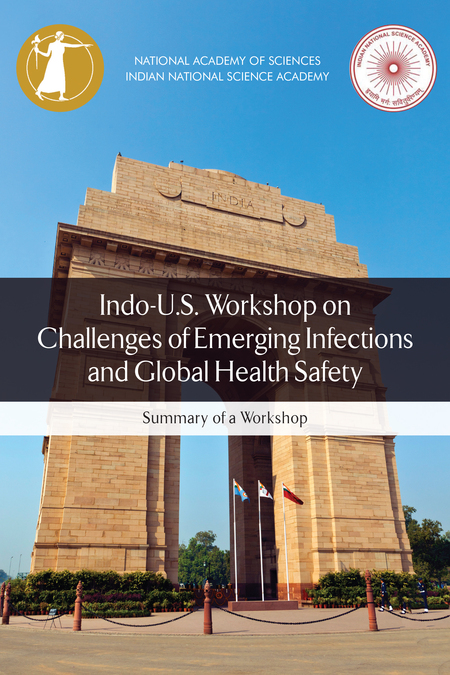 Indo-U.S. Workshop on Challenges of Emerging Infections and Global Health Safety: Indo-U.S. Workshop on Challenges of Emerging Infections and Global Health Safety:
Summary of a Workshop (2016)
Read online free Buy the book or Download the Free PDF The United States and India have pledged to deepen the linkages between their people, their businesses, and their governments for the mutual benefit of both countries and for the promotion of global peace, stability, economic growth and prosperity. Both nations are now inclined to improve relations and cooperation, but the nations need specific actions that will yield progress and build confidence and momentum for further cooperation. Committee on International Security and Arms Control (CISAC)
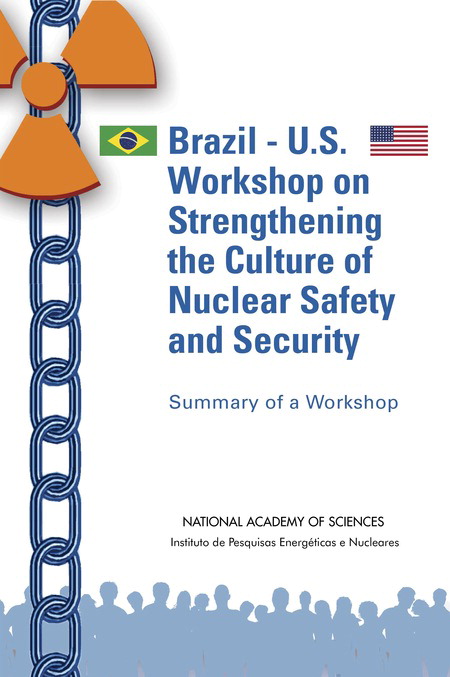 Brazil-U.S. Workshop on Strengthening the Culture of Nuclear Safety and Security: Summary of a Workshop (2015) Brazil-U.S. Workshop on Strengthening the Culture of Nuclear Safety and Security: Summary of a Workshop (2015)
Read online free Buy the book or Download the Free PDF On August 25-26, 2014, the Instituto de Pesquisas Energéticas e Nucleares (IPEN) and the National Research Council of the U.S. National Academy of Sciences convened the Brazil-U.S. Workshop on Strengthening the Culture of Nuclear Safety and Security. The workshop, held on the IPEN Campus in São Paulo, Brazil, examined how a culture of nuclear safety and security is built and maintained within the nuclear science, technology, and industrial sectors. Participants identified opportunities for cooperation to strengthen that culture and shared research, perspectives, and practices. This report summarizes the presentation and discussion of that event. Committee on International Security and Arms Control (CISAC)
 India-United States Cooperation on Science and Technology for Countering Terrorism: Summary of a Workshop (December 2014) India-United States Cooperation on Science and Technology for Countering Terrorism: Summary of a Workshop (December 2014)
Read online free Buy the book or Download the Free PDF
India and the United States are the world's two largest democracies with distinguished scientific traditions and experts in a wide range of scientific-technical fields. Given these strengths and the ability to learn from one another, the U.S. National Academy of Sciences together with the National Institute for Advanced Studies in Bangalore, India, held a joint Indian-U.S. workshop to identify and examine potential areas for substantive scientific and technical cooperation that can support counterterrorism efforts through the Homeland Security Dialogue and through direct cooperation. India-United States Cooperation on Science and Technology for Countering Terrorism is the summary of that workshop. This report examines topics such as biological threats; protection of nuclear facilities; security (physical and cyber) for chemicals, chemical facilities and other critical infrastructure; and monitoring, surveillance, and emergency response. The report also identifies and examines promising areas for further Indian-U.S. cooperation. Committee on International Security and Arms Control (CISAC)
 Strategic Engagement in Global S&T: Opportunities for Defense Research (June 2014) Strategic Engagement in Global S&T: Opportunities for Defense Research (June 2014)
Read online free Buy the book or Download the Free PDF  View media coverage View media coverage
The U.S. Department of Defense has long relied on its historical technological superiority to maintain military advantage. But as the U.S. share of global scientific and technological output shrinks, DOD needs to re-examine its strategy for maintaining awareness of S&T developments emerging around the world. This report recommends that the U.S. Department of Defense develop an implementable strategy to improve its awareness of the global S&T landscape and identify opportunities for collaboration. The report urges DOD to pursue a full spectrum of activities ranging from data analytics and reading emerging scientific literature, to holding and attending international scientific conferences, to funding collaborative research projects. (Board on Global Science and Technology)
 Complex Operational Decision Making in Networked Systems of Humans and Machines: A Multidisciplinary Approach (June 2014) Complex Operational Decision Making in Networked Systems of Humans and Machines: A Multidisciplinary Approach (June 2014)
Read online free Buy the book or Download the Free PDF
The potential for using technology to enhance the way people make complex decisions is significant now, as advances in software and memory storage make access to large amounts of data possible. Still, human beings do not have the ability to analyze the vast quantities of computer-generated data. How might humans and computers team up to turn this data into reliable and timely decisions? This report explores the possibilities for better decision making through collaboration between humans and computers. It outlines research goals and relevant milestones in several subfields that could enhance human-machine collaboration for complex decision making. (Board on Global Science and Technology)
 India-United States Cooperation on Global Security: Summary of a Workshop on Technical Aspects of Civilian Nuclear Materials Security (September 2013) India-United States Cooperation on Global Security: Summary of a Workshop on Technical Aspects of Civilian Nuclear Materials Security (September 2013)
Read online free Buy the book or Download the Free PDF
The U.S. government has made safeguarding of weapons-grade plutonium and highly enriched uranium an international policy priority, and convened The 2010 Nuclear Security Summit in Washington, D.C., on April 12 and 13, 2010. Forty six governments sent delegations to the summit and twenty nine of them made national commitments to support nuclear security. During the Summit, India announced its commitment to establish a Global Centre for Nuclear Energy Partnership. The Centre is to be open to international participation through academic0 exchanges, training, and research and development efforts.
India-United States Cooperation on Global Security is the summary of a workshop held by the U.S. National Academy of Sciences (NAS) together with its partner of more than 15 years, the National Institute for Advanced Studies (NIAS) in Bangalore, India. The workshop identified and examined potential areas for substantive scientific and technical cooperation between the two countries on issues related to nuclear material security. Technical experts from India and the United States focused on topics of nuclear material security and promising opportunities for India and the United States to learn from each other and cooperate. This report discusses nuclear materials management issues such as nuclear materials accounting, cyber security, physical security, and nuclear forensics. Committee on International Security and Arms Control (CISAC)
 The New Global Ecosystem in Advanced Computing: Implications for U.S. Competitiveness and National Security The New Global Ecosystem in Advanced Computing: Implications for U.S. Competitiveness and National Security
(October 2012)
Read online free Buy the book or Download the Free PDF
Computing and information and communications technology (ICT) gas dramatically changed how we work and live, has had profound effects on nearly every sector of society, has transformed whole industries, and is a key component of U.S. global leadership. A fundamental driver of advances in computing and ICT has been the fact that the single-processor performance has, until recently, been steadily and dramatically increasing year over years, based on a combination of architectural techniques, semiconductor advances, and software improvements. Users, developers, and innovators were able to depend on those increases, translating that performance into numerous technological innovations and creating successive generations of ever more rich and diverse products, software services, and applications that had profound effects across all sectors of society.
However, we can no longer depend on those extraordinary advances in single-processor performance continuing. This slowdown in the growth of single-processor computing performance has its roots in fundamental physics and engineering constraints--multiple technological barriers have converged to pose deep research challenges, and the consequences of this shift are deep and profound for computing and for the sectors of the economy that depend on and assume, implicitly or explicitly, ever-increasing performance. From a technology standpoint, these challenges have led to heterogeneous multicore chips and a shift to alternate innovation axes that include, but are not limited to, improving chip performance, mobile devices, and cloud services. As these technical shifts reshape the computing industry, with global consequences, the United States must be prepared to exploit new opportunities and to deal with technical challenges. The New Global Ecosystem in Advanced Computing: Implications for U.S. Competitiveness and National Security outlines the technical challenges, describe the global research landscape, and explore implications for competition and national security. (Board on Global Science and Technology)
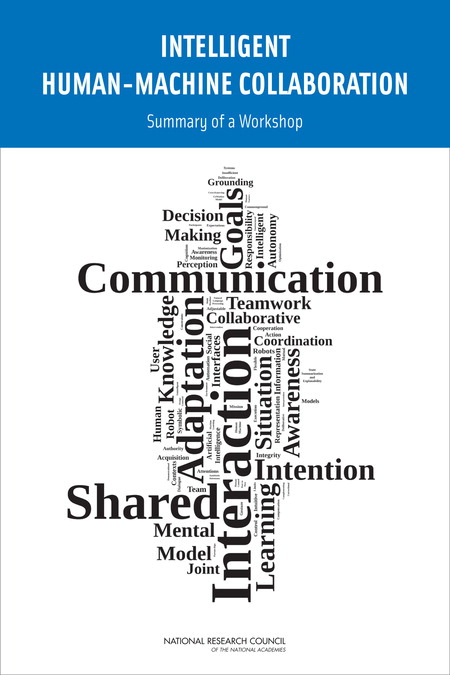 Intelligent Human-Machine Collaboration: Summary of a Workshop (August 2012) Intelligent Human-Machine Collaboration: Summary of a Workshop (August 2012)
Read online free Buy the book or Download the Free PDF
On June 12-14, 2012, the Board on Global Science and Technology held an international, multidisciplinary workshop in Washington, D.C., to explore the challenges and advances in intelligent human-machine collaboration (IH-MC), particularly as it applies to unstructured environments. This workshop convened researchers from a range of science and engineering disciplines, including robotics, human-robot and human-machine interaction, software agents and multi-agentsystems, cognitive sciences, and human-machine teamwork. Participants were drawn from research organizations in Australia, China, Germany, Israel, Italy, Japan, the Netherlands, the United Arab Emirates, the United Kingdom, and the United States.
The first day of the workshop participants worked to determine how advances in IH-MC over the next two to three years could be applied solving a variety of different real-world scenarios in dynamic unstructured environments, ranging from managing a natural disaster to improving small-lot agile manufacturing. On the second day of the workshop, participants organized into small groups for a deeper exploration of research topics that had arisen, discussion of common challenges, hoped-for breakthroughs, and the national, transnational, and global context in which this research occurs. Day three of the workshop consisted of small groups focusing on longer term research deliverables, as well as identifying challenges and opportunities from different disciplinary and cultural perspectives. In addition, ten participants gave presentations on their research, ranging from human-robot communication, to disaster response robots, to human-in-the-loop control of robot systems. Intelligent Human-Machine Collaboration: Summary of a Workshop describes in detail the discussions and happenings of the three day workshop. (Board on Global Science and Technology)
 Export Control Challenges Associated with Homeland Security ( March 2012) Export Control Challenges Associated with Homeland Security ( March 2012)
Read online free Buy the book or Download the Free PDF
The "homeland" security mission of the Department of Homeland Security (DHS) is paradoxical: Its mission space is uniquely focused on the domestic consequences of security threats, but these threats may be international in origin, organization, and implementation. The DHS is responsible for the domestic security implications of threats to the United States posed, in part, through the global networks of which the United States is a part. While the security of the U.S. air transportation network could be increased if it were isolated from connections to the larger international network, doing so would be a highly destructive step for the entire fabric of global commerce and the free movement of people.
Instead, the U.S. government, led by DHS, is taking a leadership role in the process of protecting the global networks in which the United States participates. These numerous networks are both real (e.g., civil air transport, international ocean shipping, postal services, international air freight) and virtual (the Internet, international financial payments system), and they have become vital elements of the U.S. economy and civil society.
Export Control Challenges Associated with Securing the Homeland found that outdated regulations are not uniquely responsible for the problems that export controls post to DHS, although they are certainly an integral part of the picture. This report also explains that the source of these problems lies within a policy process that has yet to take into account the unique mission of DHS relative to export controls. Export Control Challenges Associated with Securing the Homeland explains the need by the Department of Defense and State to recognize the international nature of DHS's vital statutory mission, the need to further develop internal processes at DHS to meet export control requirements and implement export control policies, as well as the need to reform the export control interagency process in ways that enable DHS to work through the U.S. export control process to cooperate with its foreign counterparts. Committee on International Security and Arms Control (CISAC)
 The Comprehensive Nuclear Test Ban Treaty: Technical Issues for the United States ( March 2012) The Comprehensive Nuclear Test Ban Treaty: Technical Issues for the United States ( March 2012)
Read online free Buy the book or Download the Free PDF View media coverage  View report highlights (PDF) View report highlights (PDF)
This report reviews and updates the 2002 National Research Council report, Technical Issues Related to the Comprehensive Nuclear Test Ban Treaty (CTBT). This report also assesses various topics, including:
- the plans to maintain the safety and reliability of the U.S. nuclear stockpile without nuclear-explosion testing;
- the U.S. capability to detect, locate, and identify nuclear explosions;
- commitments necessary to sustain the stockpile and the U.S. and international monitoring systems;
- and potential technical advances countries could achieve through evasive testing and unconstrained testing.
Sustaining these technical capabilities will require action by the National Nuclear Security Administration, with the support of others, on a strong scientific and engineering base maintained through a continuing dynamic of experiments linked with analysis, a vigorous surveillance program, adequate ratio of performance margins to uncertainties. This report also emphasizes the use of modernized production facilities and a competent and capable workforce with a broad base of nuclear security expertise. Committee on International Security and Arms Control (CISAC)
 Biosecurity Challenges of the Global Expansion of High Containment Biological Laboratories Biosecurity Challenges of the Global Expansion of High Containment Biological Laboratories
( March 2012)
Read online free Buy the book or Download the Free PDF
During July 10-13, 2011, 68 participants from 32 countries gathered in Istanbul, Turkey for a workshop organized by the United States National Research Council on Anticipating Biosecurity Challenges of the Global Expansion of High containment Biological Laboratories. The United States Department of State's Biosecurity Engagement Program sponsored the workshop, which was held in partnership with the Turkish Academy of Sciences. The international workshop examined biosafety and biosecurity issues related to the design, construction, maintenance, and operation of high-containment biological laboratories- equivalent to United States Centers for Disease Control and Prevention biological safety level 3 or 4 labs. Although these laboratories are needed to characterize highly dangerous human and animal pathogens, assist in disease surveillance, and produce vaccines, they are complex systems with inherent risks.
Biosecurity Challenges of the Global Expansion of High-Containment Biological Laboratories summarizes the workshop discussion, which included the following topics:
Technological options to meet diagnostic, research, and other goals; - Laboratory construction and commissioning;
- Operational maintenance to provide sustainable capabilities, safety, and security; and
- Measures for encouraging a culture of responsible conduct.
The Cooperative Threat Reduction (CTR) Program was created in 1991 as a set of support activities assisting the Former Soviet Union states in securing and eliminating strategic nuclear weapons and the materials used to create them. The Program evolved as needs and opportunities changed: Efforts to address biological and chemical threats were added, as was a program aimed at preventing cross-border smuggling of weapons of mass destruction. CTR has traveled through uncharted territory since its inception, and both the United States and its partners have taken bold steps resulting in progress unimagined in initial years. Over the years, much of the debate about CTR on Capitol Hill has concerned the effective use of funds, when the partners would take full responsibility for the efforts, and how progress, impact, and effectiveness should be measured.
Directed by Congress, the Secretary of Defense completed a report describing DoD's metrics for the CTR Program (here called the DoD Metrics Report) in September 2010 and, as required in the same law, contracted with the National Academy of Sciences to review the metrics DoD developed and identify possible additional or alternative metrics, if necessary. Improving Metrics for the DoD Cooperative Threat Reduction Program provides that review and advice.
Improving Metrics for the DoD Cooperative Threat Reduction Program identifies shortcomings in the DoD Metrics Report and provides recommendations to enhance DoD's development and use of metrics for the CTR Program. The committee wrote this report with two main audiences in mind: Those who are mostly concerned with the overall assessment and advice, and those readers directly involved in the CTR Program, who need the details of the DoD report assessment and of how to implement the approach that the committee recommends. Committee on International Security and Arms Control (CISAC)
This letter report describes the 2009-2011 activities of the Board on Global Science and Technology (BGST) and provides an initial characterization of the global S&T landscape that the Board can use as a roadmap to develop future activities. BGST met five times between November 2009 and May 2011. Board meetings were devoted to (1) identifying national security implications of the globalization of S&T, (2) building a baseline understanding of current indicators for the U.S. posture with regard to the evolving global S&T landscape, and (3) developing a BGST engagement strategy. The letter portion of the report summarizes activities of the board in its first year, and also describes some existing approaches to identifying and/or benchmarking emerging technologies globally. It is followed by 5 appendixes which include three experimental examples of a qualitative approach to benchmarking, and brief descriptions of programs that are part of the National Academies complex, with which BGST has cooperated.
 Review of the Scientific Approaches Used During the FBI's Investigation of the Anthrax Letters Review of the Scientific Approaches Used During the FBI's Investigation of the Anthrax Letters (May 2011)
Read online free Buy the book of Download the Free PDF
Less than a month after the September 11, 2001 attacks, letters containing spores of anthrax bacteria (Bacillus anthracis, or B. anthracis) were sent through the U.S. mail. Between October 4 and November 20, 2001, 22 individuals developed anthrax; 5 of the cases were fatal.
During its investigation of the anthrax mailings, the FBI worked with other federal agencies to coordinate and conduct scientific analyses of the anthrax letter spore powders, environmental samples, clinical samples, and samples collected from laboratories that might have been the source of the letter-associated spores. The agency relied on external experts, including some who had previously developed tests to differentiate among strains of B. anthracis. In 2008, seven years into the investigation, the FBI asked the National Research Council (NRC) of the National Academy of Sciences (NAS) to conduct an independent review of the scientific approaches used during the investigation of the 2001 B. anthracis mailings. Committee on Science, Technology and Law (CSTL)
In a world of increasing dependence on information technology, the prevention of cyberattacks on a nation's important computer and communications systems and networks is a problem that looms large. Given the demonstrated limitations of passive cybersecurity defense measures, it is natural to consider the possibility that deterrence might play a useful role in preventing cyberattacks against the United States and its vital interests. At the request of the Office of the Director of National Intelligence, the National Research Council undertook a two-phase project aimed to foster a broad, multidisciplinary examination of strategies for deterring cyberattacks on the United States and of the possible utility of these strategies for the U.S. government. Although the authors were selected and the papers reviewed and discussed by the committee, the individually authored papers do not reflect consensus views of the committee, and the reader should view these papers as offering points of departure that can stimulate further work on the topics discussed. The papers presented in this volume are published essentially as received from the authors, with some proofreading corrections made as limited time allowed.
 Letter Report for the Committee on Deterring Cyberattacks: Informing Strategies and Developing Options for U.S. Policy (March 2010) Letter Report for the Committee on Deterring Cyberattacks: Informing Strategies and Developing Options for U.S. Policy (March 2010)
Read online free Buy the book or Download the Free PDF This report is the first phase of a larger project to conduct a broad, multidisciplinary examination of deterrence strategies and their possible utility to the U.S. government in its policies toward preventing cyberattacks. This first phase identifies the key issues and questions that merit examination. The next phase will engage experts to prepare papers that address key issues and questions, including those posed here. The report provides basic information needed to understand the nature of the problem and to articulate important questions that can drive research regarding ways of more effectively preventing, discouraging, and inhibiting hostile activity against important U.S. information systems and networks.
 Nuclear Forensics: A Capability at Risk (Abbreviated Version) (August 2010) Nuclear Forensics: A Capability at Risk (Abbreviated Version) (August 2010)
Read online free Buy the book or Download the Free PDF Nuclear forensics is the examination and evaluation of discovered or seized nuclear materials and devices or, in cases of nuclear explosions or radiological dispersals, of detonation signals and post-detonation debris. Nuclear forensic evidence helps law enforcement and intelligence agencies work toward preventing, mitigating, and attributing a nuclear or radiological incident. Nuclear forensics is important to our national security. This report, requested by DHS, the National Nuclear Security Administration, and the Department of Defense, makes recommendations on how to sustain and improve U.S. nuclear forensics capabilities. Without strong leadership, careful planning, and additional funds, these capabilities will decline. The Department of Homeland Security (DHS), working with cooperating agencies and national laboratories, should plan and implement a sustainable, effective nuclear forensics program. Committee on International Security and Arms Control (CISAC)
 Global Security Engagement: A New Model for Cooperative Threat Reduction (July 2009) Global Security Engagement: A New Model for Cooperative Threat Reduction (July 2009)
Read online free Download the report brief (PDF) Download the Russian version (PDF) Buy the book or Download the Free PDF
Over three dozen world leaders joined President Obama in Washington, D.C., in April 2010 in a Nuclear Security Summit, to discuss how to secure vulnerable nuclear materials stored at sites around the world and keep terrorists from acquiring them. Many suggestions echoed recommendations in a suite of recent PGA reports on how to better secure nuclear materials and discourage proliferation. The most recent report is Global Security Engagement, which recommends upgrading the Nunn-Lugar Cooperative Threat Reduction Program and expanding it beyond Russia to new regions and countries. Committee on International Security and Arms Control (CISAC)
 Countering Biological Threats: Challenges for the Department of Defense's Nonproliferation Program Beyond the Former Soviet Union (July 2009) Countering Biological Threats: Challenges for the Department of Defense's Nonproliferation Program Beyond the Former Soviet Union (July 2009)
Read online free Download the report brief (PDF) Buy the book or Download the Free PDF
In response to a request from the U.S. Congress, this book examines how the unique experience and extensive capabilities of the Department of Defense (DOD) can be extended to reduce the threat of bioterrorism within developing countries outside the former Soviet Union (FSU). During the past 12 years, DOD has invested $800 million in reducing the risk from bioterrorism with roots in the states of the FSU. The program's accomplishments are many fold. The risk of bioterrorism in other countries is too great for DOD not to be among the leaders in addressing threats beyond the FSU. Taking into account possible sensitivities about a U.S. military presence, DOD should engage interested governments in about ten developing countries outside the FSU in biological threat reduction programs during the next five years. Whenever possible, DOD should partner with other organizations that have well established humanitarian reputations in the countries of interest. For example, the U.S. Agency for International Development, the Centers for Disease Control and Prevention, and the World Health Organization should be considered as potential partners. Development, Security, and Cooperation (DSC)
 A Survey of Attitudes and Actions on Dual Use Research in the Life Sciences: A Collaborative Effort of the National Research Council and the American Association for the Advancement of Science (July 2009) A Survey of Attitudes and Actions on Dual Use Research in the Life Sciences: A Collaborative Effort of the National Research Council and the American Association for the Advancement of Science (July 2009)
Read online free Download the report brief (PDF) Buy the book or Download the Free PDF
Over the last 50 years, rapidly expanding knowledge in the biological sciences has raised concerns over so-called "dual-use research," in which the same technologies that fuel scientific advances could also be misused to create biological weapons or for bioterrorism. Determining how to constrain these risks without slowing scientific progress is critical. The NRC conducted a survey with the American Association for the Advancement of Science to better understand life scientists’ attitudes about policies to address dual-use risks. The results suggest that there may be considerable support for approaches to oversight that rely on self-governance by the scientific community and that there is a need to clarify research activities of concern and provide guidance about what actions scientists can take to reduce risks. Development, Security, and Cooperation (DSC)
 Russian Views on Countering Terrorism During Eight Years of Dialogue: Extracts from Proceedings of Four Workshops (June 2009) Russian Views on Countering Terrorism During Eight Years of Dialogue: Extracts from Proceedings of Four Workshops (June 2009)
Read online free Buy the book or Download the Free PDF
Few countries have endured as many attacks of terrorism during the past two decades as has Russia. From bombings on the streets of a number of cities, to the disruption of pipelines in Dagestan, to the taking of hundreds of hostages at a cultural center in Moscow and at a school in Beslan, the Russian government has responded to many political and technical challenges to protect the population. The measures that have been undertaken to reduce vulnerabilities to terrorist attacks and to mitigate the consequences of attacks have been of widespread interest in many other countries as well. In June 1999, the Presidents of the National Academy of Sciences and the Russian Academy of Sciences initiated an inter-academy program to jointly address common interests in the field of counter-terrorism. Four workshops were held from 2001 to 2007 and additional consultations were undertaken prior to and after the series of workshops. This report includes 35 of the Russian presentations during the workshop series. Collectively they provide a broad overview of activities that have been supported by Russian institutions. Development, Security, and Cooperation (DSC)
 The 2nd International Forum on Biosecurity: Summary of an International Meeting, Budapest, Hungary, March 30 to April 2, 2008 (May 2009) The 2nd International Forum on Biosecurity: Summary of an International Meeting, Budapest, Hungary, March 30 to April 2, 2008 (May 2009)
Read online free Download the report brief (PDF) Buy the book or Download the Free PDF
The 2nd International Forum on Biosecurity, held in Budapest, Hungary on March 30 - April 2, 2008, represents the efforts of a number of individuals and organizations, over the last five years, to engage the international community of life scientists in addressing how to reduce the risk that the results of their work could be used for hostile purposes by terrorists and states. The participants who gathered in Budapest were already engaged in this challenging task, and, therefore, the focus of the meeting was on what had been accomplished and what challenges remained. There was no attempt to achieve consensus, since there exist real and important differences among those involved concerning the appropriate policies and actions to be undertaken. But there was a serious effort to identify a range of potential next steps, and also an effort to identify opportunities where international scientific organizations could make substantive contributions and offer their advice and expertise to policy discussions. The Forum's presentations, discussions, and results are summarized in this book. Board on International Scientific Organizations (BISO)
 Beyond 'Fortress America': National Security Controls on Science and Technology in a Globalized World (April 2009) Beyond 'Fortress America': National Security Controls on Science and Technology in a Globalized World (April 2009)
Read online free Download the report brief (PDF) Buy the book or Download the Free PDF
The national security controls that regulate access to and export of science and technology are broken. As currently structured, many of these controls undermine our national and homeland security and stifle American engagement in the global economy, and in science and technology. These unintended consequences arise from policies that were crafted for an earlier era. In the name of maintaining superiority, the U.S. now runs the risk of becoming less secure, less competitive and less prosperous. This report provides an account of the costs associated with building walls that hamper our access to global science and technology, dampening our economic potential. It recommends ways to reform the export control process, ensure scientific and technological competitiveness, and improve the non-immigrant visa system that regulates entry into the United States of foreign science and engineering students, scholars, and professionals. Development, Security, and Cooperation (DSC)
 Countering Terrorism: Biological Agents, Transportation Networks, and Energy Systems. Summary of a U.S.-Russian Workshop (March 2009) Countering Terrorism: Biological Agents, Transportation Networks, and Energy Systems. Summary of a U.S.-Russian Workshop (March 2009)
Read online free Buy the book or Download the Free PDF
This book presents the proceedings of the fourth U.S.-Russian interacademy workshop on the general theme of countering terrorism, which was held in Moscow in March 2007. The fourth in a series, this volume continues to explore topics related to urban terrorism, but with a new emphasis on potential attacks involving biological agents, transportation networks, and energy systems. Development, Security, and Cooperation (DSC)
Cleaning Up Sites Contaminated with Radioactive Materials: International Workshop Proceedings (January 2009)
Read online free Buy the book or Download the Free PDF
This publication features papers presented at the Workshop on Cleaning Up Sites Contaminated with Radioactive Materials, held in Moscow in June 2007. This activity was organized by the National Academies in cooperation with the Russian Academy of Sciences and with funding provided by the Russell Family Foundation. The workshop was designed to promote exchanges of information on specific contaminated sites in Russia and elsewhere and to stimulate greater attention to the severity of the problems and the urgent need to clean up sites of concern to the local and international communities. Development, Security, and Cooperation (DSC)
 Future of the Nuclear Security Environment in 2015: Proceedings (January 2009) Future of the Nuclear Security Environment in 2015: Proceedings (January 2009)
Read online free Download the report brief (PDF) Buy the book or Download the Free PDF
The U.S. National Academies (NAS) and the Russian Academy of Sciences (RAS), building on a foundation of years of interacademy cooperation, conducted a joint project to identify U.S. and Russian views on what the international nuclear security environment will be in 2015, what challenges may arise from that environment, and what options the U.S. and Russia have in partnering to address those challenges. The project's discussions were developed and expanded upon during a two-day public workshop held at the International Atomic Energy Agency in November 2007. A key aspect of that partnership may be cooperation in third countries where both the U.S. and Russia can draw on their experiences over the last decade of non-proliferation cooperation. More broadly, the following issues analyzed over the course of this RAS-NAS project included: safety and security culture, materials protection, control and accounting (MPC&A) best practices, sustainability, nuclear forensics, public-private partnerships, and the expansion of nuclear energy. Committee on International Security and Arms Control (CISAC)
 Internationalization of the Nuclear Fuel Cycle: Goals, Strategies, and Challenges (January 2009) Internationalization of the Nuclear Fuel Cycle: Goals, Strategies, and Challenges (January 2009)
Read online free Buy the book or Download the Free PDF
A joint committee of the U.S. and the Russian Academies of Sciences urges both countries, along with other countries and the International Atomic Energy Agency (IAEA), to redouble efforts to ensure a reliable supply of nuclear fuel, so that countries seeking nuclear energy have less incentive to build their own facilities to enrich uranium and reprocess spent nuclear fuel. This report, which also makes findings and recommendations concerning international fuel cycle centers and advanced fuel cycle technologies, draws on discussions from a 2007 workshop the committee convened at the IAEA involving 10 countries that might participate in a system to assure reliable supplies of fuel. Presented at a special forum in conjunction with the 2008 IAEA General Conference, the report was received with interest by representatives from several countries, including Romania and Iran, NGOs, academic institutions, and the IAEA secretariat. Committee on International Security and Arms Control (CISAC)
 English-Chinese, Chinese-English Nuclear Security Glossary (2008) English-Chinese, Chinese-English Nuclear Security Glossary (2008)
Read online free Download the report brief (PDF)  View the online version Buy the book or Download the Free PDF View the online version Buy the book or Download the Free PDF
With substantial and growing international efforts in nonproliferation of nuclear weapons, counter-proliferation and the prevention of nuclear terrorism, and with the expansion of the use of nuclear power and the role of international inspections, it is important that participants whose respective native languages are Chinese and English agree on the meanings given to relevant terms in the two languages. This glossary of approximately 1000 terms is intended to reduce the likelihood of misunderstanding, and to remove barriers to progress in exchanges and diplomatic, cooperative, or other activities where unambiguous understanding is essential. Committee on International Security and Arms Control (CISAC)
 Setting the Stage for International Spent Nuclear Fuel Storage Facilities: International Workshop Proceedings (2008) Setting the Stage for International Spent Nuclear Fuel Storage Facilities: International Workshop Proceedings (2008)
Read online free Buy the book or Download the Free PDF
This publication is a collection of papers presented at the Workshop on Setting the Stage for International Spent Nuclear Fuel Storage Facilities, held Vienna in June 2005, as well as a second session held in Washington, D.C., in October 2005. This activity was organized by the National Academies in cooperation with the Russian Academy of Sciences and with funding provided by the Russell Family Foundation. Papers included in these proceedings cover international monitoring at a proposed Russian spent fuel storage facility, transportation requirements, liability and insurance concerns, and the status of Russian legislation important in locating and operating such a facility. Development, Security, and Cooperation (DSC)
Science and Security in a Post 9/11 World: A Report Based on Regional Discussions Between the Science and Security Communities (2007)
Read online free  Listen to the podcast Download the report brief (PDF) Buy the book or Download the Free PDF Listen to the podcast Download the report brief (PDF) Buy the book or Download the Free PDF
Based on a series of regional meetings on university campuses with officials from the national security community and academic research institutions, this report identifies specific actions that should be taken to maintain a thriving scientific research environment in an era of heightened security concerns. Actions include maintaining the open exchange of scientific information, fostering a productive environment for international scholars in the U.S., reexamining federal definitions of sensitive but unclassified research, and reviewing policies on deemed export controls. The federal government should establish a standing entity, preferably a Science and Security Commission, that would review policies regarding the exchange of information and the participation of foreign-born scientists and students in research. Committee on Science, Technology, and Law (CSTL)
 Science and Technology to Counter Terrorism: Proceedings of an Indo-U.S. Workshop (2007) Science and Technology to Counter Terrorism: Proceedings of an Indo-U.S. Workshop (2007)
Read online free Download the report brief (PDF) Buy the book or Download the Free PDF
This volume presents the papers and summarizes the discussions of a workshop held in Goa, India, in January 2004, organized by the Indian National Institute of Advanced Science (NIAS) and the U.S. Committee on International Security and Arms Control (CISAC). During the workshop, Indian and U.S. experts examined the terrorist threat faced in both countries and elsewhere in the world, and explored opportunities for the U.S. and India to work together. Bringing together scientists and experts with common scientific and technical backgrounds from different cultures provided a unique opportunity to explore possible means of preventing or mitigating future terrorist attacks. Committee on International Security and Arms Control (CISAC)
 The Biological Threat Reduction Program of the Department of Defense: From Foreign Assistance to Sustainable Partnerships (2007) The Biological Threat Reduction Program of the Department of Defense: From Foreign Assistance to Sustainable Partnerships (2007)
Read online free Download the report brief (PDF) Buy the book or Download the Free PDF
This Congressionally-mandated report identifies areas for further cooperation with Russia and other states of the former Soviet Union under the Cooperative Threat Reduction (CTR) program of the Department of Defense in the specific area of prevention of proliferation of biological weapons. The report reviews relevant U.S. government programs, and particularly the CTR program, and identifies approaches for overcoming obstacles to cooperation and for increasing the long-term impact of the program. It recommends strong support for continuation of the CTR program. Development, Security, and Cooperation (DSC)
 U.S.-Russian Collaboration in Combating Radiological Terrorism (2007) U.S.-Russian Collaboration in Combating Radiological Terrorism (2007)
Read online free Download the report brief (PDF) Buy the book or Download the Free PDF
The International Atomic Energy Agency reports numerous incidents of illicit trafficking in radioactive materials, including ionizing radiation sources (IRSs) used in medical, agricultural, and industrial applications. This report assesses the threats posed by inadequately protected IRSs in Russia and recommends steps to enhance the effectiveness of DOE’s current cooperative program with Russia. These continuing DOE’s current program of quick security fixes and developing a comprehensive plan to work with Russian counterparts to reduce overall risk, within the context of a comprehensive Russian program for ensuring adequate life-cycle management of IRSs. Development, Security, and Cooperation (DSC)
 Countering Urban Terrorism in Russia and the United States: Proceedings of a Workshop (2006) Countering Urban Terrorism in Russia and the United States: Proceedings of a Workshop (2006)
Read free online Download the report brief (PDF) Buy the book or Download the Free PDF In January-February 2005, the National Academies Committee on Counterterrorism Challenges for Russia and the United States and the Russian Academy of Sciences Standing Committee on Counterterrorism held a workshop on urban terrorism in Washington, D.C. Prior to the workshop, three working groups convened to focus on the topics of energy systems vulnerabilities, transportation systems vulnerabilities, and cyberterrorism issues. The working groups met with local experts and first responders, prepared reports, and presented their findings at the workshop. Other workshop papers focused on various organizations’ integrated response to acts of urban terrorism, recent acts of terrorism, radiological terrorism, biological terrorism, cyberterrorism, and the roots of terrorism. Development, Security, and Cooperation (DSC)
Related: Terrorism: Reducing Vulnerabilities and Improving Responses: U.S - Russian Workshop Proceedings (2004), High-Impact Terrorism: Proceedings of a Russian-American Workshop (2002)
 The risks posed by bioterrorism and the proliferation of biological weapons capabilities have increased concern about how the rapid advances in genetic engineering and biotechnology could enable the production of biological weapons with unique and unpredictable characteristics. This report examines current trends and future objectives of research in public health, life sciences, and biomedical science that contain applications relevant to developments in biological weapons 5 to 10 years into the future and ways to anticipate, identify and mitigate these dangers. Development, Security, and Cooperation (DSC)
 Letter Report on the Threat Agent Detection Response System Database (2006) Letter Report on the Threat Agent Detection Response System Database (2006) Read online free Buy the book or Download the Free PDF
In the aim of combating the threat of bioterrorism and preventing the proliferation of biological weapons technology, pathogens, and expertise, the U.S. Defense Threat Reduction Agency is implementing the Threat Agent Detection Response (TADR) Project in selected countries of the former Soviet Union. One aspect of TADR focuses on creating a network of infectious disease surveillance facilities to detect and respond to outbreaks in the host countries. This letter report by the Committee to Review Research Proposals from Former Soviet Biological Weapons Institutes addresses the question of which U.S. government organization should house the data repository for information collected under TADR. Also considered is the question of whether and how the U.S. government should provide this information to relevant international health organizations. Development, Security, and Cooperation (DSC)
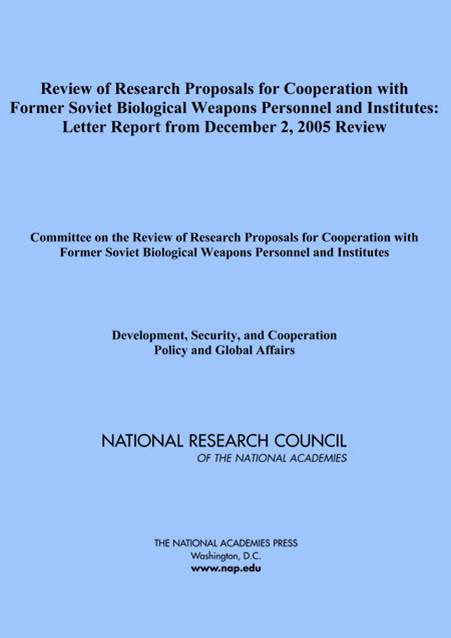 Review of Research Proposals for Cooperation with Former Soviet Biological Weapons Personnel and Institutes: Letter Report from December 2, 2005 Review (2006) Review of Research Proposals for Cooperation with Former Soviet Biological Weapons Personnel and Institutes: Letter Report from December 2, 2005 Review (2006)
Read online free Buy the book or Download the Free PDF
An ongoing committee of the National Research Council assists the Department of Defense in the development and implementation of a program of expanded scientific cooperation and exchange in peaceful applications of the biological sciences between American research scientists and Russian research scientists who had participated in the biological weapons program of the former Soviet Union. The committee reviews project proposals submitted to DOD by research scientists from Russia, suggests potential collaborators from the United States, and evaluates results of collaborative projects. This letter report provides the committee’s assessment of the proposals considered at its December 2, 2005, meeting. Development, Security, and Cooperation (DSC)
 An International Perspective on Advancing Technologies and Strategies for Managing Dual-Use Risks: Report of a Workshop (2005) An International Perspective on Advancing Technologies and Strategies for Managing Dual-Use Risks: Report of a Workshop (2005)As part of a study of current and future research in the life sciences that contains applications relevant to development of agents of biological origin 5 to 10 years into the future, an NRC/IOM committee held an international workshop in 2004 to examine advancing technologies from a global point of view. Experts from different fields and from around the world presented their diverse outlooks on these technologies and forces that drive technological progress; local and regional capacities for life sciences research, development, and application (both beneficial and nefarious); national perceptions of the dual-use risk of advancing technologies; and strategic measures that have been taken or could be taken to manage the use of technology for malevolent purposes. This report summarizes the formal and informal discussions held at the workshop. Development, Security, and Cooperation (DSC)  An International Spent Nuclear Fuel Storage Facility -- Exploring a Russian Site as a Prototype: Proceedings of an International Workshop (2006) An International Spent Nuclear Fuel Storage Facility -- Exploring a Russian Site as a Prototype: Proceedings of an International Workshop (2006)
Read online free Buy the book or Download the Free PDF
As part of a long-standing collaboration on nuclear nonproliferation, the National Academy of Sciences and the Russian Academy of Sciences held a joint workshop in Moscow in 2003 on the scientific aspects of an international radioactive disposal site in Russia. The passage of Russian laws permitting the importation and storage of high-level radioactive material (primarily spent nuclear fuel from reactors) has engendered interest from a number of foreign governments, including the U.S., in exploring the possibility of transferring material to Russia on a temporary or permanent basis. The workshop focused on the environmental aspects of the general location and characteristics of a possible storage site, transportation to and within the site, containers for transportation and storage, inventory and accountability, audits and inspections, and handling technologies. Development, Security, and Cooperation (DSC)
 Biological Science and Biotechnology in Russia: Controlling Diseases and Enhancing Security (2005) Biological Science and Biotechnology in Russia: Controlling Diseases and Enhancing Security (2005)
Read online free Download the report brief (PDF) Buy the book or Download the Free PDF
In July 2005, the National Academies released the report Biological Science and Biotechnology in Russia: Controlling Diseases and Enhancing Security. The report offered a number of recommendations that could help restore Russia’s ability to join with the United States and the broader international community in leading an expanded global effort to control infectious diseases. A proposed bilateral intergovernmental commission could play a pivotal role toward that end as cooperation moves from assistance to partnership. The report proposed the establishment of two model State Sanitary Epidemiological Surveillance Centers in Russia, more focused support of competitively selected Russian research groups as centers of excellence, the promotion of investments in biotechnology niches that are well suited for Russian companies, and expanded opportunities for young scientists to achieve scientific leadership positions in Russia. Also, the report highlighted the importance of U.S. programs that support the integration of former Soviet defense scientists with civilian researchers who had not been involved in military-related activities. Development, Security, and Cooperation (DSC)
 Frameworks for Higher Education in Homeland Security (2005) Frameworks for Higher Education in Homeland Security (2005)
Read online free Buy the book or Download the Free PDF Download the report brief (PDF)
This report explores whether there are core pedagogical and skill-based homeland security program needs; examines current and proposed education programs focusing on various aspects of homeland security; comments on the possible parallels between homeland security, area studies, international relations, and science policy, as developed or emerging academic thrusts; and suggests potential curricula needs, particularly those that involve interdisciplinary aspects. The report concentrates almost exclusively on coursework-related offerings, primarily at the undergraduate and graduate levels. Government-University-Industry Research Roundtable (GUIRR)
 Monitoring Nuclear Weapons and Nuclear-Explosive Materials: An Assessment of Methods and Capabilities (2005) Monitoring Nuclear Weapons and Nuclear-Explosive Materials: An Assessment of Methods and Capabilities (2005)
 Partnering Against Terrorism: Summary of a Workshop (2005) Partnering Against Terrorism: Summary of a Workshop (2005)
Read online free Buy the book or Download the Free PDF
Terrorism and the measures needed to prevent terrorist attacks pose a central policy challenge for the U.S. To meet this unprecedented challenge, the U.S. has great technological assets. What is needed are mechanisms to help the government draw on these strengths in a timely and effective fashion. To do so, the government needs to reach out to university researchers, national laboratories, small, high-tech businesses and leading corporations. One of the most effective ways to do this is through public-private partnerships. To link the lessons of the National Academies study on “Government-Industry Partnerships” to this critical national interest, the Academy organized a conference to bring the lessons of its analysis to bear on the war on terror. By encouraging policy attention to examples of effective public-private partnerships (in particular, the need for clear goals and regular assessments), this report contributes to a better understanding of the potential partnerships to bring new security-enhancing technologies and equipment to the market in a cost-effective and timely manner. Board on Science, Technology and Economic Policy (STEP)
 Protection, Control, and Accounting of Nuclear Materials: International Challenges and National Programs -- Workshop Summary (2005) Protection, Control, and Accounting of Nuclear Materials: International Challenges and National Programs -- Workshop Summary (2005)
Read online free Buy the book or Download the Free PDF
The U.S. and Russian academies convened a workshop in 2003 for sharing best practices in nuclear materials protection, control, and accounting (MPC&A), including the status and application of remote monitoring technologies, personnel issues, and both national and international safeguards worldwide. The goals of the workshop were to identify areas in which the United States and Russia can promote best practices in MPC&A globally and expand U.S.-Russian cooperation on nuclear non-proliferation. The papers presented in the workshop and the outcomes of workshop discussions form the basis for this workshop summary. Development, Security, and Cooperation (DSC)
Review of Research Proposals for Cooperation with Former Soviet Biological Weapons Personnel and Institutes: Letter Report from 2000-2004 Reviews (2005)
Read online free Buy the book or Download the Free PDF
An ongoing committee of the National Research Council assists the Department of Defense in the development and implementation of a program of expanded scientific cooperation and exchange in peaceful applications of the biological sciences between American research scientists and Russian research scientists who had participated in the biological weapons program of the former Soviet Union. The committee reviews project proposals submitted to DOD by research scientists from Russia, suggests potential collaborators from the United States, and evaluates results of collaborative projects. This report lists the proposals considered from 2000-2004 and summarizes the committee's recommendations. Development, Security, and Cooperation (DSC)
 Review of Research Proposals for Cooperation with Former Soviet Biological Weapons Personnel and Institutes: Letter Report from June 27, 2005 Review (2005) Review of Research Proposals for Cooperation with Former Soviet Biological Weapons Personnel and Institutes: Letter Report from June 27, 2005 Review (2005)
Read online free Buy the book or Download the Free PDF
An ongoing committee of the National Research Council assists the Department of Defense in the development and implementation of a program of expanded scientific cooperation and exchange in peaceful applications of the biological sciences between American research scientists and Russian research scientists who had participated in the biological weapons program of the former Soviet Union. The committee reviews project proposals submitted to DOD by research scientists from Russia, suggests potential collaborators from the United States, and evaluates results of collaborative projects. This letter report provides the committee’s assessment of the proposals considered at its June 27, 2005, meeting. Development, Security, and Cooperation (DSC)
 Strengthening Long-Term Nuclear Security: Protecting Weapon-Usable Material in Russia (2005) Strengthening Long-Term Nuclear Security: Protecting Weapon-Usable Material in Russia (2005)
In July 2005, the National Academies released the report Strengthening Long-term Nuclear Security: Protecting Weapon-Usable Material in Russia. The report highlighted several obstacles in the transition from a U.S.-Russian cooperative program to a Russian-directed and Russian-funded fully indigenized program that will ensure the security of 600 tons of weapon-usable nuclear material at a level of international acceptability. Overcoming these obstacles requires an increased political commitment at a number of levels of the Russian Government to modern material protection, control, and accounting systems (MPC&A). Adequate resources must be provided to facilities where weapon-usable material is located for upgrading and maintaining MPC&A systems. Additionally, the technical security systems that are being installed through the cooperative program need to be fully embraced by Russian managers and specialists. The report recommends the establishment of a ten-year indigenization fund of about $500 million provided by Russia and its G-8 partners as a new mechanism for gradually shifting the financial burden of MPC&A to the Russian Government. Development, Security, and Cooperation (DSC)
 Strengthening U.S-Russian Cooperation on Nuclear Nonproliferation (2005) Strengthening U.S-Russian Cooperation on Nuclear Nonproliferation (2005)
Read online free Download the report brief (PDF) Buy the book or Download the Free PDF
Strengthening U.S.-Russian Cooperation on Nuclear Nonproliferation: Recommendations for Action offers the consensus findings and recommendations of a joint committee established by the U.S. National Academies and the Russian Academy of Sciences to identify methods of improving the ongoing cooperation between the two nations in this area. The report finds that the best way to realize the enormous potential of the U.S.-Russian relationship on nuclear nonproliferation is to reinvigorate the relationship between the two governments as a true partnership. It recommends that the U.S. and Russia establish a Joint High-Level Commission of government and non-government experts to assess their cooperation and devise a strategic plan for moving forward. It suggests that the Senior Interagency Group that was recently established by the two presidents be empowered to carry out this strategic plan. The report then examines three issue areas, making specific recommendations in each: law and taxation, program organization and management, and scientific and technical cooperation. Development, Security, and Cooperation (DSC)
 Biotechnology Research in an Age of Terrorism (2004) Biotechnology Research in an Age of Terrorism (2004)
Read online free Download the report brief (PDF) Buy the book or Download the Free PDF
In recent years much has happened to justify an examination of biological research in light of national security concerns. The destructive application of biotechnology research includes activities such as spreading common pathogens or transforming them into even more lethal forms. Policymakers and the scientific community at large must put forth a vigorous and immediate response to this challenge. This new book by the National Research Council recommends that the government expand existing regulations and rely on self-governance by scientists rather than adopt intrusive new policies. One key recommendation of the report is that the government should not attempt to regulate scientific publishing but should trust scientists and journals to screen their papers for security risks, a task some journals have already taken up. With biological information and tools widely distributed, regulating only U.S. researchers would have little effect. A new International Forum on Biosecurity should encourage the adoption of similar measures around the world. Seven types of risky studies would require approval by the Institutional Biosafety Committees that already oversee recombinant DNA research at some 400 U.S. institutions. These “experiments of concern” include making an infectious agent more lethal and rendering vaccines powerless. Development, Security, and Cooperation (DSC)
 Overcoming Impediments to U.S-Russian Cooperation on Nuclear Non-Proliferation: Report of a Joint Workshop (2004) Overcoming Impediments to U.S-Russian Cooperation on Nuclear Non-Proliferation: Report of a Joint Workshop (2004)
Read online free Download the report brief (PDF) Buy the book or Download the Free PDF
The U.S. National Academies and the Russian Academy of Sciences convened a joint workshop to identify methods of overcoming impediments to cooperation between the United States and Russia on nonproliferation. The workshop emphasized approaches and techniques that have already been shown to work in U.S.-Russian programs and that might be applied in other areas. The workshop was intended to facilitate frank discussion between individuals in the United States and Russia who have some responsibility for cooperative nonproliferation programs in the hope of identifying both the impediments to cooperation and potential methods of addressing them. This report summarizes the discussions at the workshop. Development, Security, and Cooperation (DSC)
 Terrorism: Reducing Vulnerabilities and Improving Responses: U.S - Russian Workshop Proceedings (2004) Terrorism: Reducing Vulnerabilities and Improving Responses: U.S - Russian Workshop Proceedings (2004)
Read online free Buy the book or Download the Free PDF This report is devoted primarily to papers prepared by American and Russian specialists on cyberterrorism and urban terrorism. It also includes papers on biological and radiological terrorism from the American and Russian perspectives. Of particular interest are the discussions of the hostage situation at Dubrovko in Moscow, the damage inflicted in New York during the attacks on 9/11, and Russian priorities in addressing cyberterrorism. Development, Security, and Cooperation (DSC)
 End Points for Spent Nuclear Fuel and High-Level Radioactive Waste in Russia and the United States(2003) End Points for Spent Nuclear Fuel and High-Level Radioactive Waste in Russia and the United States(2003)
Read online free Buy the book or Download the Free PDF
This report provides an analysis of the management of spent nuclear fuel and high-level radioactive waste in Russia and the United States, describing inventories, comparing approaches, and assessing the end-point options for storage and disposal of materials and wastes. The committee finds that despite differences in philosophy about nuclear fuel cycles, Russia and the United States need similar kinds of facilities and face similar challenges, although in Russia many of the problems are worse and funding is less available. The report contains recommendations for immediate and near-term actions, for example, protecting and stabilizing materials that are security and safety hazards, actions for the longer term, such as developing more interim storage capacity and studying effects of deep injection, and areas for collaboration. Development, Security, and Cooperation (DSC)
 High-Impact Terrorism: Proceedings of a Russian-American Workshop (2002) High-Impact Terrorism: Proceedings of a Russian-American Workshop (2002)
Read online free Buy the book or Download the Free PDF
In June 2001 the National Academies and the Russian Academy of Sciences held a bilateral workshop in Moscow on terrorism in a high--technology society and modern methods to prevent and respond to it. The purpose of the workshop was to begin a dialogue on high--impact terrorism that could lead to further U.S.--Russian collaboration. This volume includes papers presented at the workshop by 31 Russian and American experts on various types of high-impact terrorism, including biological and agricultural terrorism, nuclear and electromagnetic terrorism, explosives, chemical, and technological terrorism, and cyber terrorism. The papers also address legal issues, Russian internal affairs, and the future of international cooperation in this area. Development, Security, and Cooperation (DSC)
 Technical Issues Related to the Comprehensive Nuclear Test Ban Treaty (2002) Technical Issues Related to the Comprehensive Nuclear Test Ban Treaty (2002)
Read online free Buy the book or Download the Free PDF View media coverage
Drawing upon the considerable existing body of technical material related to the Comprehensive Test Ban Treaty, the National Academy of Sciences reviewed and assessed the key technical issues that arose during the Senate debate over treaty ratification. In particular, these include: (1) the capacity of the United States to maintain confidence in the safety and reliability of its nuclear stockpile in the absence of nuclear testing; (2) the nuclear-test detection capabilities of the international monitoring system (with and without augmentation by national systems and instrumentation in use for scientific purposes, and taking into account the possibilities for decoupling nuclear explosions from surrounding geologic media); and (3) the additions to their nuclear-weapons capabilities that other countries could achieve through nuclear testing at yield levels that might escape detection, and the effect of such additions on the security of the United States. Committee on International Security and Arms Control (CISAC)
 A Comprehensive Nuclear Arms Reduction Regime: Interim Report (2001) A Comprehensive Nuclear Arms Reduction Regime: Interim Report (2001)
Read online free Buy the book or Download the Free PDF
The Committee on International Security and Arms Control (CISAC) produced an interim report of a study on “A Comprehensive Nuclear Arms Reduction Regime.” The interim report outlines the first nine months of the study, primarily focusing on the technical aspects of a potential monitoring regime, including specific monitoring technologies. CISAC is reviewing draft materials that will be the basis for the final report. Committee on International Security and Arms Control (CISAC)
 Alternative Technologies to Replace Antipersonnel Landmines (2001) Alternative Technologies to Replace Antipersonnel Landmines (2001)
Read online free Buy the book or Download the Free PDF
This report examines potential technologies for replacing antipersonnel landmines by 2006, the target date the United States set in the late 1990s for signing an international treaty banning these weapons if suitable alternatives were available. Alternative Technologies to Replace Antipersonnel Landmines emphasizes the role that technology can play to allow certain weapons to be used more selectively, reducing the danger to uninvolved civilians while improving the effectiveness of the U.S. military. Landmines are an important weapon in the U.S. military’s arsenal but their indiscriminate nature poses risks to civilians and friendly forces. Some varieties remain active for many years, posing further risks of unintended casualties. New technologies could replace some, but not all, of the U.S. military’s antipersonnel landmines by 2006. In the period following 2006, emerging technologies might eliminate landmines totally, while retaining the necessary functions that current mines provide to the military. Development, Security, and Cooperation (DSC)
|
|








 Proceedings of a Workshop on Deterring Cyberattacks: Informing Strategies and Developing Options for U.S. Policy (September 2010)
 Successes and Difficulties of Small Innovative Firms in Russian Nuclear Cities: Proceedings of a Russian-American Workshop (2002)