|
|
March 16, 2020 Washington, DC
March 16-17, 2020 Washington, DC
March 19, 2020Washington, DC
April 29-May 1, 2020 |
|
|
|
|
Strengthening American Innovation 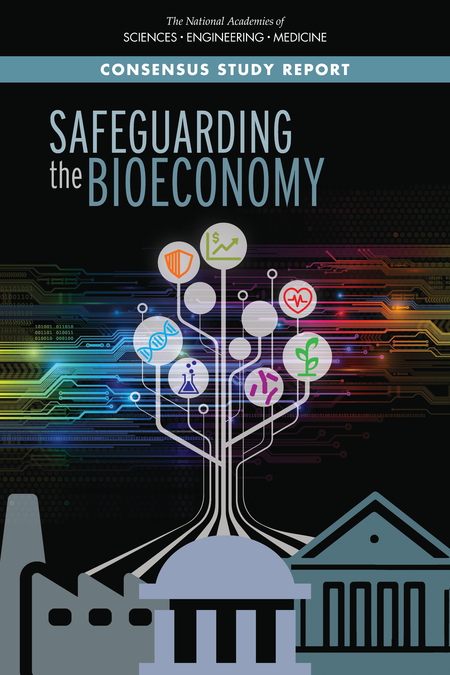 Safeguarding the Bioeconomy (2020) Safeguarding the Bioeconomy (2020)  Read online free Read online free  Buy the book or Download the Free PDF Buy the book or Download the Free PDF
Research and innovation in the life sciences is driving rapid growth in agriculture, biomedical science, information science and computing, energy, and other sectors of the U.S. economy. This economic activity, conceptually referred to as the bioeconomy, presents many opportunities to create jobs, improve the quality of life, and continue to drive economic growth. While the United States has been a leader in advancements in the biological sciences, other countries are also actively investing in and expanding their capabilities in this area. Maintaining competitiveness in the bioeconomy is key to maintaining the economic health and security of the United States and other nations.
Safeguarding the Bioeconomy evaluates preexisting and potential approaches for assessing the value of the bioeconomy and identifies intangible assets not sufficiently captured or that are missing from U.S. assessments. This study considers strategies for safeguarding and sustaining the economic activity driven by research and innovation in the life sciences. It also presents ideas for horizon scanning mechanisms to identify new technologies, markets, and data sources that have the potential to drive future development of the bioeconomy.
 Artificial Intelligence: An International Dialogue Artificial Intelligence: An International Dialogue
Proceedings of a Workshop-in Brief (2019)
Read online free Buy the book or Download the Free PDF
On May 24, 2019 the National Academies of Sciences, Engineering and Medicine, in partnership with the Royal Society, held a symposium entitled Artificial Intelligence: An International Dialogue in Washington, DC. The symposium addressed if and how artificial intelligence (AI) would benefit from further international cooperation. It primarily focused on the aspect of AI known as ‘machine learning’—or ‘deep learning’—as this is an area of increasing attention and rapid technological advancement. The event also addressed discussions at a day-and-a-half meeting on May 23-24, 2019* convened by the National Academies and Royal Society where 45 scientists, engineers, and other AI experts from the United States, United Kingdom, Canada, China, the European Commission, Germany, and Japan discussed key areas of national and international policy on AI where international collaboration would be most beneficial. This publication summarizes the presentations and discussions from the May 24 workshop.
 Revisiting the Manufacturing USA: Institutes Proceedings of a Workshop Revisiting the Manufacturing USA: Institutes Proceedings of a Workshop
Read online free Buy the book or download the free PDF
The Manufacturing USA initiative seeks to reinforce U.S.-based advanced manufacturing through partnerships among industry, academia, and government. Started in 2012 and established with bipartisan support by the Revitalize American Manufacturing and Innovation Act of 2014, the initiative envisages a nationwide network of research centers for manufacturing innovation. Some 14 manufacturing innovation institutes have been established to facilitate the movement of early-stage research into proven capabilities ready for adoption by U.S. manufacturers.
To better understand the role and experiences of the Manufacturing USA institutes, a committee of the National Academies of Sciences, Engineering, and Medicine convened a workshop on May 23, 2017 drawing together institute directors and manufacturing policy experts along with leaders from industry, academia, and government. Given the continued prominence of enhancing domestic manufacturing and international competitiveness in public policy discussions, the National Academies convened a second workshop on November 14, 2018, to monitor the progress of the Manufacturing USA institutes. This publication summarizes the presentations and discussions from this second workshop. (Board on Science, Technology, and Economic Policy)
 Adapting to the 21st Century Innovation Environment Adapting to the 21st Century Innovation Environment
Proceedings of a Workshop–in Brief (2019)
Read online free Buy the book or download the free PDF
The innovation environment of the 21st century is characterized by disruption, accelerated technology development, and globalized access to information, which is a dramatic shift from the largely government-controlled Cold War innovation environment of the previous century. The shift from an industrial age to an information age has lowered the barriers to entry into the global economy and compelled institutions to respond with greater efficiency and speed. How are companies, universities, and the U.S. government adapting to the accelerated pace of innovation in the current open information age? How are partnerships among the three sectors being utilized to adapt to current innovation conditions, and how can partnerships be fostered more deliberately to increase U.S. competitiveness in the global economy? To address these and related questions, the National Academies of Sciences, Engineering, and Medicine held a workshop on October 16–17, 2018. This publication summarizes the presentations and discussions from the workshop. Government-University-Industry-Research Roundtable (GUIRR)
 Revitalizing the University-Industry-Government Partnership: Creating New Opportunities for the 21st Century: Proceedings of a Workshop - in Brief (2018) Revitalizing the University-Industry-Government Partnership: Creating New Opportunities for the 21st Century: Proceedings of a Workshop - in Brief (2018)
Read online free Buy the book or download the free PDF
Strengthening the long-standing university-industry-government partnership is necessary to safeguard continued American leadership in research and innovation to support America’s prosperity, security, and national goals. On November 15, 2017, more than 300 educators, researchers, business and government leaders, and others gathered for a day-long series of discussions on revitalizing this historical partnership. This publication briefly summarizes the presentations and discussions from the workshop. (Board on Higher Education and Workforce)
 Securing Advanced Manufacturing in the United States: The Role of Manufacturing USA: Proceedings of a Workshop (2017) Securing Advanced Manufacturing in the United States: The Role of Manufacturing USA: Proceedings of a Workshop (2017)
Read online free Buy the book or download the free PDF
The Manufacturing USA initiative seeks to reinforce U.S.-based advanced manufacturing through partnerships among industry, academia, and government. The Innovation Policy Forum convened a workshop in May 2017 to better understand the role and experiences of the 14 Manufacturing USA institutes to date. Participants discussed the role of the manufacturing institutes in increasing advanced manufacturing in the United states, examined selected foreign programs that support advanced manufacturing, and reviewed recent assessments of the existing institutes. This publication summarizes the presentations and discussions at the workshop. (Board on Science, Technology, and Economic Policy (STEP)
 Beyond Patents: Assessing the Value and Impact of Research Investments: Proceedings of a Workshop - in Brief (2017) Beyond Patents: Assessing the Value and Impact of Research Investments: Proceedings of a Workshop - in Brief (2017)
Read online free Buy the book or download the free PDF
Companies have traditionally used the number of patents produced as one measure of the value of their research, but that information is not necessarily useful without knowing the business value of thosepatents in the marketplace. What other metrics serve to highight the value of research and innovation? In June 2017, the Government-University-Industry Research Roundtable held a meeting to explore the value of patents as a proxy for innovation, the limitations of their use, and other possible measures. This publication briefly summarizes the presentations and discussions at the meeting. (Government-University-Industry Research Roundtable)
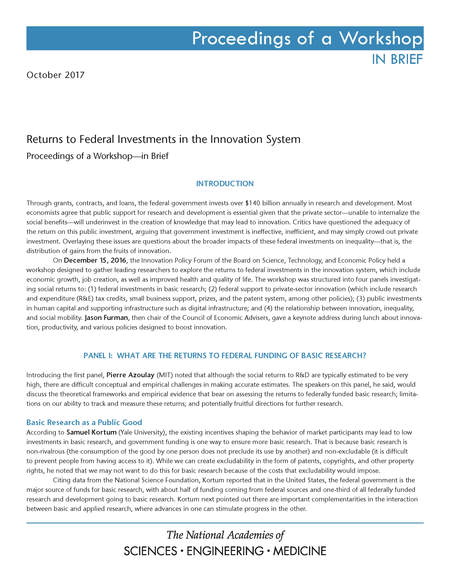 Returns to Federal Investments in the Innovation System: Proceedings of a Workshop - in Brief (2017)
Read online free Buy the book or download the free PDF The federal government invests over $140 billion annually in research and development (R&D), and most economists agree that public support for R&D is essential given that the private sector underinvests in the creation of knowledge that may lead to innovation. On December 15, 2016, the Innovation Policy Forum held a workshop designed to explore the returns to federal investments in the innovation system, which include economic growth, job creation, and improved health and quality of life. Participants examined social returns to: (1) federal investments in basic research; (2) federal support to private-sector innovation (including research and expenditure tax credits, small business support, prizes, and the patent system, among other policies); (3) public investments in human capital and supporting infrastructure such as digital infrastructure; and (4) the relationship between innovation, inequality, and social mobility. This publication briefly summarizes the presentations and discussions from the workshop. (Board on Science, Technology, and Economic Policy (STEP)
 SBIR at the National Science Foundation (2016) SBIR at the National Science Foundation (2016)
Read online free Buy the book or download the free PDF  View media coverage View media coverage
The Small Business Innovation Research (SBIR) program was established in 1982 to encourage small businesses to develop new processes and products and to provide quality research in support of the U.S. government’s many missions. Building on a 2004-2009 assessment, Congress tasked the National Academies with undertaking a second study of how the SBIR program has stimulated technological innovation and used small businesses to meet federal research and development needs, and with recommending improvements to the program. This is one of a series of reports on the SBIR program at the five agencies responsible for 96 percent of the program’s operations -- including the National Science Foundation. Reports on the programs at the Department of Defense and the National Institutes of Health have also been published, as well as a separate report on the Small Business Technology Transfer (STTR) Program. (Board on Science, Technology, and Economic Policy (STEP)
 SBIR/STTR at the National Institutes of Health (2015) SBIR/STTR at the National Institutes of Health (2015)
Read online free Buy the book or download the free PDF View media coverage
The Small Business Innovation Research (SBIR) and Small Business Technology Transfer (STTR) programs provide federal research and development funding to small businesses. In 2008, the National Research Council completed a comprehensive assessment of the SBIR and STTR programs. The first-round study found that the programs were "sound in concept and effective in practice." Building on the outcomes from the Phase I study, this second phase examines both topics of general policy interest that emerged during the first phase and topics of specific interest to individual agencies, and provides a second snapshot to measure the program's progress against its legislative goals.(Board on Science, Technology, and Economic Policy (STEP)
 Innovation, Diversity, and the SBIR/STTR Programs: Summary of a Workshop (2015) Innovation, Diversity, and the SBIR/STTR Programs: Summary of a Workshop (2015)
Read online free Buy the book or download the free PDF View media coverage
The Small Business Innovation Research (SBIR) and Small Business Technology Transfer (STTR) programs provide federal research and development funding to small businesses. One of the goals of these programs is to foster and encourage participation by minority and disadvantaged persons in technological innovation. Innovation, Diversity, and Success in the SBIR/STTR Programs is the summary of a workshop convened in February 2013 that focused on the participation of women, minorities, and both older and younger scientists, engineers, and entrepreneurs in the SBIR and STTR programs, with the goal of reviewing current efforts to expand the pool of SBIR/STTR-funded researchers and of identifying mechanisms for improving participation rates. This report is a record of the presentation and discussions of the event. .(Board on Science, Technology, and Economic Policy (STEP)
 The Flexible Electronics Opportunity (January 2015) The Flexible Electronics Opportunity (January 2015)
Read online free Buy the book or download the free PDF  View report highlights (PDF) View report highlights (PDF)
The Flexible Electronics Opportunity examines and compares selected innovation programs both foreign and domestic, and their potential to advance the production of flexible electronics technology in the United States. This report reviews the goals, concept, structure, operation, funding levels, and evaluation of foreign programs similar to major U.S. programs, e.g., innovation awards, S&T parks, and consortia. The report describes the transition of flexible electronics research into products and to makes recommendations to improve and to develop U.S. programs. Through an examination of the role of research consortia around the world to advance flexible electronics technology, the report makes recommendations for steps that the U.S. might consider to develop a robust industry in the United States. Significant U.S. expansion in the market for flexible electronics technologies is not likely to occur in the absence of mechanisms to address investment risks, the sharing of intellectual property, and the diverse technology requirements associated with developing and manufacturing flexible electronics technologies. The Flexible Electronics Opportunity makes recommendations for collaboration among industry, universities, and government to achieve the critical levels of investment and the acceleration of new technology development that are needed to catalyze a vibrant flexible electronics industry.(Board on Science, Technology, and Economic Policy (STEP)
 SBIR at the Department of Defense SBIR at the Department of Defense(October 2014) SBIR at the Department of Defense considers ways that the Department of Defense SBIR program could work better in addressing the congressional objectives for the SBIR program to stimulate technological innovation, use small businesses to meet federal research and development (R & D) needs, foster and encourage the participation of socially and economically disadvantaged small businesses, and increase the private sector commercialization of innovations derived from federal R&D. An earlier report, An Assessment of the Small Business Innovation Research Program at the Department of Defense, studied how the SBIR program has stimulated technological innovation and used small businesses to meet federal research and development needs. This report builds on the previous one, with a revised survey of SBIR companies. SBIR at the Department of Defense revisits some case studies from the 2009 study and develops new ones, and interviews agency managers and other stakeholders to provide a second snapshot of the program's progress toward achieving its legislative goals. (Board on Science, Technology, and Economic Policy (STEP)
 Capturing Change in Science, Technology, and Innovation: Improving Indicators to Inform Policy Capturing Change in Science, Technology, and Innovation: Improving Indicators to Inform Policy (prepublication November 2013) Since the 1950s, under congressional mandate, the U.S. National Science Foundation (NSF) - through its National Center for Science and Engineering Statistics (NCSES) and predecessor agencies - has produced regularly updated measures of research and development expenditures, employment and training in science and engineering, and other indicators of the state of U.S. science and technology. A more recent focus has been on measuring innovation in the corporate sector. NCSES collects its own data on science, technology, and innovation (STI) activities and also incorporates data from other agencies to produce indicators that are used for monitoring purposes - including comparisons among sectors, regions, and with other countries - and for identifying trends that may require policy attention and generate research needs. NCSES also provides extensive tabulations and microdata files for in-depth analysis. Capturing Change in Science, Technology, and Innovation assesses and provides recommendations regarding the need for revised, refocused, and newly developed indicators of STI activities that would enable NCSES to respond to changing policy concerns. This report also identifies and assesses both existing and potential data resources and tools that NCSES could exploit to further develop its indicators program. Finally, the report considers strategic pathways for NCSES to move forward with an improved STI indicators program. The recommendations offered in Capturing Change in Science, Technology, and Innovation are intended to serve as the basis for a strategic program of work that will enhance NCSES's ability to produce indicators that capture change in science and technology.(Board on Science, Technology, and Economic Policy (STEP)
 Flexible Electronics for Security, Manufacturing, and Growth in the United States: Summary of a Symposium Flexible Electronics for Security, Manufacturing, and Growth in the United States: Summary of a Symposium (November 2013) Flexible Electronics for Security, Manufacturing, and Growth in the United States is the summary of a workshop convened in September 2010 by Policy and Global Affairs' Board on Science, Technology, and Economic Policy to review challenges, plans, and opportunities for growing a robust flexible electronics industry in the United States. Business leaders, academic experts, and senior government officials met to review the role of research consortia around the world to advance flexible electronics technology. Presenters and participants sought to understand their structure, focus, funding, and likely impact, and to determine what appropriate steps the United States might consider to develop a robust flexible electronics industry. Flexible electronics refers to technologies that enable flexibility in the manufacturing process as well as flexibility as a characteristic of the final product. Features such as unconventional forms and ease of manufacturability provide important advantages for flexible electronics over conventional electronics built on rigid substrates. Today, examples of flexible electronics technologies are found in flexible flat-panel displays, medical image sensors, photovoltaic sheets, and electronic paper. According to some industry estimates, the global market for flexible electronics products is expected to grow from a few billion dollars today to $60 billion by the end of the decade, but most experts believe that the United States is not currently poised to capitalize on this opportunity. Flexible Electronics for Security, Manufacturing, and Growth in the United States examines and compares selected innovation programs, both foreign and domestic, and their potential to advance the production of flexible electronics technology. (Board on Science, Technology, and Economic Policy (STEP)
 New York's Nanotechnology Model: Building the Innovation Economy: Summary of a Symposium New York's Nanotechnology Model: Building the Innovation Economy: Summary of a Symposium(November 2013) New York's Nanotechnology Model: Building the Innovation Economy is the summary of a 2013 symposium convened by the National Research Council Board on Science, Technology, and Economic Policy and members of the Nano Consortium that drew state officials and staff, business leaders, and leading national figures in early-stage finance, technology, engineering, education, and state and federal policies to review challenges, plans, and opportunities for innovation-led growth in New York. The symposium participants assessed New York's academic, industrial, and human resources, identified key policy issues, and engaged in a discussion of how the state might leverage regional development organizations, state initiatives, and national programs focused on manufacturing and innovation to support its economic development goals. This report highlights the accomplishments and growth of the innovation ecosystem in New York, while also identifying needs, challenges, and opportunities. New York's Nanotechnology Model reviews the development of the Albany nanotech cluster and its usefulness as a model for innovation-based growth, while also discussing the New York innovation ecosystem more broadly. (Board on Science, Technology, and Economic Policy (STEP)
 Patent Challenges for Standard-Setting in the Global Economy: Lessons from Information and Communication Technology Patent Challenges for Standard-Setting in the Global Economy: Lessons from Information and Communication Technology (October 2013) Patent Challenges for Standard-Setting in the Global Economy: Lessons from Information and Communication Technology examines how leading national and multinational standard-setting organizations (SSOs) address patent disclosures, licensing terms, transfers of patent ownership, and other issues that arise in connection with developing technical standards for consumer and other microelectronic products, associated software and components, and communications networks including the Internet. Attempting to balance the interests of patent holders, other participants in standard-setting, standards implementers, and consumers, the report calls on SSOs to develop more explicit policies to avoid patent holdup and royalty-stacking, ensure that licensing commitments carry over to new owners of the patents incorporated in standards, and limit injunctions for infringement of patents with those licensing commitments. The report recommends government measures to increase the transparency of patent ownership and use of standards information to improve patent quality and to reduce conflicts of laws across countries. (Board on Science, Technology, and Economic Policy (STEP)
 Strengthening American Manufacturing: The Role of the Manufacturing Extension Partnership Strengthening American Manufacturing: The Role of the Manufacturing Extension Partnership (October 2013) The Manufacturing Extension Partnership (MEP) - a program of the U.S. Department of Commerce's National Institute of Standards and Technology - has sought for more than two decades to strengthen American manufacturing. It is a national network of affiliated manufacturing extension centers and field offices located throughout all fifty states and Puerto Rico. Funding for MEP Centers comes from a combination of federal, state, local and private resources. Centers work directly with manufacturing firms in their state or sub-state region. MEP Centers provide expertise, services and assistance directed toward improving growth, supply chain positioning, leveraging emerging technologies, improving manufacturing processes, work force training, and the application and implementation of information in client companies through direct assistance provided by Center staff and from partner organizations and third party consultants. 21st Century Manufacturing seeks to generate a better understanding of the operation, achievements, and challenges of the MEP program in its mission to support, strengthen, and grow U.S. manufacturing. This report identifies and reviews similar national programs from abroad in order to draw on foreign practices, funding levels, and accomplishments as a point of reference and discusses current needs and initiatives in light of the global focus on advanced manufacturing. (Board on Science, Technology, and Economic Policy (STEP)
 Strengthening American Manufacturing: The Role of the Manufacturing Extension Partnership : Summary of a Symposium Strengthening American Manufacturing: The Role of the Manufacturing Extension Partnership : Summary of a Symposium (September 2013) The Manufacturing Extension Partnership (MEP)-- a program of the U.S. Department of Commerce's National Institute of Standards and Technology (NIST)-- has sought for more than two decades to strengthen American manufacturing. It is a national network of affiliated manufacturing extension centers and field offices located throughout all fifty states and Puerto Rico. Qualified MEP Centers work directly with small and medium manufacturing firms in their state or sub-state region, providing expertise, services and assistance directed to foster growth, improve supply chain positioning, leverage emerging technologies, upgrade manufacturing processes, develop work force training, and apply and implement new information. Strengthening American Manufacturing: The Role of the Manufacturing Extension Partnership is the summary of a symposium convened to review current operations and some of the recent MEP initiatives in the broader context of global manufacturing trends and the opportunities for high-value manufacturing companies. Business leaders, academic experts, and state and federal officials addressed the metrics and impacts of MEP and identified potential areas of improvement. The meeting drew attention to the scale and focuses of MEP, and highlighted the role it plays in supporting and enabling U.S. manufacturers to compete more effectively in the global marketplace. This report includes an overview of key issues raised at this workshop and a detailed summary of the conference presentations. (Board on Science, Technology, and Economic Policy (STEP)
 Effects of U.S. Tax Policy on Greenhouse Gas Emissions Effects of U.S. Tax Policy on Greenhouse Gas Emissions (June 2013) The U.S. Congress charged the National Academies with conducting a review of the Internal Revenue Code to identify the types of and specific tax provisions that have the largest effects on carbon and other greenhouse gas emissions and to estimate the magnitude of those effects. To address such a broad charge, the National Academies appointed a committee composed of experts in tax policy, energy and environmental modeling, economics, environmental law, climate science, and related areas.
For scientific background to produce Effects of U.S. Tax Policy on Greenhouse Gas Emissions, the committee relied on the earlier findings and studies by the National Academies, the U.S. government, and other research organizations. The committee has relied on earlier reports and studies to set the boundaries of the economic, environmental, and regulatory assumptions for the present study. The major economic and environmental assumptions are those developed by the U.S. Energy Information Administration (EIA) in its annual reports and modeling. Additionally, the committee has relied upon publicly available data provided by the U.S. Environmental Protection Agency, which inventories greenhouse gas (GHG) emissions from different sources in the United States.
The tax system affects emissions primarily through changes in the prices of inputs and outputs or goods and services. Most of the tax provisions considered in this report relate directly to the production or consumption of different energy sources. However, there is a substantial set of tax expenditures called "broad-based" that favor certain categories of consumption—among them, employer-provided health care, owner-occupied housing, and purchase of new plants and equipment. Effects of U.S. Tax Policy on Greenhouse Gas Emissions examines both tax expenditures and excise taxes that could have a significant impact on GHG emissions. (Board on Science, Technology, and Economic Policy (STEP)
 Best Practices in State and Regional Innovation Initiatives: Competing in the 21st Century Best Practices in State and Regional Innovation Initiatives: Competing in the 21st Century (June 2013) Most of the policy discussion about stimulating innovation has focused on the federal level. This study focuses on the significant activity at the state level, with the goal of improving the public's understanding of key policy strategies and exemplary practices. Based on a series of workshops and conferences that brought together policymakers along with leaders of industry and academia in a select number of states, the study highlights a rich variety of policy initiatives underway at the state and regional level to foster knowledge based growth and employment. Perhaps what distinguishes this effort at the state level is most of all the high degree of pragmatism. Operating out of necessity, innovation policies at the state level often involve taking advantage of existing resources and recombining them in new ways, forging innovative partnerships among universities, industry and government organizations, growing the skill base, and investing in the infrastructure to develop new technologies and new industries. Many of these initiatives are being guided by leaders from the private sector and universities. The objective of Best Practices in State and Regional Innovation Initiatives: Competing in the 21st Century is not to do an empirical review of the inputs and outputs of various state programs. Nor is it to evaluate which programs are superior. Indeed, some of the notable successes, such as the Albany nanotechnology cluster, represent a leap of leadership, investment, and sustained commitment that has had remarkable results in an industry that is actively pursued by many countries. The study's goal is to illustrate the approaches taken by a variety of highly diverse states as they confront the increasing challenges of global competition for the industries and jobs of today and tomorrow.(Board on Science, Technology, and Economic Policy (STEP)  Building the Illinois Innovation Economy: Summary of a Symposium Building the Illinois Innovation Economy: Summary of a Symposium (May 2013) Responding to the challenges of fostering regional growth and employment in an increasingly competitive global economy, many U.S. states and regions have developed programs to attract and grow companies as well as attract the talent and resources necessary to develop innovation clusters. These state and regionally based initiatives have a broad range of goals and increasingly include significant resources, often with a sector focus and often in partnership with foundations and universities. These are being joined by recent initiatives to coordinate and concentrate investments from a variety of federal agencies that provide significant resources to develop regional centers of innovation, business incubators, and other strategies to encourage entrepreneurship and high-tech development. Building the Illinois Innovation Economy is a study of selected state and regional programs to identify best practices with regard to their goals, structures, instruments, modes of operation, synergies across private and public programs, funding mechanisms and levels, and evaluation efforts. This report reviews selected state and regional efforts to capitalize on federal and state investments in areas of critical national needs. This review includes both efforts to strengthen existing industries as well as specific new technology focus areas such as nanotechnology, stem cells, and energy in order to improve our understanding of program goals, challenges, and accomplishments. As a part of this review, The Committee on Competing in the 21st Century: Best Practice in State and Regional Innovation Initiatives is convening a series of public workshops and symposia involving responsible local, state, and federal officials and other stakeholders. These meetings and symposia will enable an exchange of views, information, experience, and analysis to identify best practice in the range of programs and incentives adopted. Building the Illinois Innovation Economy summarizes discussions at these symposia, fact-finding meetings, and commissioned analyses of existing state and regional programs and technology focus areas, the committee will subsequently produce a final report with findings and recommendations focused on lessons, issues, and opportunities for complementary U.S. policies created by these state and regional initiatives. (Board on Science, Technology, and Economic Policy (STEP)
 Copyright in the Digital Era: Building Evidence for Policy Copyright in the Digital Era: Building Evidence for Policy (May 2013) Over the course of several decades, copyright protection has been expanded and extended through legislative changes occasioned by national and international developments. The content and technology industries affected by copyright and its exceptions, and in some cases balancing the two, have become increasingly important as sources of economic growth, relatively high-paying jobs, and exports. Since the expansion of digital technology in the mid-1990s, they have undergone a technological revolution that has disrupted long-established modes of creating, distributing, and using works ranging from literature and news to film and music to scientific publications and computer software. In the United States and internationally, these disruptive changes have given rise to a strident debate over copyright's proper scope and terms and means of its enforcement--a debate between those who believe the digital revolution is progressively undermining the copyright protection essential to encourage the funding, creation, and distribution of new works and those who believe that enhancements to copyright are inhibiting technological innovation and free expression. Copyright in the Digital Era: Building Evidence for Policy examines a range of questions regarding copyright policy by using a variety of methods, such as case studies, international and sectoral comparisons, and experiments and surveys. This report is especially critical in light of digital age developments that may, for example, change the incentive calculus for various actors in the copyright system, impact the costs of voluntary copyright transactions, pose new enforcement challenges, and change the optimal balance between copyright protection and exceptions. (Board on Science, Technology, and Economic Policy (STEP)
 Building the Ohio Innovation Economy: Summary of a Symposium Building the Ohio Innovation Economy: Summary of a Symposium (February 2013) Since 1991, the National Research Council, under the auspices of the Board on Science, Technology, and Economic Policy, has undertaken a program of activities to improve policymakers' understandings of the interconnections of science, technology, and economic policy and their importance for the American economy and its international competitive position. The Board's activities have corresponded with increased policy recognition of the importance of knowledge and technology to economic growth. One important element of STEP's analysis concerns the growth and impact of foreign technology programs. U.S. competitors have launched substantial programs to support new technologies, small firm development, and consortia among large and small firms to strengthen national and regional positions in strategic sectors. Some governments overseas have chosen to provide public support to innovation to overcome the market imperfections apparent in their national innovation systems. They believe that the rising costs and risks associated with new potentially high-payoff technologies, and the growing global dispersal of technical expertise, underscore the need for national R&D programs to support new and existing high-technology firms within their borders. Similarly, many state and local governments and regional entities in the United States are undertaking a variety of initiatives to enhance local economic development and employment through investment programs designed to attract knowledge-based industries and grow innovation clusters. These state and regional programs and associated policy measures are of great interest for their potential contributions to growth and U.S. competitiveness and for the "best practice" lessons that they offer for other state and regional programs. STEP's project on State and Regional Innovation Initiatives is intended to generate a better understanding of the challenges associated with the transition of research into products, the practices associated with successful state and regional programs, and their interaction with federal programs and private initiatives. The study seeks to achieve this goal through a series of complementary assessments of state, regional, and federal initiatives; analyses of specific industries and technologies from the perspective of crafting supportive public policy at all three levels; and outreach to multiple stakeholders. Building the Ohio Innovation Economy: Summary of a Symposium explains the of the study, which is to improve the operation of state and regional programs and, collectively, enhance their impact. (Board on Science, Technology, and Economic Policy (STEP)  Building the Arkansas Innovation Economy: Summary of a Symposium Building the Arkansas Innovation Economy: Summary of a Symposium (December 2012) A committee under the auspices of the Board on Science, Technology, and Economic Policy (STEP), is conducting a study of selected state and regional programs in order to identify best practices with regard to their goals, structures, instruments, modes of operation, synergies across private and public programs, funding mechanisms and levels, and evaluation efforts. The committee is reviewing selected state and regional efforts to capitalize on federal and state investments in areas of critical national needs. Building the Arkansas Innovation Economy: Summary of a Symposium includes both efforts to strengthen existing industries as well as specific new technology focus areas such as nanotechnology, stem cells, and energy in order to better understand program goals, challenges, and accomplishments. As a part of this review, the committee is convening a series of public workshops and symposia involving responsible local, state, and federal officials and other stakeholders. These meetings and symposia will enable an exchange of views, information, experience, and analysis to identify best practice in the range of programs and incentives adopted. Drawing from discussions at these symposia, fact-finding meetings, and commissioned analyses of existing state and regional programs and technology focus areas, the committee will subsequently produce a final report with findings and recommendations focused on lessons, issues, and opportunities for complementary U.S. policies created by these state and regional initiatives.
Since 1991, the National Research Council, under the auspices of the Board on Science, Technology, and Economic Policy, has undertaken a program of activities to improve policymakers' understandings of the interconnections of science, technology, and economic policy and their importance for the American economy and its international competitive position. The Board's activities have corresponded with increased policy recognition of the importance of knowledge and technology to economic growth. One important element of STEP's analysis concerns the growth and impact of foreign technology programs.1 U.S. competitors have launched substantial programs to support new technologies, small firm development, and consortia among large and small firms to strengthen national and regional positions in strategic sectors. Some governments overseas have chosen to provide public support to innovation to overcome the market imperfections apparent in their national innovation systems. They believe that the rising costs and risks associated with new potentially high-payoff technologies, and the growing global dispersal of technical expertise, underscore the need for national R&D programs to support new and existing high-technology firms within their borders. (Board on Science, Technology, and Economic Policy (STEP)  Building the U.S. Battery Industry for Electric Drive Vehicles: Summary of a Symposium Building the U.S. Battery Industry for Electric Drive Vehicles: Summary of a Symposium (December 2012) Since 1991, the National Research Council, under the auspices of the Board on Science, Technology, and Economic Policy, has undertaken a program of activities to improve policymakers' understandings of the interconnections of science, technology, and economic policy and their importance for the American economy and its international competitive position. The Board's activities have corresponded with increased policy recognition of the importance of knowledge and technology to economic growth. The goal of the this symposium was to conduct two public symposia to review and analyze the potential contributions of public-private partnerships and identify other relevant issues for the Department of Energy, Office of Vehicle Technologies, Energy Storage Team's activities in the energy storage research and development area. The symposia will also identify lessons from these and other domestic and international experiences to help inform DoE as to whether its activities are complete and appropriately focused. Additional topics that emerge in the course of the planning may also be addressed. Building the U.S. Battery Industry for Electric Drive Vehicles: Summary of a Symposium gathers representatives from leading battery manufacturers, automotive firms, university researchers, academic and industry analysts, congressional staff, and federal agency representatives. An individually-authored summary of each symposium will be issued. The symposium was held in Michigan in order to provide direct access to the policymakers and industrial participants drawn from the concentration of battery manufacturers and automotive firms in the region. The symposium reviewed the current state, needs, and challenges of the U.S. advanced battery manufacturing industry; challenges and opportunities in battery R&D, commercialization, and deployment; collaborations between the automotive industry and battery industry; workforce issues, and supply chain development. It also focused on the impact of DoE's investments and the role of state and federal programs in support of this growing industry. This task of this report is to summarize the presentations and discussions that took place at this symposium. Needless to say, the battery industry has evolved very substantially since the conference was held, and indeed some of the caveats raised by the speakers with regard to overall demand for batteries and the prospects of multiple producers now seem prescient. At the same time, it is important to understand that it is unrealistic to expect that all recipients of local, state, or federal support in a complex and rapidly evolving industry will necessarily succeed. A number of the firms discussed here have been absorbed by competitors, others have gone out of business, and others continue to progress. Board on Science, Technology, and Economic Policy (STEP)
 Clustering for 21st Century Prosperity:Summary of a Symposium Clustering for 21st Century Prosperity:Summary of a Symposium (October 2012) Responding to the challenges of fostering regional growth and employment in an increasingly competitive global economy, many U.S. states and regions have developed programs to attract and grow companies as well as attract the talent and resources necessary to develop regional innovation clusters. These state and regionally based initiatives have a broad range of goals and increasingly include larger resources commitments, often with a sectoral focus and often in partnership with foundations and universities. Recent studies, however, have pointed out that many of these efforts lack the scale and the steady commitment needed for success. This has prompted new initiatives to coordinate and concentrate investments from a variety of federal agencies to develop research parks, business incubators, and other strategies to encourage entrepreneurships and high-tech development in the nation's regions. Understanding the nature of innovation clusters and public policies associated with successful cluster development is therefore of current relevance. Clustering for 21st Century Prosperity identifies best practices with regard to goals, structures, instruments, modes of operation, synergies across private and public programs, funding mechanisms and levels, and evaluation efforts. The committee, under the Board on Science, Technology, and Economic Policy (STEP) is reviewing selected state and regional efforts to capitalize on federal and state investments in areas of critical national needs. This review includes both efforts to strengthen existing industries as well as specific technology focus areas such as nanotechnology, stem cells, and advanced energy in order to better understand program goals, challenges, and accomplishments.
As part of this study, the committee is convening a series of public workshops and symposia involving responsible local, state, and federal officials and other stakeholders. Drawing from discussions at these symposia, fact-finding meetings, and commissioned analyses of existing state and regional programs and technology focus areas, the committee will subsequently produce a final report with findings and recommendations focused on lessons, issues, and opportunities for complementary U.S. policies created by these state and regional initiatives. (Board on Science, Technology, and Economic Policy (STEP)
 Meeting Global Challenges: U.S.-German Innovation Policy (October 2012) Meeting Global Challenges: U.S.-German Innovation Policy (October 2012)
Read online free Buy the book or download the free PDF
While nations have always competed for territory, mineral riches, water, and other physical assets, they compete most vigorously today for technology-based innovations and the value that flows from them. Much of this value is based on creating scientific knowledge and transforming it into new products and services for the market. This process of innovation is complex and interdisciplinary. Sometimes it draws on the genius of individuals, but even then it requires sustained collective effort, often underpinned by significant national investments. Capturing the value of these investments to spur domestic economic growth and employment is a challenge in a world where the outputs of innovation disseminate rapidly. Those equipped to understand, apply, and profit from new knowledge and technical advances are increasingly able to capture the long-term economic benefits of growth and employment. In response to this new, more distributed innovation paradigm, the National Academies Board on Science, Technology, and Economic Policy (STEP) convened leading academics, business leaders, and senior policymakers from Germany and the United States to examine the strengths and challenges of their innovation systems. More specifically, they met to compare their respective approaches to innovation, to learn from their counterparts about best practices and shared challenges, and to identify cooperative opportunities. The symposium was held in Berlin and organized jointly by the German Institute for Economic Research (DIW) and the U.S. National Academies with support of the German Federal Ministry for Education and Research (BMBF) and the American Embassy in Berlin. Both U.S. and German participants described common challenges on a wide variety of issues ranging from energy security and climate change to low-emissions transportation, early-stage financing, and workforce training. While recognizing their differences in approach to these challenges, participants on both sides drew out valuable lessons from each other's policies and practices. Participants were also aware of the need to adapt to a new global environment where many countries have focused new policy measures and new resources to support innovative firms and promising industries. Meeting Global Challenges: U.S.-German Innovation Policy reviews the participants meeting and sets goals and recommendations for future policy. (Board on Science, Technology, and Economic Policy (STEP)  Rising to the Challenge: U.S. Innovation Policy for the Global Economy Rising to the Challenge: U.S. Innovation Policy for the Global Economy (July 2012) America's position as the source of much of the world's global innovation has been the foundation of its economic vitality and military power in the post-war. No longer is U.S. pre-eminence assured as a place to turn laboratory discoveries into new commercial products, companies, industries, and high-paying jobs. As the pillars of the U.S. innovation system erode through wavering financial and policy support, the rest of the world is racing to improve its capacity to generate new technologies and products, attract and grow existing industries, and build positions in the high technology industries of tomorrow. Rising to the Challenge: U.S. Innovation Policy for Global Economy emphasizes the importance of sustaining global leadership in the commercialization of innovation which is vital to America's security, its role as a world power, and the welfare of its people. The second decade of the 21st century is witnessing the rise of a global competition that is based on innovative advantage. To this end, both advanced as well as emerging nations are developing and pursuing policies and programs that are in many cases less constrained by ideological limitations on the role of government and the concept of free market economics. The rapid transformation of the global innovation landscape presents tremendous challenges as well as important opportunities for the United States.
This report argues that far more vigorous attention be paid to capturing the outputs of innovation - the commercial products, the industries, and particularly high-quality jobs to restore full employment. America's economic and national security future depends on our succeeding in this endeavor. (Board on Science, Technology, and Economic Policy (STEP)
 Rising Above the Gathering Storm: Developing Regional Innovation Environments: A Workshop Summary (June 2012) Rising Above the Gathering Storm: Developing Regional Innovation Environments: A Workshop Summary (June 2012)
Read online free Buy the book or download the free PDF View media coverage
In October 2005, the National Academy of Sciences, National Academy of Engineering, and Institute of Medicine released a policy report that served as a call to action. The report, Rising Above the Gathering Storm: Energizing and Employing America for a Brighter Economic Future observed that "the scientific and technological building blocks critical to the United States economic leadership are eroding at a time when many other nations are gathering strength." The report laid out 20 recommendations in four broad areas - K-12 education, science and engineering research, higher education, and economic and technology policy - and warned that a failure to take action could have dire economic consequences.
Rising Above the Gathering Storm sparked intense discussion among policy makers, industrial leaders, and the general public. Five years after the release of the Gathering Storm report, a second report, Rising Above the Gathering Storm, Revisited: Rapidly Approaching Category 5, assessed changes in America's competitive posture. This report concluded that "our nation's outlook has not improved, but rather has worsened" since the Gathering Storm report was released. The report noted examples of other nations that have upgraded their investments in education, technological infrastructure, and innovation systems to a greater extent than has the United States.
The ability of the states to drive innovation was the impetus behind a major workshop held in Madison, Wisconsin, on September 20-22, 2011. Titled "Rising Above the Gathering Storm: Developing Regional Innovation Environments," the workshop brought together leaders in education, government, economic development, and industrial innovation to discuss state and regional initiatives to boost competitiveness through science, technology, and innovation. The conference was organized around four major themes:
- Revitalizing K-12 Science and Mathematics Education
- Strengthening Undergraduate Education in Science and Engineering
- Building Effective Partnerships Among Governments, Universities, Companies, and Other Stakeholders
- Fostering Regional Technology Development and Entrepreneurship
Rising Above the Gathering Storm: Developing Regional Innovation Environments: A Workshop Summary gives an overview of the presentations, observations, and recommendations made during the workshop.(Committee on Science, Engineering, Medicine, and Public Policy (COSEMPUP)
 Building Hawaii's Innovation Economy: Summary of a Symposium Building Hawaii's Innovation Economy: Summary of a Symposium (May 2012) Responding to the challenges of fostering regional growth and employment in an increasingly competitive global economy, many U.S. states and regions have developed programs to attract and grow companies as well as attract the talent and resources necessary to develop innovation clusters. These state and regionally based initiatives have a broad range of goals and increasingly include significant resources, often with a sectoral focus and often in partnership with foundations and universities. These are being joined by recent initiatives to coordinate and concentrate investments from a variety of federal agencies that provide significant resources to develop regional centers of innovation, business incubators, and other strategies to encourage entrepreneurship and high-tech development.
Building Hawaii's Innovation Economy: Summary of a Symposium explains the study of selected state and regional programs in order to identify best practices with regard to their goals, structures, instruments, modes of operation, synergies across private and public programs, funding mechanisms and levels, and evaluation efforts. This report reviews selected state and regional efforts to capitalize on federal and state investments in areas of critical national needs. Building Hawaii's Innovation Economy also reviews efforts to strengthen existing industries as well as specific new technology focus areas such as nanotechnology, stem cells, and energy in order to better understand program goals, challenges, and accomplishments. (Board on Science, Technology, and Economic Policy (STEP)
 Improving Measures of Science, Technology, and Innovation: Interim Report Improving Measures of Science, Technology, and Innovation: Interim Report (February 2012) The National Center for Science and Engineering Statistics (NCSES), at the U.S. National Foundation, is one of 14 major statistical agencies in the federal government, of which at least five collect relevant information on science, technology, and innovation activities in the United States and abroad. The America COMPETES Reauthorization Act of 2010 expanded and codified NCSES's role as a U.S. federal statistical agency. Important aspects of the agency's mandate include collection, acquisition, analysis, and reporting and dissemination of data on research and development trends, on U.S. competitiveness in science, technology, and research and development, and on the condition and progress of U.S. science, technology, engineering, and mathematics (STEM) education.
Improving Measures of Science, Technology and Innovation: Interim Report examines the status of the NCSES's science, technology, and innovation (STI) indicators. This report assesses and provides recommendations regarding the need for revised, refocused, and newly developed indicators designed to better reflect fundamental and rapid changes that are reshaping global science, technology and innovation systems. The book also determines the international scope of STI indicators and the need for developing new indicators that measure developments in innovative activities in the United States and abroad, and Offers foresight on the types of data, metrics and indicators that will be particularly influential in evidentiary policy decision-making for years to come.
In carrying out its charge, the authoring panel undertook a broad and comprehensive review of STI indicators from different countries, including Japan, China, India and several countries in Europe, Latin America and Africa. Improving Measures of Science, Technology, and Innovation makes recommendations for near-term action by NCSES along two dimensions: (1) development of new policy-relevant indicators that are based on NCSES survey data or on data collections at other statistical agencies; and (2) exploration of new data extraction and management tools for generating statistics, using automated methods of harvesting unstructured or scientometric data and data derived from administrative records. (Board on Science, Technology, and Economic Policy (STEP)/Committee on National Statistics) Growing Innovation Clusters for American Prosperity: Summary of a Symposium (October 2011)
Read online free Buy the book or download the free PDF Responding to the challenges of fostering regional growth and employment in an increasingly competitive global economy, many U.S. states and regions have developed programs to attract and grow companies as well as attract the talent and resources necessary to develop innovation clusters. These state and regionally based initiatives have a broad range of goals and increasingly include significant resources, often with a sectoral focus and often in partnership with foundations and universities. These are being joined by recent initiatives to coordinate and concentrate investments from a variety of federal agencies that provide significant resources to develop regional centers of innovation, business incubators, and other strategies to encourage entrepreneurship and high-tech development. This has led to renewed interest in understanding the nature of innovation clusters and public policies associated with successful cluster development. The Board on Science, Technology, and Economic Policy (STEP), conducted a symposium which brought together state and federal government officials, leading analysts, congressional staff, and other stakeholders to explore the role of clusters in promoting economic growth, the government's role in stimulating clusters, and the role of universities and foundations in their development. Growing Innovation Clusters for American Prosperity captures the presentations and discussions of the 2009 STEP symposium on innovation clusters. It includes an overview highlighting key issues raised at the meeting and a summary of the meeting's presentations. This report has been prepared by the workshop rapporteur as a factual summary of what occurred at the workshop. (Board on Science, Technology, and Economic Policy (STEP))
 Recent decades have witnessed an ever-increasing range and volume of digital data. All elements of the pillars of science--whether observation, experiment, or theory and modeling--are being transformed by the continuous cycle of generation, dissemination, and use of factual information. This is even more so in terms of the re-using and repurposing of digital scientific data beyond the original intent of the data collectors, often with dramatic results. We all know about the potential benefits and impacts of digital data, but we are also aware of the barriers, the challenges in maximizing the access, and use of such data. There is thus a need to think about how a data infrastructure can enhance capabilities for finding, using, and integrating information to accelerate discovery and innovation. How can we best implement an accessible, interoperable digital environment so that the data can be repeatedly used by a wide variety of users in different settings and with different applications? With this objective: to use the microbial communities and microbial data, literature, and the research materials themselves as a test case, the Board on Research Data and Information held an International Symposium on Designing the Microbial Research Commons at the National Academy of Sciences in Washington, DC on 8-9 October 2009. The symposium addressed topics such as models to lower the transaction costs and support access to and use of microbiological materials and digital resources from the perspective of publicly funded research, public-private interactions, and developing country concerns. The overall goal of the symposium was to stimulate more research and implementation of improved legal and institutional models for publicly funded research in microbiology. (Board on Research Data and Information)
 The enactment of the America COMPETES Act in 2006 (and its reauthorization in 2010), the increase in research expenditures under the 2009 American Recovery and Reinvestment Act (ARRA), and President Obama's general emphasis on the contribution of science and technology to economic growth have all heightened interest in the role of scientific and engineering research in creating jobs, generating innovative technologies, spawning new industries, improving health, and producing other economic and societal benefits. Along with this interest has come a renewed emphasis on a question that has been asked for decades: Can the impacts and practical benefits of research to society be measured either quantitatively or qualitatively? On April 18-19, 2011, the Board on Science, Technology, and Economic Policy (STEP) and the Committee on Science, Engineering and Public Policy (COSEPUP) of the National Academy of Sciences, the National Academy of Engineering, and the Institute of Medicine, held a workshop to examine this question. (Board on Science, Technology, and Economic Policy (STEP) 
The global economy is characterized by increasing locational competition to attract the resources necessary to develop leading-edge technologies as drivers of regional and national growth. One means of facilitating such growth and improving national competitiveness is to improve the operation of the national innovation system. This involves national technology development and innovation programs designed to support research on new technologies, enhance the commercial return on national research, and facilitate the production of globally competitive products.
Understanding the policies that other nations are pursuing to become more innovative and to what effect is essential to understanding how the nature and terms of economic competition are shifting. Building the 21st Century U.S.-China Cooperation on Science, Technology, and Innovation studies selected foreign innovation programs and comparing them with major U.S. programs. This analysis of Comparative Innovation Policy includes a review of the goals, concept, structure, operation, funding levels, and evaluation of foreign programs designed to advance the innovation capacity of national economies and enhance their international competitiveness. This analysis focuses on key areas of future growth, such as renewable energy, among others, to generate case-specific recommendations where appropriate. (Board on Science, Technology, and Economic Policy (STEP))
Technological innovation and growth are critical to U.S. competitiveness in a global economy. One means of facilitating growth and improving competitiveness is to foster more robust innovation ecosystems through the development of public-private partnerships, industry consortia, and other regional and national economic development initiatives. Public-private partnerships, in particular, catalyze the commercialization of state and national investments in research and development. In April and July 2009, STEP convened two meeting to assess the future of the U.S. photovoltaic industry and the practical steps that the federal government and some state and regional governments are taking to develop the capacity to manufacture photovoltaics competitively. The Future of Photovoltaic Manufacturing in the United States captures the presentations and discussions of these meetings. This report explores the prospects for cooperative R&D efforts, standards, and roadmapping efforts that could accelerate innovation and growth of a U.S. photovoltaics industry. It includes both efforts to strengthen existing industries as well as specific new technology focus areas such as nanotechnology, stem cells, and energy in order to gain an improved understanding of program goals, challenges, and accomplishments. (Board on Science, Technology, and Economic Policy (STEP)
Thirty years ago federal policy underwent a major change through the Bayh-Dole Act of 1980, which fostered greater uniformity in the way research agencies treat inventions arising from the work they sponsor. Before the Act, if government agencies funded university research, the funding agency retained ownership of the knowledge and technologies that resulted. However, very little federally funded research was actually commercialized. As a result of the Act's passage, patenting and licensing activity from such research has accelerated. Although the system created by the Act has remained stable, it has generated debate about whether it might impede other forms of knowledge transfer. Concerns have also arisen that universities might prioritize commercialization at the expense of their traditional mission to pursue fundamental knowledge--for example, by steering research away from curiosity-driven topics toward applications that could yield financial returns.
To address these concerns, the National Research Council convened a committee of experts from universities, industry, foundations, and similar organizations, as well as scholars of the subject, to review experience and evidence of the technology transfer system's effects and to recommend improvements. The present volume summarizes the committee's principal findings and recommendations. (Board on Science, Technology, and Economic Policy (STEP)/Committee on Science, Technology, and Law (CSTL)  Rising Above the Gathering Storm, Revisited: Rapidly Approaching Category 5 (2010) Rising Above the Gathering Storm, Revisited: Rapidly Approaching Category 5 (2010)
Read online free Buy the book or download the free PDF View media coverage
In the face of so many daunting near-term challenges, U.S. government and industry are letting the crucial strategic issues of U.S. competitiveness slip below the surface. Five years ago, the National Academies prepared Rising Above the Gathering Storm, a book that cautioned: "Without a renewed effort to bolster the foundations of our competitiveness, we can expect to lose our privileged position." Since that time we find ourselves in a country where much has changed--and a great deal has not changed. So where does America stand relative to its position of five years ago when the Gathering Storm book was prepared? The unanimous view of the authors is that our nation's outlook has worsened. The present volume, Rising Above the Gathering Storm, Revisited, explores the tipping point America now faces. Addressing America's competitiveness challenge will require many years if not decades; however, the requisite federal funding of much of that effort is about to terminate. Rising Above the Gathering Storm, Revisited provides a snapshot of the work of the government and the private sector in the past five years, analyzing how the original recommendations have or have not been acted upon, what consequences this may have on future competitiveness, and priorities going forward. In addition, readers will find a series of thought- and discussion-provoking factoids--many of them alarming--about the state of science and innovation in America. Rising Above the Gathering Storm, Revisited is a wake-up call. To reverse the foreboding outlook will require a sustained commitment by both individual citizens and government officials--at all levels. This book, together with the original Gathering Storm volume, provides the roadmap to meet that goal. While this book is essential for policy makers, anyone concerned with the future of innovation, competitiveness, and the standard of living in the United States will find this book an ideal tool for engaging their government representatives, peers, and community about this momentous issue. (Committee on Science, Engineering, Medicine, and Public Policy (COSEMPUP)
See also: Rising Above The Gathering Storm: Energizing and Employing America for a Brighter Economic Future (2007)
 Hidden Costs of Energy: Unpriced Consequences of Energy Production and Use (June 2010) Hidden Costs of Energy: Unpriced Consequences of Energy Production and Use (June 2010)
Read online free Buy the book or download the free PDF View media coverage
This report and evaluates key external costs and benefits that are associated with the production, distribution, and use of energy, but not reflected in market prices. In aggregate, the damage estimates presented here are substantial, and reflect damages from air pollution associated with electricity generation, motor vehicle transportation, and heat generation. The book also considers other effects not quantified in dollar amounts, such as damages from climate change, effects of some air pollutants such as mercury, and risks to national security.
While not a comprehensive guide to policy, this analysis indicates that major initiatives to further reduce other emissions, improve energy efficiency, or shift to a cleaner electricity-generating mix could substantially reduce the damages of external effects. A first step in minimizing the adverse consequences of new energy technologies is to better understand these external effects and damages. Hidden Costs of Energy will therefore be a vital informational tool for government policy makers, scientists, and economists in even the earliest stages of research and development on energy technologies. (Board on Science, Technology and Economic Policy (STEP)/ Board on Environmental Studies and Toxicology/ Board on Energy and Environmental Systems)  The Dragon and the Elephant: Understanding the Development of Innovation Capacity in China and India: Summary of a Conference (April 2010) The Dragon and the Elephant: Understanding the Development of Innovation Capacity in China and India: Summary of a Conference (April 2010)The return of the once-dormant economies of China and India to dynamism and growth is one of the most remarkable stories in recent history. The two countries are home to nearly 40 percent of the world's population, but until recently neither had played an influential role in the contemporary global economy. In the past two decades, China and India have liberalized internal economic policy, treatment of foreign investment, and trade, and have experienced economic growth at sustained high rates. From the point of view of the United States, however, the most important development in the Chinese and Indian economies in the long term may be the strides they are making in developing their own domestic innovation capacities. After a long period of underinvestment, both countries have committed to growing their science and education systems to bolster research and further economic expansion. ( Board on Science, Technology and Economic Policy (STEP)  Intangible Assets: Measuring and Enhancing Their Contribution to Corporate Value and Economic Growth. Summary of a Workshop (December 2009) Intangible Assets: Measuring and Enhancing Their Contribution to Corporate Value and Economic Growth. Summary of a Workshop (December 2009)US investment in intangible assets such as computer software, research and development, intellectual property, human capital, brand equity, and organizational competence exceeds all investment in tangible property. If properly accounted for, it would raise measured productivity growth significantly. Yet many intangible assets are treated in the national economic accounts as expenses rather than investments with future returns. In June 2008, representatives of the Bureau of Economic Analysis, NSF, and other statistical agencies joined experts in accounting, asset valuation, corporate management, and productivity analysis to examine the role of intangible investments in national economic and firm-level performance and what steps businesses, accountants, statistical agencies, and public policymakers might take to measure them accurately and maximize their contribution to growth. ( Board on Science, Technology and Economic Policy (STEP)/ Committee on National Statistics)  Investor Exits, Innovation, and Entrepreneurial Firm Growth: Questions for Research. Summary of a Workshop (December 2009)
In 2007 the National Academies’ Board on Science, Technology, and Economic Policy (STEP) held a workshop to examine the marked change in exit strategies of investors in venture-backed U.S. firms coinciding with the dot.com crash of 2001. In that year there was an abrupt and lasting shift away from taking firms public through initial public offerings (IPOs) and toward mergers with established firms. Approximately 30 entrepreneurs, investors, and academic experts in corporate finance, law, and venture economics convened to discuss possible causes and consequences of this shift and to explore the merits, feasibility, and possible directions of future research. (Board on Science, Technology and Economic Policy (STEP) Understanding Research, Science and Technology Parks: Global Best Practice: Report of a Symposium (September 2009) Understanding Research, Science and Technology Parks: Global Best Practice: Report of a Symposium (September 2009)
Read online free Buy the book or download the free PDF
Many nations are currently adopting a variety of directed strategies to launch and support research parks, often with significant financial commitments and policy support. By better understanding how research parks of other nations operate, we can seek to improve the scale and contributions of parks in the U.S. To that end, the National Academies convened an international conference on global best practices in research parks. This volume, a report of the conference, includes discussion of the diverse roles that research parks in both universities and laboratories play in national innovation systems. The presentations identify common challenges and demonstrate substantial differences in research park programs around the world. (Board on Science, Technology and Economic Policy (STEP))
 An Assessment of the Small Business Innovation Research Program at the Department of Defense (September 2009) An Assessment of the Small Business Innovation Research Program at the Department of Defense (September 2009)
Read online free Buy the book or download the free PDF
The SBIR program allocates 2.5 percent of 11 federal agencies' extramural R&D budgets to fund R&D projects by small businesses, providing approximately $2 billion annually in competitive awards. At the request of Congress, the National Academies conducted a comprehensive study of how the SBIR program has stimulated technological innovation and used small businesses to meet federal research and development needs. Drawing substantially on new data collection, this book examines the SBIR program at the Department of Defense and makes recommendations for improvements. Separate reports will assess the SBIR program at NSF, NIH, DOE, and NASA, respectively, along with a comprehensive report on the entire program. (Policy and Global Affairs (PGA)
 The Small Business Innovation Research Program: An Assessment of the Department of Defense Fast Track Initiative (September 2009) The Small Business Innovation Research Program: An Assessment of the Department of Defense Fast Track Initiative (September 2009)
Read online free Buy the book or download the free PDF
In 1992, Congress for the first time explicitly directed the federal agencies making SBIR grants to use commercial potential as a criterion for granting SBIR awards. In response, the Department of Defense developed the SBIR Fast Track initiative, which provides expedited decision-making for SBIR awards to companies that have commitments from outside vendors. To verify the effectiveness of this initiative, the DoD asked the STEP Board to assess the operation of Fast Track. This volume of original field research includes case studies comparing Fast Track and non-Fast Track firms, a large survey of SBIR awardees, and statistical analyses of the impact of regular SBIR and Fast Track awards. Collectively, the commissioned papers and the findings and recommendations represent a significant contribution to our understanding of the SBIR program. (Board on Science, Technology and Economic Policy (STEP)
 Frontiers in Soil Science Research: Report of a Workshop (August 2009) Frontiers in Soil Science Research: Report of a Workshop (August 2009)
Read online free Download the report brief (PDF) Buy the book or download the free PDF
There has been renewed interest in soil and soil science in recent years as the recognition that biogeochemical processes that occur at the Earth's surface influence global climate change, land degradation and remediation, the fate and transport of nutrients and contaminants, soil and water conservation, soil and water quality, food sufficiency and safety, and many other issues pertinent to the stewardship and conservation of land and water resources. In some areas of the Earth we have approached near irreversible soil conditions that may threaten the existence of future generations. Understanding the long-term implications of decreased soil quality and addressing the aforementioned challenges will require new information based on advances and breakthroughs in soil science research that need to be effectively communicated to stakeholders, policy makers, and the general public.
On December 12-14, 2005, the National Academies convened the Frontiers in Soil Science Research Workshop, summarized in this volume, to identify emerging areas for research in soil science by addressing the interaction of soil science subdisciplines, collaborative research with other disciplines, and the use of new technologies in research. The workshop focused around seven key questions addressing research frontiers for the individual soil science disciplines, and also addressing the need for integration across soil science with other disciplines. (Board on International Scientific Organizations (BISO))
 Venture Funding and the NIH SBIR Program (June 2009) Venture Funding and the NIH SBIR Program (June 2009)
Read online free Buy the book or download the free PDF
The Small Business Administration issued a policy directive in 2002, the effect of which has been to exclude innovative small firms in which venture capital firms have a controlling interest from the SBIR program. This book seeks to illuminate the consequences of the SBA ruling excluding majority-owned venture capital firms from participation in SBIR projects. This book is part of the National Research Council's study to evaluate the SBIR program's quality of research and value to the missions of five government agencies. (Policy and Global Affairs (PGA))
Comparative Innovative Policy: 21st Century Innovation Systems for Japan and the United States: Lessons from a Decade of Change: Report of a Symposium (March 2009)
Read online free Buy the book or download the free PDF
Recognizing that a capacity to innovate and commercialize new high-technology products is increasingly a key for the economic growth in the environment of tighter environmental and resource constraints, governments around the world have taken active steps to strengthen their national innovation systems. These steps underscore the belief of these governments that the rising costs and risks associated with new potentially high-payoff technologies, their spillover or externality-generating effects and the growing global competition, require national R&D programs to support the innovations by new and existing high-technology firms within their borders. The National Research Council's Board on Science, Technology, and Economic Policy (STEP) has embarked on a study of selected foreign innovation programs in comparison with major U.S. programs. The "21st Century Innovation Systems for the United States and Japan: Lessons from a Decade of Change" symposium reviewed government programs and initiatives to support the development of small- and medium-sized enterprises, government-university- industry collaboration and consortia, and the impact of the intellectual property regime on innovation. This book brings together the papers presented at the conference and provides a historical context of the issues discussed at the symposium. (Board on Science, Technology and Economic Policy (STEP)
 An Assessment of the Small Business Innovation Research Program at the National Aeronautics and Space Administration (March 2009)
Read online free Buy the book or download the free PDF View media coverage
The Small Business Innovation Research (SBIR) program is one of the largest examples of U.S. public-private partnerships. Founded in 1982, SBIR was designed to encourage small business to develop new processes and products and to provide quality research in support of the many missions of the U.S. government, including health, energy, the environment, and national defense. In response to a request from the U.S. Congress, the National Research Council assessed SBIR as administered by the five federal agencies that together make up 96 percent of program expenditures. This book, one of six in the series, reports on the SBIR program at the National Aeronautics and Space Administration, and finds that the program is making significant progress in achieving the Congressional goals for the program. Keeping in mind NASA's unique mission and the recent significant changes to the program, the committee found the SBIR program to be sound in concept and effective in practice at NASA.. The book recommends programmatic changes that should make the SBIR program even more effective in achieving its legislative goals. (Board on Science, Technology and Economic Policy (STEP)
 An Assessment of the Small Business Innovation Research Program at the National Institutes of Health (March 2009) An Assessment of the Small Business Innovation Research Program at the National Institutes of Health (March 2009)
Read online free Buy the book or Dowload the Free PDF
The SBIR program allocates 2.5 percent of 11 federal agencies’ extramural R&D budgets to fund R&D projects by small businesses, providing approximately $2 billion annually in competitive awards. At the request of Congress the National Academies conducted a “comprehensive study of how the SBIR program has stimulated technological innovation and used small businesses to meet federal research and development needs”. Drawing substantially on new data collection, this report examines the SBIR program at the National Institutes of Health and makes recommendations for improvements. Separate reports will assess the SBIR program at DOD, NSF, DOE, and NASA, respectively, along with a comprehensive report on the entire program. (Board on Science, Technology and Economic Policy (STEP)
 Rising Above the Gathering Storm Two Years Later: Accelerating Progress Toward a Brighter Economic Future. Summary of a Convocation (January 2009) Rising Above the Gathering Storm Two Years Later: Accelerating Progress Toward a Brighter Economic Future. Summary of a Convocation (January 2009)
Read online free Download the report brief (PDF) Buy the book or download the free PDF View media coverage
Rising Above the Gathering Storm Two Years Later: Accelerating Progress Toward a Brighter Economic Future summarizes a convocation held in April 2008 to commemorate the release of the original Gathering Storm report. The convocation featured participation by Members of Congress, Cabinet Secretaries, leaders from industry and academia, and other experts. The discussions reviewed progress made thus far in implementing the Gathering Storm recommendations to strengthen K-12 education in math and science, research, higher education, and the environment for innovation. Participants also noted that much additional work is needed to ensure that America remains a leader in science and engineering in the long term. (Committee on Science, Engineering, Medicine, and Public Policy (COSEMPUP)
See also: Rising Above The Gathering Storm: Energizing and Employing America for a Brighter Economic Future (2007)
 An Assessment of Small Business Innovation Research Program at the Department of Energy (2008) An Assessment of Small Business Innovation Research Program at the Department of Energy (2008)
Read online free Buy the book or download the free PDF
The Small Business Innovation Research (SBIR) program is one of the largest examples of U.S. public-private partnerships. Founded in 1982, SBIR was designed to encourage small business to develop new processes and products and to provide quality research in support of the many missions of the U.S. government, including health, energy, the environment, and national defense. In response to a request from the U.S. Congress, the National Research Council assessed SBIR as administered by the five federal agencies that together make up 96 percent of program expenditures. This book, one of six in the series, reports on the SBIR program at the Department of Energy. It finds that, in spite of resource constraints, the DoE has made significant progress in meeting the legislative objectives of SBIR and that the program is effectively addressing the mission of the Department of Energy. The book documents the achievements and challenges of the program and recommends programmatic changes to make the SBIR program even more effective in achieving its legislative goals. (Board on Science, Technology and Economic Policy (STEP))
 Innovation in Global Industries: U.S. Firms Competing in a New World (Collected Studies) (2008) Innovation in Global Industries: U.S. Firms Competing in a New World (Collected Studies) (2008)
Read online free Buy the book or download the free PDF  Listen to the podcast Listen to the podcast
Prevailing thinking on the potential loss of U.S. competitiveness is that the world is flat; i.e., that innovative capacity is spreading uniformly, and as new centers of manufacturing emerge, research and new product development follow. This collection of individually authored studies challenges that thinking through analyses of 10 service and manufacturing industries: personal computers; semiconductors; flat-panel displays; software; lighting; biotechnology; pharmaceuticals; financial services; logistics; and venture capital. Overall there has been acceleration in global sourcing of innovation, but the patterns are highly variable, and many industries retain leading-edge capacity in the U.S. Nevertheless, innovation deserves more emphasis in firm performance measures and more sustained support in public policy. (Board on Science, Technology and Economic Policy (STEP))
 INNOVATIVE FLANDERS: Innovation Policies for the 21st Century - Report of Symposium (2008) INNOVATIVE FLANDERS: Innovation Policies for the 21st Century - Report of Symposium (2008)
Read online free Buy the book or download the free PDF
Recognizing that innovation is the key to international competitiveness in the 21st century, policymakers around the world are seeking more effective ways to translate scientific and technological knowledge into new products, processes, and businesses. They have initiated major programs, often with substantial funding, that are designed to attract, nurture, and support innovation and high-technology industries within their national economies. To help U.S. policymakers become more aware of these developments, a committee of the National Academies' Board on Science, Technology, and Economic Policy undertook a review of the goals, concept, structure, operation, funding levels, and evaluation efforts of significant innovation programs around the world. As a part of this effort, the committee identified Flanders, a region of Belgium with substantial autonomy, which is recognized for its comprehensive approach to innovation. Based on initial meetings in Washington and Brussels, and with the endorsement of Flanders Vice Minister-President Fientje Moerman, it was agreed to organize a conference that would review regional innovation policies in the context of the policies and programs of the Flanders government, and their interaction with those of the European Union. This book provides a summary of that symposium. (Board on Science, Technology and Economic Policy (STEP))
 An Assessment of the Small Business Innovation Research Program (2008) An Assessment of the Small Business Innovation Research Program (2008)
Read online free Buy the book or download the free PDF
The SBIR program allocates 2.5 percent of 11 federal agencies’ extramural R&D budgets to fund R&D projects by small businesses, providing approximately $2 billion annually in competitive awards. At the request of Congress the National Academies conducted a “comprehensive study of how the SBIR program has stimulated technological innovation and used small businesses to meet federal research and development needs”. Drawing substantially on new data collection, this report provides a comprehensive overview of the SBIR program at the five agencies representing 96 percent of program expenditure-- DOD, NIH, NSF, DOE, and NASA--and makes recommendations on improvements to the program. Separate reports on each agency will also be issued. (Board on Science, Technology and Economic Policy (STEP))
 An Assessment of the SBIR Program at the National Science Foundation (2007) An Assessment of the SBIR Program at the National Science Foundation (2007)
Read online free Buy the book or download the free PDF
The Small Business Innovation Research (SBIR) program is one of the largest examples of U.S. public-private partnerships. Founded in 1982, SBIR was designed to encourage small business to develop new processes and products and to provide quality research in support of the many missions of the U.S. government, including health, energy, the environment, and national defense. In response to a request from the U.S. Congress, the National Research Council assessed SBIR as administered by the five federal agencies that together make up 96 percent of program expenditures. This book, one of six in the series, reports on the SBIR program at the National Science Foundation. The study finds that the SBIR program is sound in concept and effective in practice, but that it can also be improved. Currently, the program is delivering results that meet most of the congressional objectives, including stimulating technological innovation, increasing private-sector commercialization of innovations, using small businesses to meet federal research and development needs, and fostering participation by minority and disadvantaged persons. The book suggests ways in which the program can improve operations, continue to increase private-sector commercialization, and improve participation by women and minorities. (Board on Science, Technology and Economic Policy (STEP)) Enhancing Productivity Growth in the Information Age: Measuring and Sustaining the New Economy (2007) Enhancing Productivity Growth in the Information Age: Measuring and Sustaining the New Economy (2007)
Read online free Download the report brief (PDF) Buy the book or download the free PDF
Starting in the mid 1990s, the United States economy experienced an unprecedented upsurge in economic productivity. Rapid technological change in communications, computing, and information management continue to promise further gains in productivity, a phenomenon often referred to as the New Economy. To better understand this phenomenon, the National Academies Board on Science, Technology, and Economic Policy (STEP) initiated a project to better measure the contributions of different elements of the “new economy” (semiconductors, computers, software, and telecommunications) and to develop policies to meet the needs of these growth-enhancing industries. Accompanied by four workshop reports, this summary volume describes the steps required to better measure and sustain the benefits of this “new economy” in the sectors examined. (Board on Science, Technology and Economic Policy (STEP))
 Innovation Inducement Prizes at the National Science Foundation (2007) Innovation Inducement Prizes at the National Science Foundation (2007)
Read online free Download the report brief (PDF) Buy the book or download the free PDF
View media coverage
An ambitious program of innovation inducement prize contests would be a sound investment in strengthening the infrastructure for U.S. innovation. The National Science Foundation (NSF) is well suited to designing an experimental program understand better the appropriate goals of such contests, the motivations of participants and sponsors, and the rules and conditions that contribute to successful contests. NSF should start off with a series of small-scale prizes ($200K - $2M) in diverse areas, while beginning to plan for much more ambitious contests ($3M-$30M) that would address significant economic or social challenges and be conducted over several years. The report addresses many of the generic issues that arise in administering innovation prize contests and explores seven research and technology fields that might lend themselves to prize contests. (Board on Science, Technology and Economic Policy (STEP))
 Rising Above The Gathering Storm: Energizing and Employing America for a Brighter Economic Future (2007) Rising Above The Gathering Storm: Energizing and Employing America for a Brighter Economic Future (2007)
Read online free Download the summary (PDF) Buy the book or download the free PDF View media coverage
In a world where advanced knowledge is widespread and low-cost labor is readily available, U.S. advantages in the marketplace and in science and technology have begun to erode. A comprehensive and coordinated federal effort is urgently needed to bolster U.S. competitiveness and pre-eminence in these areas. This congressionally requested report by a pre-eminent committee makes four recommendations along with 20 implementation actions that federal policy-makers should take to create high-quality jobs and focus new science and technology efforts on meeting the nation's needs, especially in the area of clean, affordable energy:
1) Increase America's talent pool by vastly improving K-12 mathematics and science education;
2) Sustain and strengthen the nation's commitment to long-term basic research;
3) Develop, recruit, and retain top students, scientists, and engineers from both the U.S. and abroad; and
4) Ensure that the United States is the premier place in the world for innovation.
Some actions will involve changing existing laws, while others will require financial support that would come from reallocating existing budgets or increasing them. (Committee on Science, Engineering, Medicine, and Public Policy (COSEMPUP))
 SBIR and the Phase III Challenge of Commercialization: Report of a Symposium (2007) SBIR and the Phase III Challenge of Commercialization: Report of a Symposium (2007)
Read online free Buy the book or download the free PDF
Commercialization of successful SBIR awards is a key challenge for the program and represents an essential step in the program’s contribution to government missions. To better understand the challenges inherent in the conversion of promising research to useful products and processes, the National Research Council convened a conference focused on the commercialization of SBIR-funded innovations at DoD and NASA. A unique feature of the conference is that it brought together, for the first time, the program managers, small business leaders, and prime contractor personnel involved in commercializing the results of SBIR awards through procurement at DoD and NASA. These participants identified the challenges and highlighted existing and evolving best practices among successful cases in the third (or commercialization) phase of the SBIR program. The conference, captured in this report, contributed significantly to a better understanding of the obstacles and opportunities in this phase of the SBIR program and to legislation designed to address these challenges. (Board on Science, Technology and Economic Policy (STEP))
 Strategic Management of Information and Communication Technology: The United States Air Force Experience with Y2K (2007) Strategic Management of Information and Communication Technology: The United States Air Force Experience with Y2K (2007)
Read online free Buy the book or download the free PDF
Although Y2K did not result in major disruptions, the event is a rich source of critical lessons for strategic management of information and communication technology (ICT), many of which apply to large organizations today. Using a case study approach, this report describes lessons learned from the response of the Air Force to Y2K and makes recommendations for managing ICT complexity, aligning organizational and ICT strategies, and minimizing risk. (Development, Security, and Cooperation (DSC))
 Advanced Research Instrumentation and Facilities (2006) Advanced Research Instrumentation and Facilities (2006)
Read online free Buy the book or download the free PDF
In recent years, the instrumentation needs of the nation’s research communities have changed and expanded. The need for particular instruments has become broader, crossing scientific and engineering disciplines. The growth of interdisciplinary research that focuses on problems defined outside the boundaries of individual disciplines demands more instrumentation. Instruments that were once of interest only to specialists are now required by a wide array of scientists to solve critical research problems. The need for entirely new types of instruments—such as distributed networks, cybertools, and sensor arrays—is increasing. Researchers are increasingly dependent on advanced instruments that require highly specialized knowledge and training for their proper operation and use.
The National Academies Committee on Science, Engineering, and Public Policy Committee on Advanced Research Instrumentation was asked to describe the current programs and policies of the major federal research agencies for advanced research instrumentation, the current status of advanced mid-sized research instrumentation on university campuses, and the challenges faced by each. The committee was then asked to evaluate the utility of existing federal programs and to determine the need for and, if applicable, the potential components of an interagency program for advanced research instrumentation. (Committee on Science, Engineering, Medicine, and Public Policy (COSEMPUP))
 Aeronautics Innovation: NASA's Challenges and Opportunities (2006) Aeronautics Innovation: NASA's Challenges and Opportunities (2006)
Read online free Download the report brief (PDF) Buy the book or download the free PDF
NASA is a global leader in aeronautics research and development — fostering advances in aviation safety and emissions, propulsion technology, and many other areas. And the agency's Aeronautics Research Mission Directorate (ARMD) has played a vital role in the U.S. aeronautics industry. In recent years, the directorate's leaders and experts outside the agency have sought ways to speed innovative uses of ARMD's research results. But the directorate faces management challenges that make it difficult for such applications to succeed — or to occur at all. AERONAUTICS INNOVATION: NASA'S CHALLENGES AND OPPORTUNITIES, a new report from the National Academies' National Research Council, offers the agency guidance on how to manage the transfer of technology to external users, as well as implement flexible personnel and financial-management practices. The report also points out problems that stem from a lack of agreement on ARMD's future direction and several years of federal budget cuts. (Board on Science, Technology and Economic Policy (STEP))
 Here or There? A Survey on the Factors in Multinational R&D Location -- Report to the Government-University-Industry Research Roundtable (2006) Here or There? A Survey on the Factors in Multinational R&D Location -- Report to the Government-University-Industry Research Roundtable (2006)
Read online free Download the report brief (PDF) Buy the book or download the free PDF
In this report to the Government-University-Industry Research Roundtable, authors Jerry Thursby and Marie Thursby summarize their research on the globalization of corporate R&D. The authors surveyed 200 multinational companies about recent and future R&D location decisions, and the factors influencing those decisions. The survey confirms that China and India are primary targets of R&D expansion, but this trend does not yet portend a "hollowing out" of R&D capability in the United States. R&D location decisions are complex and driven by a variety of factors, including the potential for market growth, the quality of R&D personnel, and the environment for collaborating with universities. The cost of research, while important, is not the primary factor in siting decisions. (Government-University-Industry Research Roundtable (GUIRR))
 Measuring and Sustaining the New Economy, Software, Growth, and the Future of the U.S Economy: Report of a Symposium (2006) Measuring and Sustaining the New Economy, Software, Growth, and the Future of the U.S Economy: Report of a Symposium (2006)
Read online free Buy the book or download the free PDF
Starting in the mid 1990s, the United States economy experienced an unprecedented upsurge in economic productivity. Rapid technological change in communications, computing, and information management continue to promise further gains in productivity, a phenomenon often referred to as the New Economy. To better understand this phenomenon, the National Academies Board on Science, Technology, and Economic Policy (STEP) has convened a series of workshops and commissioned papers on Measuring and Sustaining the New Economy. This major workshop, entitled Software, Growth, and the Future of the U.S. Economy, convened academic experts and industry representatives from leading companies such as Google and General Motors to participate in a high-level discussion of the role of software and its importance to U.S. productivity growth; how software is made and why it is unique; the measurement of software in national and business accounts; the implications of the movement of the U.S. software industry offshore; and related policy issues. (Board on Science, Technology and Economic Policy (STEP)
 Telecommunications Challenge: Changing and Evolving Polices - Report of a Symposium (2006) Telecommunications Challenge: Changing and Evolving Polices - Report of a Symposium (2006)
Read online free Buy the book or download the free PDF
Starting in the mid 1990s, the United States economy experienced an unprecedented upsurge in economic productivity. Rapid technological change in communications, computing, and information management continue to promise further gains in productivity, a phenomenon often referred to as the New Economy. To better understand the sources of these gains and the policy measures needed to sustain these positive trends, the National Academies Board on Science, Technology, and Economic Policy (STEP) convened a series of workshops and commissioned papers on Measuring and Sustaining the New Economy. This workshop, entitled “The Telecommunications Challenge: Changing Technologies and Evolving Policies,” brought together leading industry representatives and government officials to discuss issues generated by the rapid technological change occurring in the telecommunications industry and the regulatory and policy challenges this creates. The workshop presented a variety of perspectives relating to developments in the telecommunications industry such as the potential of and impediments to broadband technology. (Board on Science, Technology and Economic Policy (STEP)
 Deconstructing the Computer: Report of a Symposium (2005) Deconstructing the Computer: Report of a Symposium (2005)
Read online free Buy the book or download the free PDF
Starting in the mid 1990s, the United States economy experienced an unprecedented upsurge in economic productivity. Rapid technological change in communications, computing, and information management continue to promise further gains in productivity, a phenomenon often referred to as the New Economy. To better understand this phenomenon, the National Academies Board on Science, Technology, and Economic Policy (STEP) has convened a series of workshops and commissioned papers on Measuring and Sustaining the New Economy. This major workshop, entitled Deconstructing the Computer, brought together leading industrialists and academic researchers to explore the contribution of the different components of computers to improved price-performance and quality of information systems. The objective was to help understand the sources of the remarkable growth of American productivity in the 1990s, the relative contributions of computers and their underlying components, and the evolution and future contributions of the technologies supporting this positive economic performance. (Board on Science, Technology and Economic Policy (STEP)
 National Laboratories and Universities: Building New Ways to Work Together -- Report of a Workshop (2005) National Laboratories and Universities: Building New Ways to Work Together -- Report of a Workshop (2005)
Read online free Buy the book or download the free PDF
This volume is a report of a workshop held in 2003 to address best practices and remaining challenges with respect to national laboratory-university collaborations. (Government-University-Industry Research Roundtable (GUIRR)
 Partnering Against Terrorism: Summary of a Workshop (2005) Partnering Against Terrorism: Summary of a Workshop (2005)
Read online free Buy the book or download the free PDF
Terrorism and the measures needed to prevent terrorist attacks pose a central policy challenge for the U.S. To meet this unprecedented challenge, the U.S. has great technological assets. What is needed are mechanisms to help the government draw on these strengths in a timely and effective fashion. To do so, the government needs to reach out to university researchers, national laboratories, small, high-tech businesses and leading corporations. One of the most effective ways to do this is through public-private partnerships. To link the lessons of the National Academies study on “Government-Industry Partnerships” to this critical national interest, the Academy organized a conference to bring the lessons of its analysis to bear on the war on terror. By encouraging policy attention to examples of effective public-private partnerships (in particular, the need for clear goals and regular assessments), this report contributes to a better understanding of the potential partnerships to bring new security-enhancing technologies and equipment to the market in a cost-effective and timely manner. (Board on Science, Technology and Economic Policy (STEP)
 Research and Development Data Needs: Proceedings of a Workshop (2005) Research and Development Data Needs: Proceedings of a Workshop (2005)
Read online free Buy the book or download the free PDF
This report contains the proceedings of a one-day workshop organized by the National Research Council’s Board on Science, Technology, and Economic Policy (STEP), in conjunction with a study by a panel of the NRC Committee on National Statistics (CNSTAT). This combined activity was commissioned by the Science Resources Statistics Division (SRS) of the National Science Foundation (NSF) to recommend improvements in the Foundation’s portfolio of surveys of research and development spending by the federal government, state governments, private industry, the nation’s universities and colleges, and other nonprofit institutions. (Board on Science, Technology and Economic Policy (STEP)
 An Assessment of the Small Business Innovation Research Program: Project Methodology (2004) An Assessment of the Small Business Innovation Research Program: Project Methodology (2004)
Read online free Buy the book or download the free PDF
In response to a Congressional mandate, the National Research Council conducted a review of the SBIR program at the five federal agencies with SBIR programs with budgets in excess of $100 million (DOD, NIH, NASA, DOE, and NSF). The project was designed to answer questions of program operation and effectiveness, including the quality of the research projects being conducted under the SBIR program, the commercialization of the research, and the program's contribution to accomplishing agency missions. This report describes the proposed methodology for the project, identifying how the following tasks will be carried out: 1) collecting and analyzing agency databases and studies; 2) surveying firms and agencies; 3) conducting case studies organized around a common template; and 4) reviewing and analyzing survey and case study results and program accomplishments. Given the heterogeneity of goals and procedures across the five agencies involved, a broad spectrum of evaluative approaches is recommended. (Policy and Global Affairs (PGA)
 A Patent System for the 21st Century (2004) A Patent System for the 21st Century (2004)
Read online free Buy the book or download the free PDF View media coverage
The U.S. patent system is in an accelerating race with human ingenuity and investments in innovation. In many respects the system has responded with admirable flexibility, but the strain of continual technological change and the greater importance ascribed to patents in a knowledge economy are exposing weaknesses including questionable patent quality, rising transaction costs, impediments to the dissemination of information through patents, and international inconsistencies. A panel including a mix of legal expertise, economists, technologists, and university and corporate officials recommends significant changes in the way the patent system operates. The report urges creation of a mechanism for post-grant challenges to newly issued patents, reinvigoration of the non-obviousness standard to quality for a patent, strengthening of the U.S. Patent and Trademark Office, simplified and less costly litigation, harmonization of the U.S., European, and Japanese examination process, and protection of some research from patent infringement liability. (Board on Science, Technology and Economic Policy (STEP)
 Productivity and Cyclicality in Semiconductors: Trends, Implications, and Questions -- Report of a Symposium (2004) Productivity and Cyclicality in Semiconductors: Trends, Implications, and Questions -- Report of a Symposium (2004)
Read online free Buy the book or download the free PDF
Hosted by Harvard University’s Kennedy School of Government, this symposium brought together leading technologists and economists to review technical challenges facing the semiconductor industry, the industry’s business cycle, the interconnections between the two, and the implications of growth in semiconductors for the economy as a whole. This volume includes a summary of the symposium proceedings and three major research papers. Topics reviewed encompass the industry technology roadmap, challenges to be overcome to maintain the trajectory of Moore’s Law, the drivers of the continued growth in productivity in the U.S. economy, and economic models for gaining a better understanding of this leading U.S. industry. (Board on Science, Technology and Economic Policy (STEP)
 SBIR Program Diversity and Assessment Challenges: Report of a Symposium (2004) SBIR Program Diversity and Assessment Challenges: Report of a Symposium (2004)
Read online free Buy the book or download the free PDF
In response to a Congressional mandate, the National Research Council conducted a review of the Small Business Innovation Research Program (SBIR) at the five federal agencies with SBIR programs with budgets in excess of $100 million (DOD, NIH, NASA, DOE, and NSF). The project was designed to answer questions of program operation and effectiveness, including the quality of the research projects being conducted under the SBIR program, the commercialization of the research, and the program's contribution to accomplishing agency missions. The first in a series to be published in response to the Congressional request, this report summarizes the presentations at a symposium convened at the beginning of the project. The report provides a comprehensive overview of the SBIR program’s operations at the five agencies responsible for 96 percent of the program’s operations. (Policy and Global Affairs (PGA)
 Patents in the Knowledge-Based Economy (2003) Patents in the Knowledge-Based Economy (2003)
Read online free Buy the book or download the free PDF View media coverage
This volume assembles papers commissioned by the National Research Council’s Board on Science, Technology, and Economic Policy (STEP) to inform judgments about the significant institutional and policy changes in the patent system made over the past two decades. The chapters fall into three areas. The first four chapters consider the determinants and effects of changes in patent “quality.” Quality refers to whether patents issued by the U.S. Patent and Trademark Office (USPTO) meet the statutory standards of patentability, including novelty, nonobviousness, and utility. The fifth and sixth chapters consider the growth in patent litigation, which may itself be a function of changes in the quality of contested patents. The final three chapters explore controversies associated with the extension of patents into new domains of technology, including biomedicine, software, and business methods. (Board on International Scientific Organizations (BISO)
 Securing the Future: Regional and National Programs to Support the Semiconductor Industry (2003) Securing the Future: Regional and National Programs to Support the Semiconductor Industry (2003)
Read online free Buy the book or download the free PDF
Based on the deliberations of a high-level international conference, this report summarizes the presentations of an exceptional group of experts, convened by Intel’s Chairman Emeritus Gordon Moore and SEMATECH’s Chairman Emeritus William Spencer. The report documents the critical technological challenges facing this key industry and the rapid growth in government-industry partnerships overseas to support centers of semiconductor research and production in national economies. Importantly, the report provides a series of recommendations designed to strengthen U.S. research in disciplines supporting the continued growth of semiconductor industry, an industry which has made major contributions to the remarkable increases in productivity in the U.S. economy. (Board on Science, Technology and Economic Policy (STEP)
 Government-Industry Partnerships for Development of New Technologies (2002) Government-Industry Partnerships for Development of New Technologies (2002)
Read online free Buy the book or download the free PDF
This report reviews a variety of partnership programs in the United States, and finds that partnerships constitute a vital positive element of public policy, helping to address major challenges and opportunities at the nexus of science, technology, and economic growth. (Board on Science, Technology and Economic Policy (STEP)
 Measuring and Sustaining the New Economy: Report of a Workshop (2002) Measuring and Sustaining the New Economy: Report of a Workshop (2002)
Read online free Buy the book or download the free PDF
Sustaining the New Economy will require public policies that remain relevant to the rapid technological changes that characterize it. While data and its timely analysis are key to effective policy-making, we do not yet have adequate statistical images capturing changes in productivity and growth brought about by the information technology revolution. This report on a STEP workshop highlights the need for more information and the challenges faced in measuring the New Economy and sustaining its growth. (Board on Science, Technology and Economic Policy (STEP)
 Partnerships for Solid-State Lighting: Report of a Workshop (2002) Partnerships for Solid-State Lighting: Report of a Workshop (2002)
Read online free Buy the book or download the free PDF
As part of its analysis of public-private partnerships, the Academies convened leading academic researchers, government officials and policy makers, and representatives from large and small firms to explore the potential contributions, technical challenges, and opportunities for government-industry-university collaboration in the area of solid-state lighting. The workshop report devotes special attention to the potential for substantial social benefits—relating to the environment, energy consumption, and national security—that could arise with the widespread use of solid-state lighting technology. The workshop also focused on the technical and competitive hurdles currently faced in bringing solid-state lighting to market and the potential contributions of a well-conceived national consortium for solid-state lighting research. (Board on Science, Technology and Economic Policy (STEP)
 Using Human Resource Data to Track Innovation: Summary of a Workshop (2002) Using Human Resource Data to Track Innovation: Summary of a Workshop (2002)
Read online free Buy the book or download the free PDF
Despite the fact that technology is embodied in human as well as physical capital and that interactions among technically trained people are critical to innovation and technology diffusion, data on scientists, engineers and other professionals have not been adequately exploited to illuminate the productivity of and changing patterns in innovation. STEP convened a workshop to examine how data on qualifications and career paths, mobility, cross sector relationships, and the structure of work in firms could shed light on issues of research productivity, interactions among private and public sector institutions, and other aspects of innovation. (Board on Science, Technology and Economic Policy (STEP)
The Manufacturing USA initiative seeks to reinforce U.S.-based advanced manufacturing through partnerships among industry, academia, and government. The Innovation Policy Forum convened a workshop in May 2017 to better understand the role and experiences of the 14 Manufacturing USA institutes to date. Participants discussed the role of the manufacturing institutes in increasing advanced manufacturing in the United States, examined selected foreign programs that support advanced manufacturing, and reviewed recent assessments of the existing institutes. This publication summarizes the presentations and discussions at the workshop.(Board on Science, Technology, and Economic Policy (STEP)
Returns to Federal Investments in the Innovation System: Proceedings of a Workshop–in Brief The federal government invests over $140 billion annually in research and development (R&D), and most economists agree that public support for R&D is essential given that the private sector underinvests in the creation of knowledge that may lead to innovation. On December 15, 2016, the Innovation Policy Forum held a workshop designed to explore the returns to federal investments in the innovation system, which include economic growth, job creation, and improved health and quality of life. Participants examined social returns to: (1) federal investments in basic research; (2) federal support to private-sector innovation (including research and expenditure tax credits, small business support, prizes, and the patent system, among other policies); (3) public investments in human capital and supporting infrastructure such as digital infrastructure; and (4) the relationship between innovation, inequality, and social mobility. This publication briefly summarizes the presentations and discussions from the workshop. (Board on Science, Technology, and Economic Policy (STEP) Returns to Federal Investments in the Innovation System: Proceedings of a Workshop–in Brief (2017)
Read online free Buy the book or download the free PDF The federal government invests over $140 billion annually in research and development (R&D), and most economists agree that public support for R&D is essential given that the private sector underinvests in the creation of knowledge that may lead to innovation. On December 15, 2016, the Innovation Policy Forum held a workshop designed to explore the returns to federal investments in the innovation system, which include economic growth, job creation, and improved health and quality of life. Participants examined social returns to: (1) federal investments in basic research; (2) federal support to private-sector innovation (including research and expenditure tax credits, small business support, prizes, and the patent system, among other policies); (3) public investments in human capital and supporting infrastructure such as digital infrastructure; and (4) the relationship between innovation, inequality, and social mobility. This publication briefly summarizes the presentations and discussions from the workshop. (Board on Science, Technology, and Economic Policy (STEP)
|
|